
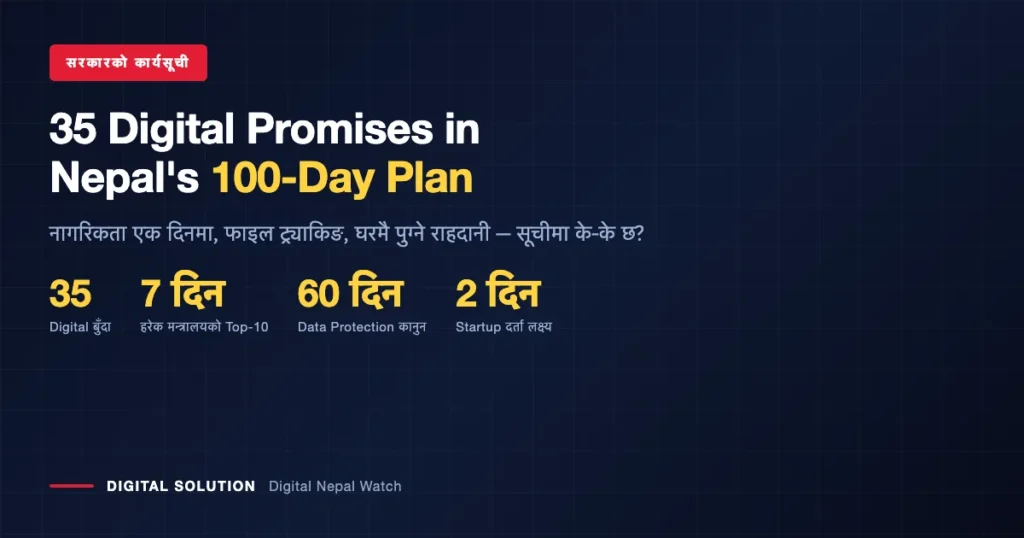
Analysis · August 2026. Based on the newly formed government’s published short-term work list, as read and filtered in our video coverage — 35 of its items are digital-transformation commitments. These are announced plans, not completed work; deadlines and details may change as implementation begins.
Nepal’s new government has published a 100-day work list, and buried inside it are 35 digital commitments that — if they actually ship — would change almost every interaction you have with a government office: citizenship in a day, files you can track like a courier package, passports delivered to your door, and business registration through one door instead of five.
We went through the list item by item. This is what is in it, sorted by what it means for you rather than by bullet number — and an honest note on the one thing that could sink all of it.
The Deadlines the Government Set for Itself
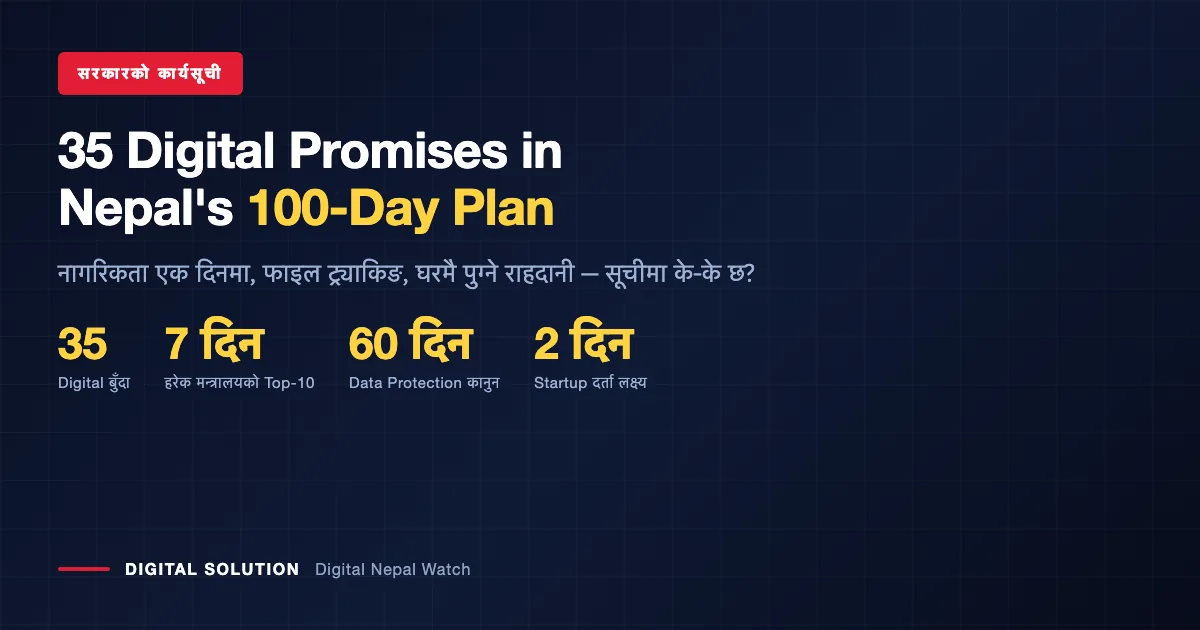
| Deadline | Commitment |
|---|---|
| Already executed | Betting sites blocked within 24 hours of the announcement — we covered the blocking when it happened |
| 7 days | Every ministry publishes its top-10 tasks with deadlines, responsible officers and KPIs |
| 60 days | Digital governance and personal data protection law drafted |
| 60 days | IT and E-Governance Bill (सूचना प्रविधि तथा विद्युतीय शासन विधेयक) drafted |
| 2 days | Startup registration, under a new fast-track |
The 24-hour betting-site block matters beyond gambling: it is the one item already delivered, which makes it the plan’s proof-of-seriousness. Everything below is still a promise.
Theme 1: Services That Respect Your Time
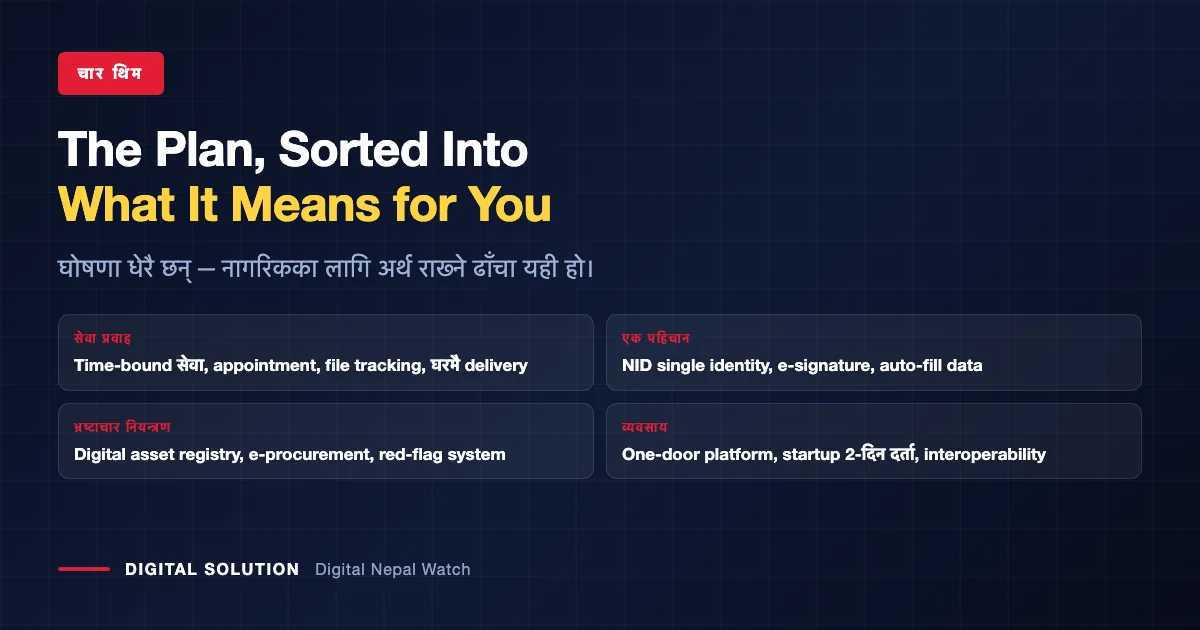
- Time-bound “predictable” services — citizenship, passports, vehicle licences delivered within a committed time, faceless and trackable.
- File tracking with alerts — see which desk your file is sitting on and for how long, with automatic alerts when it stalls. The single biggest answer to “मेरो फाइल कहाँ छ?”
- Digital appointment booking — book a slot at the DAO or transport office instead of standing in the 6 AM line for biometrics.
- Any-district service — passport renewal from whichever district you live in, ending the “go back to Syangja for your own paperwork” era.
- Government courier — the postal service modernised so documents like passports arrive at your home.
- Citizen service centres — staffed one-stop centres in major cities for those who cannot or do not want to fill forms online, cutting out the बिचौलिया who currently fills that gap for a fee.
- 24-hour grievance system — complaints by phone, app, portal or social media, with escalation to a senior officer if the assigned one ignores you, and Hello Sarkar upgraded with real-time dashboards.
Theme 2: One Identity, Entered Once
- NID as the single identity — citizenship, passport and National ID services digitised and integrated, with the NID number as the master key. Our guides on Nepal’s digital identity system cover where this stands today.
- Auto-filled government data — stop re-typing your father’s name and citizenship number on every form; data the government already holds gets pre-filled.
- E-signature by NID, biometrics or OTP — sign documents remotely instead of appearing in person for a थुम्का.
- Nagarik App as the front door — police reports, passport and driving-licence application forms filed from the app.
- Digital certificates — company registration and similar certificates downloadable and digitally verifiable, no office visit.
- Accessible portals — government sites usable by low-tech users and citizens with disabilities, in Nepali.
Theme 3: The Anti-Corruption Machinery
The least discussed and possibly most consequential part of the list:
- An integrated digital asset registry — bank accounts, digital wallets and share investments visible in one system, with a risk-based red-flag system. This is digital transformation as corruption control, not convenience.
- Fully digital public procurement — purchases transparent and trackable end to end, plus an e-procurement monitoring system from project selection through final payment.
- PM Delivery Unit with a KPI dashboard — ministry performance tracked centrally under the Prime Minister’s office.
- An independent digital regulator — a standalone authority for IT and digital governance, potentially the body that eventually regulates payments and other digital activity.
- An IT and E-Governance Office under the PMO — details still to be exposed, as we noted in the video.
A file-tracking alert and a procurement dashboard sound boring. They are the two features corruption hates most.
Theme 4: Business Without the Circuit of Offices
- One-door business platform — registration, tax, bank account and permits through a single digital flow.
- Startup fast-track — registration within two days.
- Interoperability between OCR, the Department of Industry and Commerce — the offices finally reading each other’s data so you stop carrying documents between them.
- One-door investment approval under the Investment Board, plus a single window for export and industry.
- Risk-weight adjustment for IT and SME lending — designed to push loan flow toward startups and small enterprises.
- Business process re-engineering across government — cutting multi-layer approvals wherever they add nothing.
The Honest Caveat
Announcement is the easy part. Nepal has had a Digital Nepal Framework since 2076, and a 2.0 draft precisely because version one under-delivered. The hard question — the one we raised in the video — is whether this can be executed from inside the same bureaucracy it is trying to re-engineer. The plan’s own design gives a way to check: ministry top-10 lists within 7 days, two bills within 60 days, and a public KPI dashboard. Those deadlines make the plan gradeable. We will grade it.
Watch: All 35 Points, Explained in Nepali
From the Digital Solution YouTube channel — subscribe for more coverage in Nepali.
The plan assumes a digital-ready citizen. Be one.
Every promise above lands on people who can use digital platforms confidently. Our 10-day AI Mastery Course — live on Zoom in Nepali, from Rs 3,000 — builds exactly that fluency.
Frequently Asked Questions
What is in Nepal’s 100-day digital plan?
Thirty-five digital commitments inside the new government’s published work list — spanning time-bound citizen services, NID-based single identity, file tracking, digital appointments, a digital asset registry for corruption control, fully digital procurement, and a one-door business platform.
Has any of it actually happened yet?
One item was executed immediately: betting sites were blocked within 24 hours of the announcement. Ministry top-10 task lists are due within 7 days, and two bills — data protection and IT/e-governance — within 60 days. The rest is announced, not delivered.
What is the digital asset registry?
A proposed integrated registry covering bank accounts, digital wallets and share investments, with a risk-based red-flag system — positioned in the plan as an anti-corruption tool, not just a convenience feature.
Will I be able to renew my passport from any district?
That is the commitment — services like passport renewal handled from the district where you live, with modernised postal delivery bringing documents to your home. It is a plan item, not yet an operating service.
What does the plan mean for businesses?
A one-door platform for registration, tax, bank account and permits; startup registration within two days; interoperability between the Company Registrar, Department of Industry and Commerce; and single-window investment and export approval.
Related Reading

Rabin Paudel
Rabin Paudel is the Founder of Digital Solution, a Content Creator, and an AI Trainer. He shares practical and easy-to-understand content on Artificial Intelligence, Digital Literacy, Online Services, FinTech, and Technology. His mission is to make technology simple, accessible, and useful for everyone.
View all posts by Rabin Paudel →