
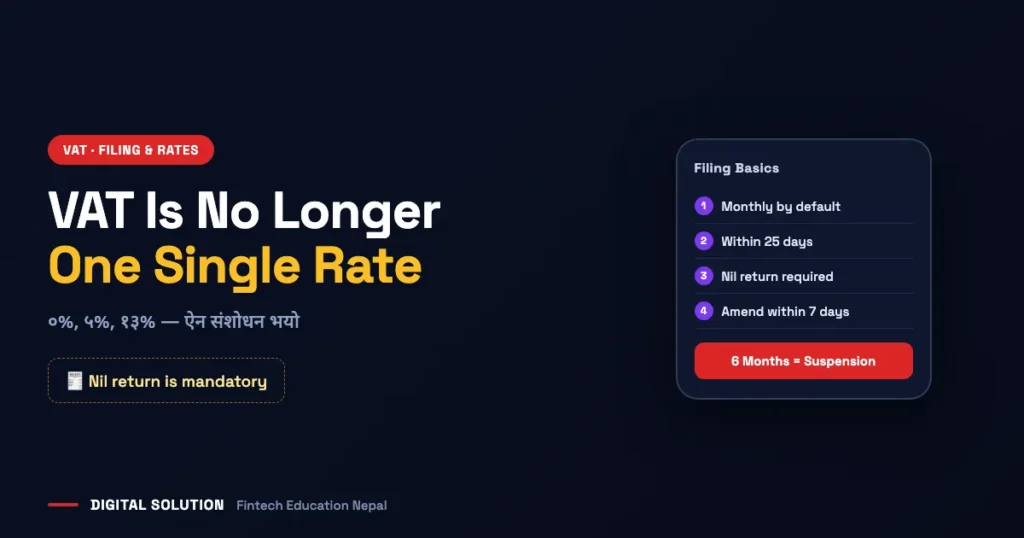
Nepal is no longer a single-rate VAT country. That is the biggest VAT change in years, and most businesses have not registered it yet. Alongside it came e-invoicing powers, a new correction window, and a change to how the electronic-payment discount works.
The New 5% Rate
| What now attracts 5% VAT | Note |
|---|---|
| Passenger transport and cargo or delivery through resident ride-hailing platforms | The platform operator collects and remits under a new reverse-charge provision |
| Electricity to end consumers using more than 50 units a month | Business-to-business electricity trading is exempt |
When You Must File
Four-monthly filing is available on application to a narrow set: tourism service providers and hoteliers, publication and broadcasting media, and brick producers. Everyone else files monthly.
What Late Filing Costs
| Charge | Amount |
|---|---|
| Late or non-filing | Rs 1,000 per tax period or 0.05% of tax payable per day — whichever is higher |
| Late payment | 5% additional charge to the end of the following month, then a further 5% |
| Interest | 15% per year from when the tax first became due |
| Six consecutive months unfiled | Name published, refunds withheld, registration may be suspended |
Input VAT Credit
A registered person deducts input tax paid on imports and purchases used for taxable transactions, substantiated by the prescribed documents. Restricted or partial credit applies to aeroplanes, motor vehicles and other prescribed high-value dual-use items.
🤝 Behind on VAT returns, or unsure which rate now applies?
Tell us your business type and filing status. Digital Solution will help you understand where you stand and what regularising will involve — and tell you plainly when you need a registered practitioner.
Three More Changes Worth Knowing
Electronic payment discount is now instant
The 10% VAT benefit on electronic payments changed from a refund to an immediate exemption at billing — effectively a 1.3% discount visible on the invoice rather than money you wait for.
E-invoicing powers
IRD may now mandate e-invoices integrated with the Centralized Billing Monitoring System. Using software capable of erasing or altering transaction data carries a fine of Rs 5,00,000; other breaches Rs 1,00,000.
Automated refunds
A fully automated VAT refund system has been introduced.
Circulars are now binding
IRD public circulars are treated as final under both the Income Tax Act and the VAT Act unless a court rules otherwise — so a circular is no longer just guidance.
Frequently Asked Questions
What is the VAT rate in Nepal?
13% remains standard, but the law now also provides for 0%, 5% and further rates by notification. The 5% currently applies to ride-hailing transport and delivery, and to electricity for consumers using over 50 units a month.
When is the VAT return due?
Within 25 days of the end of the tax period, with payment due in the same window.
Do I have to file if I had no transactions?
Yes. The Act requires a return whether or not any taxable transaction occurred.
Who can file four-monthly instead of monthly?
Tourism service providers and hoteliers, publication and broadcasting media, and brick producers — on application.
What is the penalty for late VAT filing?
Rs 1,000 per period or 0.05% of tax per day, whichever is higher — though a Finance Act 2083 amendment may have raised this to Rs 10,000. Confirm before assuming the lower figure.
Can I correct a mistake in a filed return?
If you filed on time, you may file an amended return within 7 days of the original.
How long can I carry excess input credit?
It is set off against payable VAT for the next four months, after which it becomes refundable.
What if my district has no Inland Revenue Office?
You may file and pay within 15 days after month end through the Local Government or DTCO.
Sources
- Value Added Tax Act 2052 — Sections 7, 17, 18, 19, 26 and 29, via consolidated published text; note that clause lettering has shifted through amendments.
- Finance Act 2083 changes as set out in published professional budget and tax summaries for FY 2083/84.
Related Reading
Disclaimer: Digital Solution Nepal is an independent educational and digital-service assistance website — not a tax authority, not a chartered accountancy firm and not a law firm. Tax rates and thresholds change with every Finance Act, and individual circumstances differ. Nothing here is tax advice — the Inland Revenue Department, the current Finance Act and a registered tax practitioner are final. Verify before filing or paying.

Rabin Paudel
Rabin Paudel is the Founder of Digital Solution, a Content Creator, and an AI Trainer. He shares practical and easy-to-understand content on Artificial Intelligence, Digital Literacy, Online Services, FinTech, and Technology. His mission is to make technology simple, accessible, and useful for everyone.
View all posts by Rabin Paudel →