
Last updated: July 2026 (Shrawan 2083). Course layouts and marking practice vary slightly by office — your center’s briefing on the day is final.
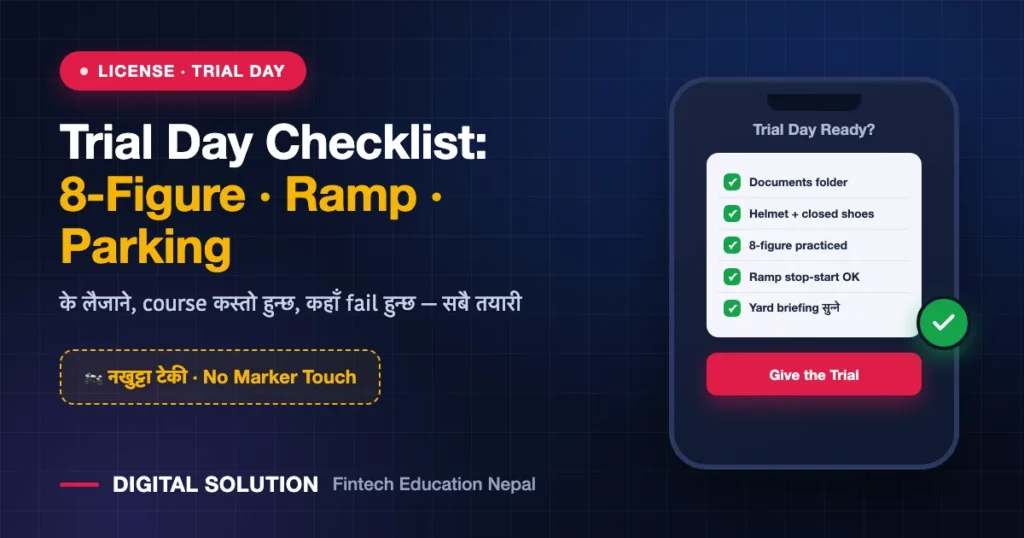
The written was the warm-up. The driving license trial (प्रयोगात्मक परीक्षा) is where most applicants actually fail — usually not from bad driving, but from not knowing the course, the rules of the yard, or what examiners/sensors actually check. This is your trial day checklist: what to bring, the course element by element for bike and car, how marking works, and the fail reasons that repeat every single day.
📥 FREE Download: Driving License Complete Checklist (PDF)
Apply गर्नुअघि चाहिने सबै — documents, age, exam format, fees, SMS codes — २ पानाको checklist। Print गरेर टिक लगाउँदै जानुहोस्।
Haven’t passed the written yet? Start with yesterday’s written exam guide — trial comes after likhit.
What to Bring on Trial Day
- Documents: citizenship original, application/reference number, payment proof, written-pass slip/status — the same folder from your documents checklist.
- Gear (two-wheeler): helmet is mandatory; wear closed shoes and clothes you can balance in. Long loose scarfs/shawls are a hazard — skip them.
- Vehicle: offices run trials on center-arranged vehicles and/or permit your own per local practice — confirm your office’s rule beforehand. If using your own, papers must be current (registration, insurance, bill book).
- Time buffer: report early; trial batches run in sequence and late arrival can forfeit your slot.
The Bike/Scooter (A/K) Trial Course
1. The 8-Figure (आठ आकार) — the famous one
- Ride the marked 8 without putting a foot down (नखुट्टा टेकी) and without touching/knocking the boundary markers.
- Secret is speed control: steady clutch/throttle at walking pace, eyes ahead at the curve exit — not at your front wheel.
2. Ramp / Uthkas (उकालो)
- Stop on the incline, hold without rolling back, restart smoothly. Rolling back beyond the tolerance or stalling is the classic fail.
3. Narrow Lane / Straight Balance
- Slow ride through the straight strip — stability at low speed is the test; rushing it defeats the purpose and knocks markers.
Element names/order vary a little by office, but 8-figure + incline + balance strip is the standard trio.
The Car (B) Trial Course
1. Forward Course & Turns
- Controlled driving through the marked path — lane discipline, mirror use, signal use where marked.
2. Ramp Stop-and-Start
- Incline stop, handbrake hold, roll-back-free restart. Practice the handbrake-clutch timing until it’s boring.
3. Reverse / Parking Element
- Reverse into the marked box (or parallel-style slot per office layout) without touching markers, within reasonable maneuvers. This is the #1 car-trial killer — practice with cones at home dimensions.
How Marking Works
- Offices use sensor-based automated yards and/or examiner observation — knocked markers, foot-downs, roll-backs and skipped elements register as faults either way.
- You pass by completing the required elements within the fault tolerance — clean, slow and steady beats fast and flashy every time.
- The result is recorded to your application (portal status/notice per office practice).
The Repeat-Offender Fail Reasons
- Foot down in the 8 (nerves, not skill — slow down earlier).
- Marker knocked on the exit curve (eyes on exit, not on the wheel).
- Roll-back on the ramp (handbrake discipline).
- Stalling repeatedly under pressure (practice cold starts).
- Reverse-box corrections beyond allowance (practice the actual dimensions).
- Yard rule mistakes — starting before signal, skipping the sequence, wrong entry direction. Listen to the briefing.
If You Pass — and If You Don’t
- Pass: your record moves to license issue; the smart card enters the print queue (tomorrow morning’s print-status guide covers tracking via SearchLicense + SMS 33001).
- Fail: breathe. You get retrial attempts — the rules (fees, waiting period, how many chances, what happens after three) are tonight’s guide: retrial rules in Nepal.
FAQ
Can I use my own scooter for the trial?
Many offices allow own two-wheelers with valid papers; center-vehicle rules vary for cars. Confirm your office’s current practice before the date.
Is the trial the same for scooter (K) and bike (A)?
The yard elements are similar; you attempt on the vehicle type of your category. Gearless scooter skills don’t auto-qualify geared bike control — practice on what you’ll test on.
How long does trial day take?
Your slot is minutes; the day is queue-dependent — batches, verification and result recording can take hours. Keep the day free.
Do driving institute certificates skip the trial?
No — training helps you pass, it doesn’t replace the exam. Anyone claiming to sell trial passes is scamming you.
Trial को tension? 8-figure र ramp का practice videos हामी social मा post गर्छौं — Digital Solution लाई TikTok/YouTube मा follow गर्नुहोस्। Specific question भए site को WhatsApp (+977 9766597181) बाट सोध्नुहोस्।
Disclaimer: Digital Solution Nepal is an independent educational/digital-service assistance website, not a government body. Trial layouts, vehicle rules and marking practice vary by office and change over time — your exam center’s briefing is final.

Rabin Paudel
Rabin Paudel is the Founder of Digital Solution, a Content Creator, and an AI Trainer. He shares practical and easy-to-understand content on Artificial Intelligence, Digital Literacy, Online Services, FinTech, and Technology. His mission is to make technology simple, accessible, and useful for everyone.
View all posts by Rabin Paudel →