
Updated 22 November 2026 (6 Mangsir 2083) after the UN General Assembly decision of 29 October 2026. First written on 20 October 2026. Sources checked: UN General Assembly resolution A/RES/76/8, the UN LDC Portal’s Nepal page, the Committee for Development Policy’s crisis assessment of July 2026, ECOSOC decision E/2026/L.24 as described by the UN portal and UNB, the EU statement at Nepal’s WTO trade policy review of 17 November 2025, and reporting by Nepal News, The Financial Express (Dhaka) and People’s Review, attributed in the text. The General Assembly decision is from reporting by NepYork and People’s Review of Nepal’s Permanent Mission to the UN; the full resolution text was not yet on the UN documents site when we checked.
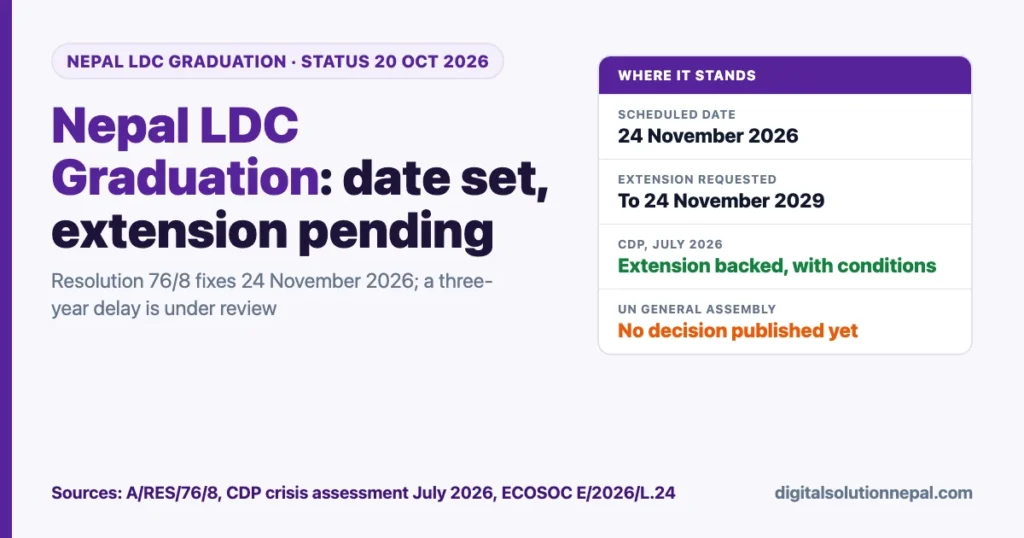
Nepal LDC graduation has moved to 24 November 2029. On Thursday 29 October 2026, the UN General Assembly adopted resolution A/81/L.8 by consensus, extending the preparatory period for Nepal and Bangladesh by three years, NepYork reported, citing Nepal’s Ambassador to the UN, Lok Bahadur Thapa. The old date, 24 November 2026, had been fixed by resolution 76/8 in 2021. Nepal asked for the extension in May 2026, the UN’s expert committee said in July it would be appropriate on conditions, and ECOSOC passed the question to the Assembly.
This page explains what graduation means, where the extension request stands, and what changes for exporters, businesses and students when graduation happens in 2029.
Quick answers
| Question | Answer (as of 22 November 2026) |
|---|---|
| Graduation date | 24 November 2029 (A/81/L.8, adopted 29 October 2026). The earlier date was 24 November 2026 under A/RES/76/8 |
| Extension | Three years, as Nepal requested in May 2026 |
| CDP position | Extension “would be appropriate” if tied to a clear, time-bound plan with measurable targets |
| ECOSOC position | Decision E/2026/L.24 of 21 July 2026 asks the General Assembly to decide before 24 November 2026 |
| General Assembly decision | Adopted by consensus on 29 October 2026; Nepal must report progress yearly to the CDP |
| EU market access after graduation | Duty-free, quota-free under EBA continues for three years, then GSP+ on request |
| Does India trade change? | No; India access runs on the bilateral treaty, not LDC status |
What LDC status is and why Nepal qualifies to leave
The UN classifies a country as a least developed country (LDC) on three criteria reviewed every three years by the Committee for Development Policy (CDP): gross national income per capita, a human assets index (HAI) and an economic and environmental vulnerability index (EVI). To graduate, a country must meet two of the three thresholds at two consecutive reviews, or meet the income-only threshold at a high level.
Nepal met the HAI and EVI thresholds in 2015 and 2018 but asked for deferral both times. At the February 2021 review the CDP recommended graduation with income per capita still below the threshold, the first time a country has been recommended on the human assets and vulnerability criteria alone (Nepal News explainer, 13 May 2026, citing the CDP). ECOSOC endorsed the recommendation in June 2021 and the General Assembly adopted resolution 76/8 on 24 November 2021, deciding “on an exceptional basis” to give the three countries five years to prepare because of COVID-19.
The CDP’s July 2026 assessment confirms that Nepal “continues to meet the graduation thresholds in all three established LDC criteria”, with income per capita only moderately above the line, and finds no significant risk of becoming ineligible.
The extension request and where it stands
| Date | Step | Source |
|---|---|---|
| March 2024 | CDP says at its plenary that it would not recommend extending Nepal’s period beyond 2026 | Nepal News, 13 May 2026 |
| 12 May 2026 | National Planning Commission decides to seek a three-year deferral to 2029 | Nepal News, 13 May 2026 |
| May 2026 | Government letter to the UN Secretary-General requesting three more years to November 2029; the CDP’s crisis response process is triggered; UN portal records the request on 15 May 2026 | CDP crisis assessment, July 2026; UN LDC Portal |
| July 2026 | CDP publishes its crisis assessment: extension appropriate, conditional on a time-bound plan to adjust the smooth transition strategy | CDP crisis assessment |
| 21 July 2026 | ECOSOC adopts decision E/2026/L.24 by consensus, recommending that the General Assembly take a final decision before 24 November 2026 | UN LDC Portal; UNB, 22 July 2026 |
| 24 September 2026 | Prime Minister Balendra Shah addresses the UN General Assembly; the Foreign Ministry says he raised the extension with Secretary-General Guterres | People’s Review, 27 September 2026 |
| 26 September 2026 | A Bangladeshi finance official tells The Financial Express the Assembly is expected to take up the Bangladesh and Nepal proposals in October or early November | The Financial Express, 26 September 2026 |
| 29 October 2026 | General Assembly adopts resolution A/81/L.8 by consensus, extending the preparatory period for Nepal and Bangladesh to 24 November 2029 | NepYork and People’s Review, 30 October 2026, citing Nepal’s Permanent Mission |
The CDP’s reasoning is worth reading in full because it sets the terms of any extension. The committee’s concern is not eligibility but capacity: Nepal’s ability to carry out a credible smooth transition strategy under “very difficult and uncertain conditions”. It names the Middle East crisis and its risk to remittances and tourism, more frequent climate shocks, a harder external trade environment, and a domestic political transition. It also warns that delay has costs, including “delaying the benefits from graduation”, and records the government’s “clear commitment to graduate in 2029”. It notes the three-year request matches all five previous extensions granted to other countries.
The Assembly granted what the CDP suggested. According to NepYork’s report of the resolution, Nepal is invited to adjust, prioritise and begin carrying out its smooth transition strategy during the extra three years, and must give regular updates through its annual reports to the CDP. The UN resident coordinator is encouraged to support this work. The resolution also says graduation should be “sustainable and irreversible”.
What changes on graduation
Graduation removes LDC-specific international support measures. The important ones for Nepal are trade preferences, a few WTO flexibilities, and some concessional finance terms. Each has its own transition rule.
Trade preferences
| Market | Today (LDC) | After graduation |
|---|---|---|
| European Union | Duty-free, quota-free under Everything But Arms (EBA) | EBA access continues for three years after graduation; Nepal can then request GSP+, which requires ratifying and implementing the conventions listed in the EU GSP Regulation (EU statement at the WTO, 17 November 2025; CDP assessment) |
| United Kingdom | Comprehensive tier of the Developing Countries Trading Scheme | Three-year transition, then enhanced preferences; the UK eased rules of origin on 1 January 2026, including removing double transformation for garments (CDP assessment) |
| India | Bilateral trade treaty | Unchanged; not linked to LDC status (Nepal News, May 2026) |
| Other LDC-only duty-free schemes (Canada, Australia, China and others) | Available | Lost at graduation unless the partner offers a transition (Nepal News, May 2026) |
The EU is the exposure that matters. The CDP assessment puts the EU at about 7% of Nepal’s exports in 2024, mostly apparel entering duty-free under EBA. EU-Nepal goods trade was EUR 376 million in 2024 (EU statement, November 2025). GSP+ covers roughly two thirds of EU tariff lines rather than everything, so apparel exporters should plan for some duty after the three-year EBA window, whichever year graduation falls.
WTO flexibilities
LDC members are exempt from implementing the TRIPS intellectual property agreement until 1 July 2034 and from pharmaceutical product patents until 1 January 2033; a graduated country loses those exemptions (UN-OHRLLS presentation on trade impacts of graduation). The CDP assessment notes that LDCs secured in 2024 a three-year post-graduation extension for certain LDC-specific WTO procedures. For Nepal’s generic medicine manufacturers this is the single biggest regulatory change, and it is one reason the private sector pushed for deferral.
Concessional finance
Eligibility for World Bank IDA lending depends on income and creditworthiness, not LDC status, so it does not change on 24 November. What does change are LDC-linked terms from some bilateral lenders. Nepal News reported that JICA’s most concessional loan terms are tied to LDC and low-income status and would phase out, and that South Korea’s terms would become less favourable.
Other support measures
LDCs get travel support to UN meetings, a capped share of UN budget contributions, and access to some LDC-only scholarship and research programmes. These end or taper after graduation according to each programme’s rules; the UN LDC Portal lists them, and students holding LDC-conditioned scholarships should check the awarding body’s transition policy rather than assume continuity.
What it means for businesses
- Exporters to the EU and UK have at least three years of unchanged access after the graduation date. Use the window to meet GSP+ rules of origin and to diversify markets; the CDP suggests graduation can be sold to investors as a signal of a more mature economy.
- Pharmaceutical firms face product patents after graduation. Licensing agreements and generic pipelines should be reviewed now.
- Companies registering or expanding will not see any change in domestic procedure; the Office of the Company Registrar process is unaffected. Our guide to private limited company registration in Nepal covers it.
- Tax compliance does not change with LDC status. VAT and income tax rules stay as set by the Finance Act; see our VAT return filing guide.
- Investors may read graduation as a positive signal. The government’s digital and reform agenda, including the 100-day digital plan, is part of the “high value economic sectors” shift the CDP describes.
What it means for students
Scholarships that are explicitly reserved for LDC nationals, such as some UN and multilateral training schemes, may close to new Nepali applicants after graduation or after a transition period set by the programme. Bilateral scholarships from India, China, Japan, Korea and others are not generally LDC-conditioned. Students should check the eligibility wording of each programme for the words “least developed country” and ask the provider how it handles graduation.
Why the government asked for more time
The government’s letter, as summarised in the CDP assessment, cited lingering effects of global crises, current external shocks, the loss of trade-related support measures, and the domestic political transition. The private sector federation FNCCI had lobbied for deferral since early 2026 (Business 360, February 2026). The Middle East conflict is the specific risk the CDP flagged for remittances and tourism; more than 70% of Nepali migrant workers are in the Gulf, and new labour permits fell in the first part of 2025/26, according to the assessment.
Against that, the CDP and some Nepali economists point out that graduation has been deferred twice already and that the signalling benefit of leaving the category is real.
Planning exports or a new company? Get the paperwork right
Digital Solution helps Pokhara businesses with company registration, PAN and VAT filing and export documentation so you are ready whichever year graduation lands. व्यवसाय दर्ता र कर फाइलिङका लागि सम्पर्क गर्नुहोस्।
Frequently asked questions
Will Nepal graduate from LDC status on 24 November 2026?
No. On 29 October 2026 the UN General Assembly extended Nepal’s preparatory period by three years, so graduation is now due on 24 November 2029. Nepal stays an LDC, with its current trade and finance support, until then.
What does the CDP recommend?
Its July 2026 crisis assessment says an extension “would be appropriate” if it is linked to a clear, time-bound plan to adjust Nepal’s smooth transition strategy, with measurable targets, financing and monitoring.
Will Nepali goods face EU duties immediately after graduation?
No. EBA duty-free access continues for three years after graduation. After that, Nepal can apply for GSP+, which requires ratifying and implementing the conventions in the EU GSP Regulation and covers fewer tariff lines than EBA.
Does graduation affect trade with India?
No. Nepal-India trade runs on the bilateral treaty, which is not linked to LDC status.
Does graduation change company registration or taxes in Nepal?
No. Domestic registration, VAT and income tax procedures are set by Nepali law and do not depend on the UN category.
Which sector is most affected?
Pharmaceuticals, because LDC exemptions from product patents under TRIPS end with graduation, and apparel, because of eventual EU tariff changes after the three-year EBA window.
Conclusion
Nepal LDC graduation is now due on 24 November 2029, after the UN General Assembly agreed to Nepal’s three-year extension request on 29 October 2026. The extra time comes with a duty to report progress each year to the CDP. For businesses and students the practical advice holds, only three years later: EU and UK preferences last three more years after whichever date applies, patent flexibilities end, India trade does not change, and any LDC-conditioned scholarship or loan should be checked against the provider’s transition rules. Use the extra time to prepare, not to wait.
Sources
- NepYork, Nepal gets three more years to prepare for graduation from least developed country status (30 October 2026): nepyork.com
- People’s Review, Nepal’s LDC graduation period extended until Nov 2029 (30 October 2026): peoplesreview.com.np
- UN General Assembly, resolution A/RES/76/8, Graduation of Bangladesh, the Lao People’s Democratic Republic and Nepal from the least developed country category (24 November 2021): https://documents.un.org/doc/undoc/gen/n21/355/26/pdf/n2135526.pdf
- UN LDC Portal, Nepal graduation status page (checked 20 October 2026): https://www.un.org/ldcportal/content/nepal
- Committee for Development Policy, Crisis Assessment: Nepal (July 2026): https://policy.desa.un.org/sites/default/files/2026-07/nepal-cdp-crisis-assessment.pdf
- ECOSOC, decision E/2026/L.24 (21 July 2026): https://docs.un.org/E/2026/L.24
- UNB, LDC graduation extension: ECOSOC recommends UNGA to take decision on Bangladesh, Nepal (22 July 2026): https://unb.com.bd/category/Bangladesh/ldc-graduation-extension-ecosoc-recommends-unga-to-take-decision-on-bangladesh-nepal/191243
- Nepal News, Everything you need to know about Nepal’s plan to request LDC graduation deferral (13 May 2026): https://english.nepalnews.com/s/explainers/everything-you-need-to-know-about-nepals-plan-to-request-ldc-graduation-deferral/
- People’s Review, Nepal seeks more time for graduation from LDC status (27 September 2026): https://peoplesreview.com.np/2026/09/27/nepal-seeks-more-time-for-graduation-from-ldc-status/
- The Financial Express (Dhaka), LDC graduation deferment confirmation unlikely during this UNGA session (26 September 2026): https://thefinancialexpress.com.bd/home/ldc-graduation-deferment-confirmation-unlikely-during-this-unga-session
- European Union, EU statement at the Trade Policy Review of Nepal (17 November 2025): https://www.eeas.europa.eu/delegations/world-trade-organization-wto/eu-statement-trade-policy-review-federal-democratic-republic-nepal-17-novembre-2025_en
- UN-OHRLLS, Trade impacts of LDC graduation (presentation by Taufiqur Rahman, WTO): https://www.un.org/ohrlls/sites/www.un.org.ohrlls/files/session_4_trade_impacts_of_ldc_graduation_taufiq_rahman_.pdf
- Business 360, FNCCI president Dhakal holds meeting with UN Resident Coordinator (February 2026): https://www.b360nepal.com/detail/27829/fncci-president-dhakal-holds-meeting-with-un-resident-coordinator
This is a status report as of 22 November 2026 based on the documents listed. Trade and finance terms depend on each partner’s rules.

Rabin Paudel
Rabin Paudel is the Founder of Digital Solution, a Content Creator, and an AI Trainer. He shares practical and easy-to-understand content on Artificial Intelligence, Digital Literacy, Online Services, FinTech, and Technology. His mission is to make technology simple, accessible, and useful for everyone.
View all posts by Rabin Paudel →