
As of 2 November 2026 (16 Kartik 2083). Checked: the Citizen Investment Trust (nlk.org.np) scheme pages, FAQ, interest-rate page, the Rs 5 lakh income tax notice, the loan information notice and the Employee Saving Growth Retirement Fund Operating Procedure 2080 (second amendment, 12 Bhadra 2082); Income Tax Act 2058 sections 63, 65 and 88 (English consolidated text on nepallaws.com). Rates on the CIT site can change; confirm before you decide.
Every Poush, as salary TDS is adjusted, office accounts sections hear the same question: “Can I cut my tax by putting more into CIT?” Citizen Investment Trust Nepal, known in Nepali as नागरिक लगानी कोष (Nagarik Lagani Kosh), is the statutory fund behind that question. It runs the retirement scheme many employees use for tax planning, plus a unit scheme and a voluntary pension scheme for people outside formal jobs.
This guide covers each scheme, the current tax limit, online balance checks, loans and withdrawal tax, using CIT’s own notices and the Income Tax Act. Our own arithmetic is labelled.
Quick answers
| Question | Answer |
|---|---|
| What is CIT? | A fund set up under the Citizen Investment Trust Act 2047, established 4 Chaitra 2047 |
| Main scheme for employees | Employee Saving Growth Approved Retirement Fund (कर्मचारी बचतवृद्धि अवकाश कोष) |
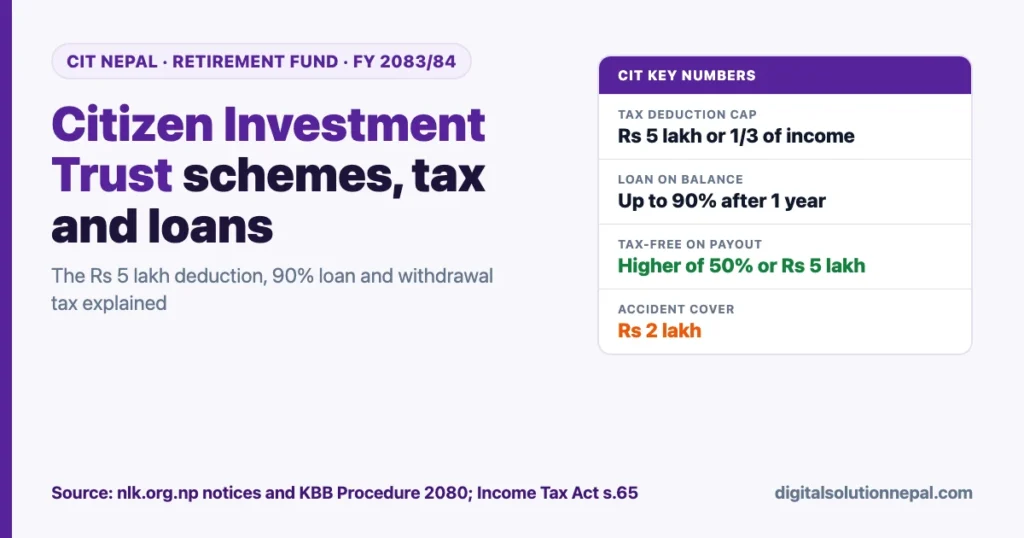
| Tax deduction limit | Lower of Rs 5,00,000 a year or one-third of assessable income (Income Tax Rules, Rule 21) |
| Who can join the retirement scheme? | Permanent, temporary, contract and daily-wage employees of government and private bodies |
| Online statement | eservice.nlk.org.np or the CIT Mobile App (Android) |
| Loan against your balance | Up to 90% of your balance, after one year in the scheme |
| Tax on final lump-sum payment | 5% on the amount above the higher of 50% or Rs 5 lakh |
| Voluntary pension for anyone | Citizen Pension Scheme, from Rs 500 a month |
What Citizen Investment Trust Nepal is
CIT was created under the Citizen Investment Trust Act 2047 and started operations on 1 Magh 2048. According to its own profile, its paid-up capital has grown from Rs 2.4 crore at founding to Rs 6.8 arba. The head office is in New Baneshwor, Kathmandu, and there are branch offices in Biratnagar, Janakpur, Pokhara, Butwal, Surkhet and Dhangadhi, so every province has one.
Its job is to collect long-term savings, mostly retirement money, and invest them. Your money earns a return that CIT declares each year, not a fixed deposit rate.
CIT schemes compared
CIT lists seven programmes on its website. Four matter to most readers:
| Scheme | Who it is for | Key feature | Return or rate shown on CIT site |
|---|---|---|---|
| Employee Saving Growth Approved Retirement Fund | Employees whose office deducts from salary | Tax-deductible, loan facility, accident cover | 3.50% |
| Citizen Unit Scheme | Any Nepali citizen (individual) and institutions | Units with buyback by CIT; regulated by SEBON | 4.50% (individual), 3.0% (corporate) |
| Citizen Pension Scheme | Citizens not covered by other schemes | Monthly pension after age 60 and 15 years of saving | 4.50% |
| Investor and Gratuity Fund schemes | Offices funding staff gratuity, welfare or insurance liabilities | Institution-level account, 80% loan facility for participants | Not stated on the rate page |
CIT also runs compulsory term life insurance funds for several government services, not covered here.
Our reading: the 3.50% return on retirement balances is modest, so the main attraction for salaried people is the tax saving.
The CIT tax benefit in 2083/84
The rule that matters is Rule 21 of the Income Tax Rules 2059, as changed by the fifteenth amendment in 2081. CIT quoted it in a notice on its website. In our own words, it says a natural person who is a beneficiary of an approved retirement fund may deduct retirement contributions from taxable income up to Rs 5,00,000 or one-third of assessable income, whichever is lower.
Section 63 of the Income Tax Act allows the deduction for contributions to an approved retirement fund up to the prescribed limit, and CIT’s retirement fund is an approved fund.
Some older articles still cite Rs 3 lakh for CIT and Rs 5 lakh only for SSF. The CIT notice quoting amended Rule 21 makes no such split. Our reading is that it is one overall cap for all your approved retirement contributions (SSF, EPF and CIT together), not Rs 5 lakh per fund.
Worked examples (our calculation)
| Annual assessable income | One-third | Maximum deduction | Notes |
|---|---|---|---|
| Rs 9,00,000 | Rs 3,00,000 | Rs 3,00,000 | One-third is lower than Rs 5 lakh |
| Rs 15,00,000 | Rs 5,00,000 | Rs 5,00,000 | Both limits meet |
| Rs 24,00,000 | Rs 8,00,000 | Rs 5,00,000 | Rs 5 lakh cap applies |
Suppose you earn Rs 15 lakh a year and already have Rs 2.4 lakh going to EPF or SSF through your employer. Under our reading, the room left for CIT is about Rs 2.6 lakh. Anything you put in above that saves no tax this year, though it still earns the CIT return.
The deduction saves tax at your highest marginal rate. See our income tax deductions guide before deciding how much to add.
How to join the CIT retirement fund
The retirement fund works only through payroll. You cannot open it as an individual walk-in saver. Under the Operating Procedure 2080, the steps are:
- Tell your office in writing that you want to join and what percentage of your monthly salary should be deducted. The office must agree to make the deduction.
- Fill the identity card format (Annex 1) and the KYC form (Annex 2), have them certified by your office, and submit them electronically to CIT.
- CIT registers you in its participant list and informs you through your office, SMS or its website.
- Each month your office deducts the agreed amount and deposits it through CGAS, SUTRA, Connect IPS, Corporate Pay or a bank, using CIT’s eService portal to submit the name-wise details (फाँटवारी, the deduction schedule).
- The office must deposit the money on salary day or within three days of it, and CIT sends you an SMS once your account is credited.
If your employer has never used CIT, the accounts team first registers the office on eservice.nlk.org.np.
Check your CIT balance online
CIT offers two self-service channels.
eService portal. Go to eservice.nlk.org.np and choose Register for E-service, then Personal Login, and fill in the requested details. CIT’s FAQ says accounts are verified within at least 24 hours and you get an email alert. After login you can see deposits, loan statements and update your KYC.
CIT Mobile App. Available on Android through the Play Store. You register with your name, mobile number, office and identity card number, and CIT sends an SMS with a PIN once it approves you. You then log in with your mobile number and that PIN to see your retirement fund and loan statement. CIT’s FAQ says the service is free.
CIT has also asked participants to complete a biometric KYC update: fill the KYC Update section in eService, download the confirmation form, and take it with your original citizenship and CIT card to the head office or a branch (Pokhara has one).
CIT loans: borrowing against your balance
The retirement fund has a simple loan facility, called सापटी (sapati, an advance against your own savings). Under section 11 of the Operating Procedure:
- You can borrow up to 90% of the balance in your account.
- You must have been in the scheme for at least one year.
- You can take the advance at most twice in a fiscal year.
- Interest is the return rate on your savings plus 1.5% as a service charge. The CIT rate page shows 5.0% for the 90% advance.
- Your office must send a recommendation, and you attach a copy of your CIT card and your bank details.
CIT also offers collateral-based loans to participants with at least two years of regular deductions, including these:
| Loan | Ceiling (CIT loan notice) | Maximum term | Rate on CIT rate page |
|---|---|---|---|
| Home loan | 20 years of starting salary or Rs 1 crore (Rs 1.5 crore if both spouses are participants), whichever is lower | 20 years or remaining service | 6.75% |
| Saral loan | Rs 5 lakh to Rs 50 lakh | 5 years or remaining service | 6.95% |
| Vehicle loan | 10 years of salary or Rs 50 lakh, whichever is lower | 7 years or remaining service | 6.75% |
The loan notice image shows 7% to 7.25%, while the interest-rate page shows the lower figures in the table. The notice itself says rates can be revised, so ask CIT for the current rate. Repayment can be made through Connect IPS, eSewa or Khalti under CIT Loan Repayment, according to the CIT FAQ.
Withdrawal: when you can take the money out
You cannot withdraw the full retirement fund whenever you like. Section 10 of the procedure allows a full payment only when:
- You retire or leave service (the procedure defines retirement broadly, including resignation and end of contract).
- A recognised medical board certifies you as fully disabled.
- You are removed from service after a final court verdict.
- You die, in which case your nominee or legal heir is paid.
- Your office no longer exists, with a recommendation letter from the relevant authority.
You apply on CIT’s final payment form (Annex 3) with your bank account, bank name and PAN, and CIT pays your contributions plus the returns as a lump sum. The fund deducts tax and deposits it against your PAN through e-TDS.
How the final payment is taxed
Section 65(1)(b) of the Income Tax Act says that for a lump-sum retirement payment, you subtract 50% of the amount or Rs 5 lakh, whichever is higher, and the rest is treated as a gain. Section 88 sets withholding at 5% on that benefit for payments from an approved retirement fund. CIT’s FAQ gives the same result in plain terms.
| Final balance | Exempt part | Taxable part | 5% tax (our calculation) |
|---|---|---|---|
| Rs 4,00,000 | Rs 4,00,000 | Nil | Nil |
| Rs 8,00,000 | Rs 5,00,000 | Rs 3,00,000 | Rs 15,000 |
| Rs 20,00,000 | Rs 10,00,000 | Rs 10,00,000 | Rs 50,000 |
On large payouts the effective tax is at most 2.5% of the total (our calculation).
Accident and death cover
The procedure also creates a participant welfare fund. If a participant dies in an accident or suffers the listed serious disabilities, the family or participant receives Rs 2,00,000. No claim is paid if you joined less than two years ago, made no deposit in the six months before the accident, or claim after one year. (CIT’s FAQ still says Rs 1 lakh; the 2082 amended procedure says Rs 2 lakh.)
The Citizen Pension Scheme for people without a payroll
For shopkeepers, freelancers and returnee migrant workers, CIT offers the Citizen Pension Scheme (since 2019):
- Minimum contribution of Rs 500 a month, paid monthly, quarterly, half-yearly or yearly.
- Pension starts after age 60, provided you contributed for at least 15 years.
- If you are too old to complete 15 years, you can pay a lump sum calculated at the Rs 500 monthly minimum.
- The pension continues for life, then passes to the spouse; after both die, the remaining fund goes to legal nominees.
Whether contributions to this scheme qualify for the Rule 21 deduction was not stated on the pages we checked. Ask CIT or your tax officer before claiming it.
CIT, SSF or EPF?
Many employees use CIT on top of SSF or EPF to fill the rest of the Rs 5 lakh limit. We compare the three side by side in our SSF vs EPF vs CIT guide. For how employers deduct and deposit tax from salary, see our TDS rate guide.
Need Help With CIT, SSF or Tax Paperwork?
Digital Solution in Pokhara can help you register on the CIT eService portal, fill KYC and nominee details, and prepare the forms your office or CIT asks for. हामी कागजात तयार गर्न सहयोग गर्छौं।
Frequently asked questions
Can I join the CIT retirement fund without an employer?
Not the Employee Saving Growth Retirement Fund, which runs through payroll deductions. Individuals without an employer can use the Citizen Pension Scheme or the Citizen Unit Scheme instead.
Is the Rs 5 lakh limit separate for CIT and SSF?
Our reading of Rule 21, as quoted by CIT, is that it is one combined limit for retirement contributions to approved funds, capped at the lower of Rs 5 lakh or one-third of assessable income.
How much can I borrow from my CIT account?
Up to 90% of your balance after one year in the scheme, at most twice in a fiscal year, at the return rate plus 1.5%.
Is CIT money taxed when I withdraw it?
Yes, lightly. On a lump sum, the higher of 50% or Rs 5 lakh is exempt, and 5% tax is withheld on the rest.
Conclusion
Citizen Investment Trust Nepal is mainly a tax-planning and retirement tool for salaried workers. Its return is modest, but the Rule 21 deduction, the 90% loan facility and the low tax on final payment make it worth using if you have room under the Rs 5 lakh or one-third limit. Check your existing SSF or EPF contributions first, adjust your CIT deduction with your office before Poush, and keep your eService KYC up to date.
Sources
- Citizen Investment Trust, notice on Rs 5 lakh income tax deduction for the Employee Saving Growth Retirement Fund (quoting Income Tax Rules 2059, Rule 21, fifteenth amendment 2081): https://nlk.org.np/content/detail/income-tax-waiver-for-retirement-fund-deposit
- Citizen Investment Trust, Employee Saving Growth Approved Retirement Fund page and Operating Procedure 2080 (second amendment 2082-05-12): https://nlk.org.np/program/retirement-fund-KBB
- Citizen Investment Trust, Interest Rates: https://nlk.org.np/page/interest-rates
- Citizen Investment Trust, information about collateral loans: https://nlk.org.np/content/detail/information-about-collateral-loans
- Citizen Investment Trust, FAQ: https://nlk.org.np/faq
- Citizen Investment Trust, Citizen Pension Scheme: https://nlk.org.np/program/citizen-pension-scheme
- Citizen Investment Trust, Citizen Unit Scheme: https://nlk.org.np/program/citizen-unit-scheme
- Citizen Investment Trust, About Us: https://nlk.org.np/page/about-us
- Income Tax Act 2058, section 63 (Approval of retirement fund), nepallaws.com: https://nepallaws.com/Laws/income-tax-act-2058-2002/chapter-12-special-provisions-on-retirement-saving/section-63-approval-of-retirement-fund/
- Income Tax Act 2058, section 65 (Retirement payments), nepallaws.com: https://nepallaws.com/Laws/income-tax-act-2058-2002/chapter-12-special-provisions-on-retirement-saving/section-65-retirement-payments/
This guide is general information, not tax or investment advice; confirm current rates and rules with CIT or the Inland Revenue Department.

Rabin Paudel
Rabin Paudel is the Founder of Digital Solution, a Content Creator, and an AI Trainer. He shares practical and easy-to-understand content on Artificial Intelligence, Digital Literacy, Online Services, FinTech, and Technology. His mission is to make technology simple, accessible, and useful for everyone.
View all posts by Rabin Paudel →