
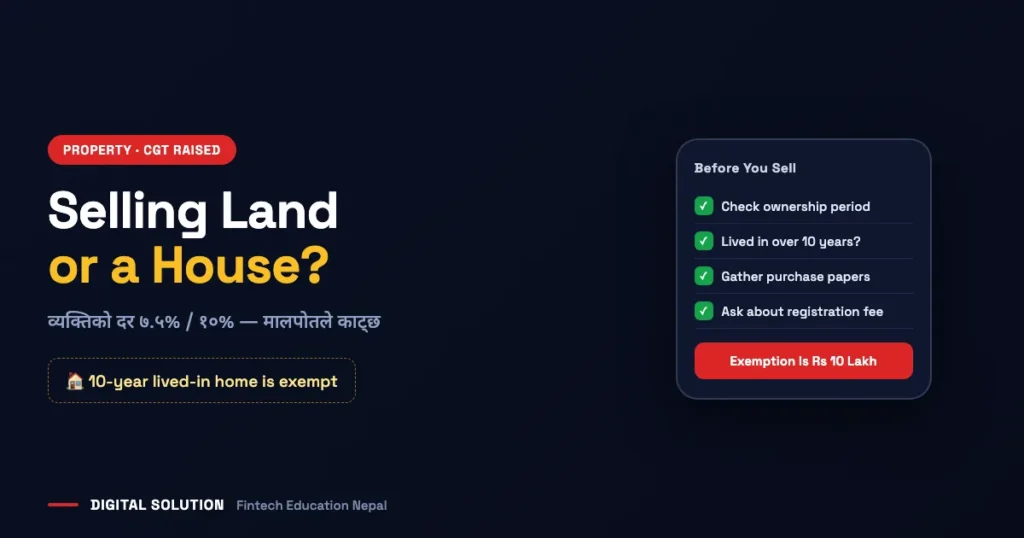
Selling land or a house in Nepal triggers capital gains tax collected at the Land Revenue Office when the transfer is registered. The rates rose this year, and there is one exemption that saves some sellers the tax entirely — which many do not know they qualify for.
The Rates for FY 2083/84
| Seller | Ownership period | FY 2083/84 | Was |
|---|---|---|---|
| Individual | Owned more than 5 years | 7.5% | 5% |
| Owned 5 years or less | 10% | 7.5% | |
| Entity or company | Any | 1.5% of sale value | 1.5% — no change |
| Involuntary disposal (government compulsory acquisition) | Any | 2.5% | 5% or 7.5% |
Two Exemptions
🏠 The 10-year residence exemption
A building owned AND resided in for more than 10 years falls outside the definition of a non-business chargeable asset — and is therefore not taxable on disposal. Both conditions must hold: ownership and residence.
💰 The small-value exclusion
Land, or land and building, disposed of for proceeds of less than Rs 10,00,000 is outside the chargeable-asset definition.
Who Collects It, and When
The tax is withheld by the Land Revenue Office (मालपोत) on the sale amount at the time of registration. You do not calculate and remit it separately — it comes out of the transaction as it completes.
🤝 Selling or buying property and want the tax position clear first?
Tell us the ownership period, rough value and whether you have lived in it. Digital Solution will explain which rate applies and whether an exemption might — and when to involve a practitioner before you sign.
How the Gain Is Calculated
For an individual, the tax applies to the gain — broadly the disposal proceeds less what the asset cost you. The cost base generally includes the purchase price, the registration fee you paid when buying, and the cost of improvements.
A Claim You Will See That We Could Not Support
Frequently Asked Questions
What is the capital gains tax on selling land in Nepal?
For an individual: 7.5% if owned more than five years, 10% if owned five years or less. Entities pay 1.5% of the sale value.
Did the rates change this year?
Yes — the individual rates rose by 2.5 percentage points for FY 2083/84, from 5% and 7.5%.
Is there any exemption?
Two. A building owned and resided in for more than ten years is outside the chargeable-asset definition, and disposals under Rs 10 lakh are excluded.
Is the exemption threshold Rs 1 crore?
No — it is Rs 10 lakh. The crore figure circulates widely and is wrong.
Who deducts the tax?
The Land Revenue Office withholds it on the sale amount at registration.
What does the buyer pay?
The registration fee, set by each local level. There is no single national rate — ask your Land Revenue Office.
What if the government acquires my land?
Involuntary disposal now attracts a reduced 2.5%.
What counts toward my cost base?
Broadly the purchase price, the registration fee you paid on purchase, and improvement costs — if you can evidence them.
Sources
- Published professional tax-rate summary for FY 2083/84 on capital gains rates and the Land Revenue Office withholding.
- Published professional tax fact document on the non-business chargeable asset exemptions, including the ten-year ownership and residence condition.
- Reporting on the Finance Act 2083 capital gains changes.
Related Reading
Disclaimer: Digital Solution Nepal is an independent educational and digital-service assistance website — not a tax authority, not a chartered accountancy firm and not a law firm. Tax rates and thresholds change with every Finance Act, and individual circumstances differ. Nothing here is tax advice — the Inland Revenue Department, the current Finance Act and a registered tax practitioner are final. Verify before filing or paying.

Rabin Paudel
Rabin Paudel is the Founder of Digital Solution, a Content Creator, and an AI Trainer. He shares practical and easy-to-understand content on Artificial Intelligence, Digital Literacy, Online Services, FinTech, and Technology. His mission is to make technology simple, accessible, and useful for everyone.
View all posts by Rabin Paudel →