
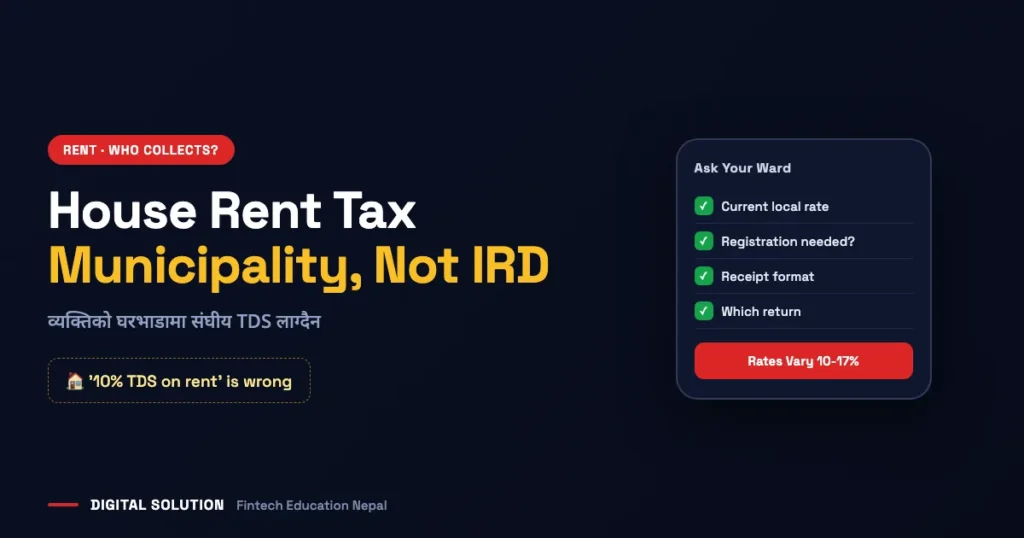
Ask three people in Nepal who collects tax on house rent and you will get three answers. The confusion is not the public’s fault — a lot of Nepali tax pages state this wrongly, including some that publish annual rate tables. Here is the actual position.
Who Actually Collects It
| Federal (IRD) | Local level | |
|---|---|---|
| House rent from an individual landlord | No TDS | Yes — this is where it is taxed |
| Other rent (equipment, vehicles, commercial arrangements) | 10% TDS | Varies |
| Landlord is a company or entity | 10% TDS applies | Municipal tax may also apply |
| Who sets the rate | Finance Act | Each local level’s own Economic Act |
What Rate Will You Pay?
Kathmandu Metropolitan City, for instance, has set 10% of rent in its Economic Act. Rates elsewhere differ, and the reported spread runs to around 17%.
🤝 Renting out property and unsure what you owe, or to whom?
Tell us where the property is and whether you own it personally or through a company. Digital Solution will help you work out which office applies and what to ask them.
What We Could Not Verify — and Why That Matters to You
We are being explicit here because this is an area where confident-sounding articles are frequently wrong:
- Whether the local house rent tax is a final tax — we found no authoritative statement either way.
- Whether residential and commercial property attract different rates at local level — unverified.
- The landlord’s exact compliance steps — whether you must register, obtain a PAN for rental income, issue receipts in a prescribed form, or register a written tenancy agreement. Every source we could reach on this was inaccessible or content-thin.
The practical consequence: the single most useful thing you can do is visit your ward or municipality office and ask three questions — what is the current rate, what do I need to register, and what receipt or return do you want from me. Ten minutes there beats any amount of reading.
A Structural Point Worth Understanding
Because there is no federal TDS on house rent paid to an individual, that rent does not automatically enter the IRD system at all. There is no withholding agent generating a record. This is exactly why the local-level charge functions as the operative tax in practice — and why compliance rests almost entirely on the landlord declaring it.
Frequently Asked Questions
Who collects house rent tax in Nepal?
The local level — your municipality or rural municipality — under powers given by the Constitution, at a rate set in its own annual Economic Act.
Is there TDS on house rent?
Not when the landlord is a natural person. House rent to a natural person is specifically excluded from federal withholding. Other categories of rent attract 10%.
What is the house rent tax rate?
Commonly 10%, but it is set by each local level and reported figures range up to around 17%. Check your own municipality’s Economic Act.
What if my landlord is a company?
Then the federal 10% TDS applies, and the municipal tax may apply as well — a genuine overlap worth taking advice on.
Do I need a PAN to rent out my house?
We could not verify the registration requirements for an individual landlord. Ask your ward or municipality directly.
Is the local rent tax final?
We found no authoritative statement either way. Confirm with your local level.
Do I need a written rental agreement?
We could not verify whether one is required or must be registered. Having one in writing is sensible regardless.
My tenant deducted TDS from my rent. What now?
If you are an individual landlord, check the basis with them — that deduction is not the federal position for house rent. Take advice before treating it as settled tax.
Sources
- Income Tax Act 2058, Section 88(4) — exclusion of house rent from withholding.
- Published professional tax-rate summary for FY 2083/84 — TDS table entry excluding house rent to a natural person.
- Constitution of Nepal, Schedule 8 — house rent tax as a local-level power; Local Government Operation Act 2074.
- Kathmandu Metropolitan City Economic Act as a worked example of a local rate.
Related Reading
Disclaimer: Digital Solution Nepal is an independent educational and digital-service assistance website — not a tax authority, not a chartered accountancy firm and not a law firm. Tax rates and thresholds change with every Finance Act, and individual circumstances differ. Nothing here is tax advice — the Inland Revenue Department, the current Finance Act and a registered tax practitioner are final. Verify before filing or paying.

Rabin Paudel
Rabin Paudel is the Founder of Digital Solution, a Content Creator, and an AI Trainer. He shares practical and easy-to-understand content on Artificial Intelligence, Digital Literacy, Online Services, FinTech, and Technology. His mission is to make technology simple, accessible, and useful for everyone.
View all posts by Rabin Paudel →
Pingback: Local Business Licence Nepal: Ward Registration