
Updated August 2026. There is no official Nepali formula for this — we checked. What follows is a method, not a regulation, and the tax figure is the one verified number in it.
“How much life insurance do I need?” usually gets answered backwards in Nepal: an agent asks what premium you can afford, and the cover falls out of that. That is the wrong direction. Start with what your family would need, then find the product that delivers it.
The Only Question That Matters
Not “what is my life worth” — that question has no answer. The useful question is narrower:
That converts into four numbers you can actually add up.
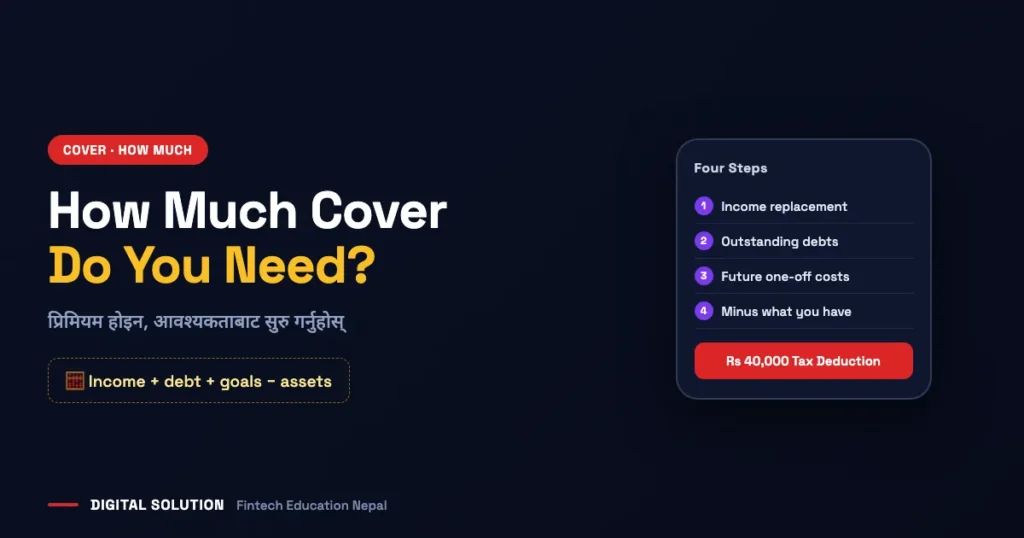
The Four-Part Calculation
| Component | How to work it out |
|---|---|
| 1. Income replacement | Your annual contribution to the household × the number of years your family would need it. Until the youngest child finishes education is a common anchor. |
| 2. Debts that would remain | Home loan outstanding, education loan, business borrowing, anything guaranteed. These do not disappear. |
| 3. One-off future costs | Children’s higher education, a daughter’s or son’s marriage if that is your family’s expectation, dependent parents’ care. |
| 4. Minus what already exists | Existing policies, savings, fixed deposits, SSF or provident fund entitlements, property that could realistically be sold. |
Cover needed = (1 + 2 + 3) − 4. Most people who do this honestly for the first time are surprised by how large the number is — and by how far their existing policy falls short of it.
A worked example
| Item | Amount |
|---|---|
| Income replacement: Rs 6 lakh a year × 12 years | Rs 72,00,000 |
| Home loan outstanding | Rs 25,00,000 |
| Children’s education fund | Rs 15,00,000 |
| Less existing savings, FD and SSF entitlement | − Rs 12,00,000 |
| Cover actually needed | Rs 1,00,00,000 |
Three Adjustments for Nepali Households
Count the non-earning spouse
If one partner runs the household full-time, replacing that work — childcare, elderly care — has a real cost. It is routinely valued at zero and should not be.
Remittance households
If the family depends on one member working abroad, the dependency is total and the person is furthest from help. Foreign employment carries its own mandatory cover — but that is a separate, limited scheme, not a substitute.
Joint family reality
Do not assume the extended family absorbs everything. It often does, for a while. Plan for the arithmetic rather than the goodwill.
Business owners and guarantors
If you have personally guaranteed a business loan, that liability follows your estate. It belongs in component 2, in full.
🤝 Want help working out your own number?
Send us your rough figures — income, loans, dependants and what you already hold — and Digital Solution will walk you through the calculation. We do not sell insurance and take no commission.
What the Tax Rule Actually Allows
Two things follow from that, and both cut against how policies are usually sold:
- The deduction caps out at Rs 40,000. Paying a Rs 1 lakh premium does not give you two and a half times the tax benefit — it gives you the same Rs 40,000 deduction. Premium above that earns no extra relief.
- A term policy can often use the full deduction while delivering many times the cover, because the premium for a large sum assured can still sit near that threshold.
Before You Sign Anything
- Do the four-part calculation first, on paper, before you talk to anyone selling.
- Ask for the premium on that exact sum assured — as term, and as endowment.
- Check what you already have. Employer cover, SSF entitlements, existing policies. See our SSF guide.
- Name a nominee, and tell them. A policy nobody knows about pays nobody.
- Answer the health questions truthfully. Non-disclosure is the single most common reason a claim is repudiated in Nepal — see why claims get rejected.
- Review every few years — a new child, a new loan or a bigger income all change the number.
Frequently Asked Questions
How much life insurance do I need in Nepal?
Income replacement for the years your family would need it, plus outstanding debts and known future costs, minus what you already have. There is no official Nepali formula.
Is there a rule like 10 times my income?
Not from any Nepali authority. It is a rough international heuristic, useful as a sanity check rather than an answer.
Is there a minimum or maximum sum assured?
No regulatory limit that we could find. Individual products set their own minimums, which vary widely between insurers.
How much tax do I save on the premium?
Premium is deductible up to Rs 40,000 a year for life insurance, and separately up to Rs 20,000 for health insurance. Above that there is no further deduction.
Does my SSF or provident fund count as cover?
It counts in component 4 as an existing entitlement, but it is not life insurance and should not be treated as a substitute.
Is the death benefit taxable?
We could not verify the death-benefit position against the statute. There is a 5% withholding on the gain element of investment-insurance benefit payments. Check with a tax practitioner for a large sum.
Should I insure my children?
Insurance replaces lost income. A child has none. Child plans are savings products — judge them as savings, not protection.
Sources
- Finance Act 2079 raising the life insurance premium deduction to Rs 40,000; separate Rs 20,000 deduction for health insurance premium.
- Income Tax Act 2058 — 5% withholding on investment-insurance benefit payments.
- Nepal Insurance Authority public awareness material; no published sum-assured guidance located.
Related Reading
Disclaimer: Digital Solution Nepal is an independent educational and digital-service assistance website — not an insurer, not an insurance agent or broker, and not a law firm. We do not sell insurance and receive no commission from any insurer. Policy terms, premiums and regulations differ by company and change over time, and nothing here is financial, legal or insurance advice — your policy document, your insurer and the Nepal Insurance Authority are final.

Rabin Paudel
Rabin Paudel is the Founder of Digital Solution, a Content Creator, and an AI Trainer. He shares practical and easy-to-understand content on Artificial Intelligence, Digital Literacy, Online Services, FinTech, and Technology. His mission is to make technology simple, accessible, and useful for everyone.
View all posts by Rabin Paudel →