
Updated August 2026. Benefit amounts are from the Nepal Insurance Authority’s foreign employment term life directive of 2080. Note that a proposal to abolish this compulsory insurance was drafted in 2025 — its current status is unconfirmed. Verify before relying on any figure.
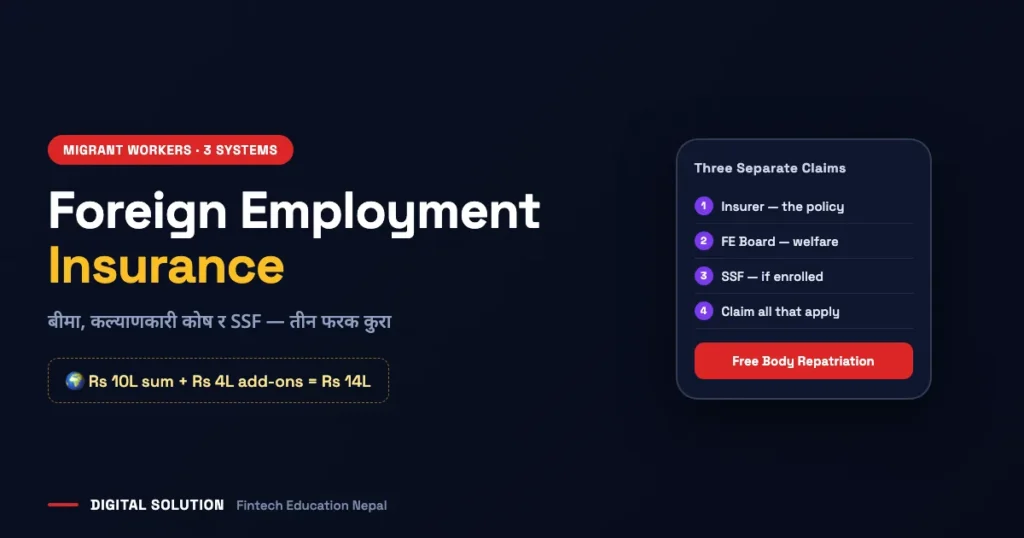
If a Nepali worker dies abroad, the family is usually told “there is insurance” — and then discovers there are actually three separate systems, run by three different bodies, with three different claim routes. Getting them confused is why families chase the wrong office for months.
The Three Things People Confuse
| 1. Term life insurance | 2. Welfare Fund | 3. SSF scheme | |
|---|---|---|---|
| What it is | A private insurance policy, made compulsory by law | A government fund | A contributory social security scheme |
| Legal basis | Foreign Employment Act 2064 s.14 + NIA directive 2080 | Foreign Employment Act 2064 s.33 | Contribution-Based Social Security Act |
| Who administers | Licensed insurers | Foreign Employment Board | Social Security Fund |
| You pay | One-off premium by age and term | Fixed contribution at labour approval | Monthly contribution |
| Claim goes to | The insurer | The Board | SSF |
The Insurance: What It Actually Pays
Under the foreign employment term life directive, on death from any cause:
| Component | Amount |
|---|---|
| Sum insured (बीमांक) | Rs 10,00,000 |
| Cremation / funeral (किरिया खर्च) | Rs 1,00,000 |
| Loss of income to the family | Rs 2,00,000 |
| Repatriation of the body | Rs 1,00,000 |
| Total on death abroad | Rs 14,00,000 |
Also provided: Rs 10,00,000 for permanent total disability (partial disability scaled), and Rs 5,00,000 for critical illness, with up to Rs 1,00,000 for pre-diagnostic or accident treatment.
Policy term
Must run at least six months longer than the employment contract — so it covers the gap around return.
Banned destinations
Insurers may not issue policies for countries where the Government of Nepal has banned foreign employment. If no insurer will cover it, that is a signal about the destination.
Premium
Age- and term-banded. One insurer’s published table runs from about Rs 1,486 to Rs 18,222 across age bands 18–35, 36–50 and 51–64, plus around Rs 400 for the critical-illness rider.
Who pays
The recruitment agency procures it under the Act — but in practice the cost is passed to the worker. Ask for the policy document and the receipt, not just a line on a bill.
🤝 A family member died or was injured abroad?
Tell us where they were working and through which agency. Digital Solution will help you identify which of the three systems apply and what each one needs — so you are not sent between offices.
The Welfare Fund: The Second Claim
Separate from insurance, every worker contributes to the Foreign Employment Welfare Fund at labour-approval time — commonly reported at around Rs 1,500. It is administered by the Foreign Employment Board and provides financial assistance on death or disability, free repatriation of the body, family health treatment support and reintegration help.
How to Claim, in Order
- Get the death registered and documented in the country of death, and obtain the certificates. See our death registration guide for the Nepal side.
- Contact the recruitment agency for the insurance policy number and the insurer’s name. They procured it; they hold the record.
- File the insurance claim with the insurer — that is claim number one.
- Separately approach the Foreign Employment Board for welfare assistance and repatriation — claim number two.
- Check SSF separately if the worker was enrolled — claim number three.
- Keep a written record of every submission, with dates and the name of who received it.
Frequently Asked Questions
Is insurance compulsory for foreign employment from Nepal?
Yes, under Section 14 of the Foreign Employment Act 2064, with terms set by the Nepal Insurance Authority’s 2080 directive. A proposal to abolish it was drafted in 2025 — confirm the current position.
Is the payout Rs 10 lakh or Rs 14 lakh?
Both figures are correct. Rs 10 lakh is the sum insured; Rs 14 lakh is the total with cremation, income-loss and repatriation components added.
Who pays the premium?
The recruitment agency procures the policy under the Act, but the cost is generally passed to the worker. Ask for the policy document.
How long does the policy last?
At least six months longer than the employment contract period.
Is the Welfare Fund the same as the insurance?
No. They are separate systems with separate claim routes — the insurer for insurance, the Foreign Employment Board for welfare. A family may be entitled to both.
Does the Board really repatriate the body free?
The Board publishes a free body-repatriation service. Contact it before arranging anything privately.
What if the worker went abroad irregularly?
Entitlements are tied to going through the legal process with labour approval. That is one of the strongest practical reasons not to depart irregularly.
Does SSF cover foreign employment too?
There is a separate SSF scheme for foreign employment. Check it independently — see our SSF foreign employment guide.
Sources
- Foreign Employment Act 2064 — Section 14 (compulsory insurance) and Section 33 (Welfare Fund).
- Nepal Insurance Authority foreign employment term life directive, 2080 — benefit schedule as reported in detail by insurance press.
- Citizen Life published foreign employment premium table.
- Foreign Employment Board published welfare services and helpline.
- 2025 reporting on the draft amendment to abolish compulsory migrant worker term life insurance.
Related Reading
Disclaimer: Digital Solution Nepal is an independent educational and digital-service assistance website — not an insurer, not an insurance agent or broker, and not a law firm. We do not sell insurance and receive no commission from any insurer. Policy terms, premiums and regulations differ by company and change over time, and nothing here is financial, legal or insurance advice — your policy document, your insurer and the Nepal Insurance Authority are final.

Rabin Paudel
Rabin Paudel is the Founder of Digital Solution, a Content Creator, and an AI Trainer. He shares practical and easy-to-understand content on Artificial Intelligence, Digital Literacy, Online Services, FinTech, and Technology. His mission is to make technology simple, accessible, and useful for everyone.
View all posts by Rabin Paudel →