
Last updated: 23 August 2026 (7 Bhadra 2083). Based on the National Transport Policy 2083 as approved by the Cabinet and reported by TechPana. Policy deadlines below are the government’s own targets, not achieved milestones.
🗂️ सबै license guides एकै ठाउँमा: Driving License Nepal — Complete Guide Hub
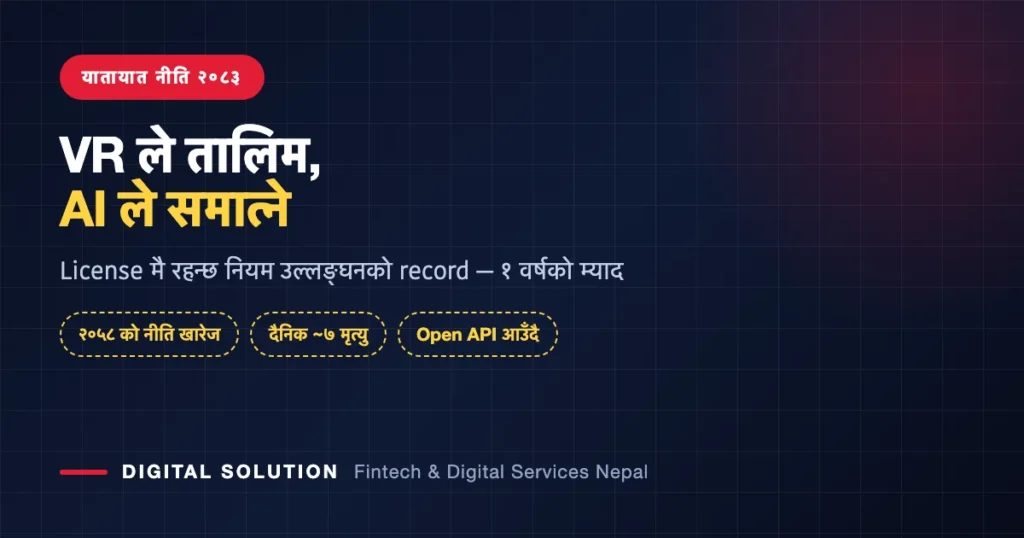
Quick answer: The Cabinet has approved the National Transport Policy 2083, which repeals the National Transport Policy 2058 and, for the first time in Nepal’s transport history, writes modern digital technology into road safety and driver training. Headline items: VR and driving simulators for new drivers, automated AI enforcement for speeding, red lights and overloading, a safe driving record attached to your licence, electronic tolls on highways, an EV battery second-life framework, and an Open Transport Data Policy with public APIs. Each item carries a one- or two-year target.
Key takeaways
- The policy replaces the National Transport Policy 2058, issued by the Ministry of Infrastructure Development.
- The problem it is aimed at: roughly seven people die on Nepal’s roads every day.
- Within 1 year: driver training, testing and licensing to become practical, competency-based and fully digital — assigned to the Department of Transport Management and provincial governments.
- Within 2 years: VR/simulation pilot, crash-footage education, electronic toll pilot, and the EV battery framework.
- Your licence will carry a record of violations and of safe driving — penalties for one, incentives for the other.
- 63,280 EVs were registered by FY 2082/83, and over 70% of newly imported private cars are electric — second in the world only to Norway.
- An Open Transport Data Policy and public APIs are promised, which is the line Nepali developers should read twice.
The deadline table nobody prints
Policies are judged on dates, not adjectives. Here is what the policy commits to and when.
| Commitment | Target | Who owns it |
|---|---|---|
| Driver training, testing and licensing made practical, competency-based and fully digital | 1 year | Dept. of Transport Management + provinces |
| Vehicle registration, route permit and licence systems fully integrated and paperless | 1–2 years | Government |
| Evidence-based communication toolkit, crash-footage education, VR/simulation pilot | 2 years | Road Safety Council, with universities and youth NGOs |
| Electronic toll collection pilot on highways | 2 years | Government |
| EV battery safety, recycling, disposal and second-life framework | 2 years | Government |
Note which one is fastest. The one-year item is the licensing overhaul — and it lands on the same Department and provincial offices that are still bedding in the eDLVRS portals. That is the deadline worth watching, because it is the one that touches every reader of this site.
VR before the road
The most eye-catching provision: new drivers will practise in a virtual environment before going onto a real road, using VR and driving simulators. The stated purpose is to build the ability and confidence to handle risky situations — the situations you cannot safely rehearse in traffic.
Alongside it sits crash-footage-based education: real accident videos with scientific analysis, used to make drivers and the public aware of what actually kills people. And for young people specifically, short videos, social media campaigns and influencer collaborations.
The Road Safety Council leads this work, with universities and youth NGOs as supporting bodies.
Whether it works depends entirely on scale. A VR pilot in Kathmandu changes little for someone taking a trial in Surkhet. The policy says “pilot”, so treat it as a pilot — the interesting question in two years is how many centres actually have a headset, and whether it becomes part of the trial or stays a demonstration.
A score on your licence
This is the change with the longest tail, and the one most people have not registered yet.
The policy replaces the traditional model — issue a licence, then monitor behaviour separately — with a fully digital one in which a driver’s violations and safe-driving history are tracked together in the licence system itself. The stated intent is to punish rule-breakers and reward those who drive safely.
For commercial drivers there is a further link: capacity-building training will be tied to licence renewal. Renewal stops being a formality and becomes conditional on training.
Two practical implications worth thinking about now:
- If violations become part of a permanent record, the cost of a fine is no longer just the fine. Our guide to traffic fines and rules in Nepal covers what is currently charged.
- If your licence record is going to matter more, the details on it need to be correct. Fixing a wrong name or date of birth is a separate paid process with office approval — better done before the record starts carrying weight.
AI and cameras on the highway
The enforcement side is where “AI catches violations” comes from. The policy expands automated systems for:
- Speeding — speed limit zoning, speed cameras and automated enforcement expanded nationwide
- Red-light violations
- Overloading
Plus an Intelligent Transport System (ITS) pilot promoting seat-belt use, helmet use, drink-driving control (मापसे) and speed control.
And electronic tolling: a pilot within two years letting vehicles pay highway tolls without stopping, with the stated benefits of less congestion and fuel saved.
One honest caveat that the policy text does not address and readers should hold onto: automated enforcement is only as fair as the vehicle records behind it. A speed camera issues a ticket to a plate, and the ticket reaches whoever the registration says owns that plate. Countries that rolled this out without cleaning up registration and ownership-transfer data first spent years arguing about wrongly issued fines. Nepal’s नामसारी backlog is not a small detail here.
The EV numbers, and the battery problem coming next
| Figure | Value |
|---|---|
| Share of newly imported private cars that are electric | over 70% |
| Nepal’s global rank on new EV share | 2nd, behind Norway |
| Total EVs registered by FY 2082/83 | 63,280 |
That adoption curve has a consequence arriving on a delay: tens of thousands of large lithium batteries reaching end of life at roughly the same time. The policy commits to building a framework within two years for battery safety, recycling, disposal and second-life use — including reusing spent vehicle batteries for solar energy storage in homes or industry.
This is the rare case of Nepali policy arriving before the problem rather than after it. Whether the framework exists before the first big wave of retired batteries does is a different question — but the two-year clock started now, and the EV fleet is still young.
The line Nepali developers should read twice
Buried below the road-safety headlines is the provision with the most commercial upside for the tech sector.
The policy explicitly provides for an Open Transport Data Policy and public APIs for data sharing. In plain terms: local innovators and startups would be able to use public transport data to build live tracking, route planning and useful mobile apps.
Nepal has seen the demand already — Kathmandu Valley’s public vehicles moving to live tracking is exactly the kind of service that becomes an app ecosystem once the data is open rather than locked in one vendor’s system. Combined with the government’s move to build state software in house, the direction of travel is towards public systems that expose data rather than hoard it.
Two cautions before anyone builds a business plan on it. First, “will provide an API” and “has published a documented, stable API” are separated in most countries by several years. Second, open data policies without a maintained specification tend to produce one dump, once. If you are a developer, the thing to watch for is not the announcement — it is documentation with a version number.
What this does not change today
A policy is a statement of intent with deadlines attached. As of today:
- Your licence process is still the province-wise eDLVRS system, with the same portals and the same steps.
- Fees remain what each province’s economic act says they are.
- No VR centre, no speed-camera network and no toll gantry exists because a policy was approved this week.
The value of reading it now is knowing what to expect and, where it matters, getting ahead of it — particularly the licence record, which is the one thing you can put in order before the system starts scoring it.
🚗 License को विवरण मिलेको छ त?
नाम, जन्ममिति वा वर्ग बिग्रिएको छ भने record मा weight आउनुअघि मिलाउनु राम्रो। eDLVRS correction, renewal वा IDP — Digital Solution को team सँग सोध्नुहोस्।
Frequently asked questions
What is the National Transport Policy 2083?
A new national transport policy approved by Nepal’s Cabinet and issued by the Ministry of Infrastructure Development. It repeals the National Transport Policy 2058 and makes digital technology part of road safety, driver training and enforcement for the first time.
Will driving tests really use VR in Nepal?
The policy commits to a VR and simulation pilot within two years, letting new drivers practise in a virtual environment before driving on real roads. It is described as a pilot, led by the Road Safety Council with universities and youth NGOs.
Will traffic violations be recorded on my licence?
Yes, that is the stated plan. A smart driving licence system is to track violation records and safe-driving records together, so rule-breakers can be penalised and safe drivers rewarded.
When does the digital licensing change happen?
The policy targets one year for driver training, testing and licensing to become practical, competency-based and fully digital, with the Department of Transport Management and provincial governments responsible.
How many EVs are registered in Nepal?
63,280 electric vehicles were registered by FY 2082/83, and more than 70 percent of newly imported private cars are electric — placing Nepal second globally behind Norway on new EV share.
What happens to old EV batteries?
The policy commits to a framework within two years covering battery safety, recycling, disposal and second-life use — including reusing retired vehicle batteries for solar energy storage in domestic or industrial settings.
What does the open transport data policy mean for developers?
It promises public APIs for transport data, which would let local startups build live tracking, route planning and other mobile applications on public transport data instead of collecting it themselves.
Does anything change for me today?
No. Licence applications still run through the province-wise eDLVRS portals under existing fees and steps. The policy sets one- and two-year targets; nothing in it is operational because it was approved.
The bottom line
The National Transport Policy 2083 is unusually specific for a Nepali policy document — it names technologies, assigns owners and attaches deadlines, which at least makes it checkable. The provision that will touch ordinary drivers soonest is not VR; it is the one-year target to make licensing fully digital and to start attaching a behaviour record to the licence itself. Roughly seven people a day are the reason it exists. In one year we will be able to say whether the first deadline was met, and this article will be updated when we can.
Digital Solution disclaimer: Digital Solution Pvt. Ltd. is an independent private company and is not affiliated with, endorsed by or acting on behalf of the Government of Nepal, the Ministry of Infrastructure Development, the Department of Transport Management or TechPana. This article summarises a policy as reported on 23 August 2026; policy targets are intentions, not guarantees, and implementation details may change. Verify any requirement affecting you through your provincial transport office before acting.

Rabin Paudel
Rabin Paudel is the Founder of Digital Solution, a Content Creator, and an AI Trainer. He shares practical and easy-to-understand content on Artificial Intelligence, Digital Literacy, Online Services, FinTech, and Technology. His mission is to make technology simple, accessible, and useful for everyone.
View all posts by Rabin Paudel →
Pingback: BYD Atto 1 Price in Nepal 2026: Rs. 30.75 lakh
Pingback: BYD Atto 2 Price in Nepal 2026: Rs. 45.95 lakh
Pingback: BYD Atto 3 Price in Nepal 2026: Rs. 61.99 lakh
Pingback: BYD Dolphin Price in Nepal 2026: Rs. 41.15 lakh
Pingback: Tata Punch EV Price in Nepal 2026: Rs. 34.99 lakh
Pingback: MG Windsor EV Price in Nepal 2026: Rs. 37.99 lakh
Pingback: Mahindra XEV 9e Price in Nepal 2026: Rs. 69 lakh
Pingback: Neta X Price in Nepal 2026: Rs. 57.99 lakh
Pingback: BYD Seal Price in Nepal 2026: Rs. 1.10 crore