
As of 2 November 2026 (16 Kartik 2083). Checked: Income Tax Act 2058 sections 54, 88, 92 and 11 (English consolidated text on nepallaws.com and the Law Commission English edition), the Inland Revenue Department (IRD) notice on bonus and right share cost price as reported by ShareSansar, and 2026 dividend announcements on ShareSansar. The IRD’s own Act PDF did not download from this machine, so the editor should spot-check against ird.gov.np.
AGM season is here. Between Kartik and Mangsir, many banks, insurers and hydropower companies approve the dividends their boards proposed in Bhadra and Asoj, and shareholders start asking the same three questions: how much dividend tax in Nepal comes out of my cash, why do I have to “pay tax” on bonus shares, and what happens to my cost price when bonus and right shares land in my demat account?
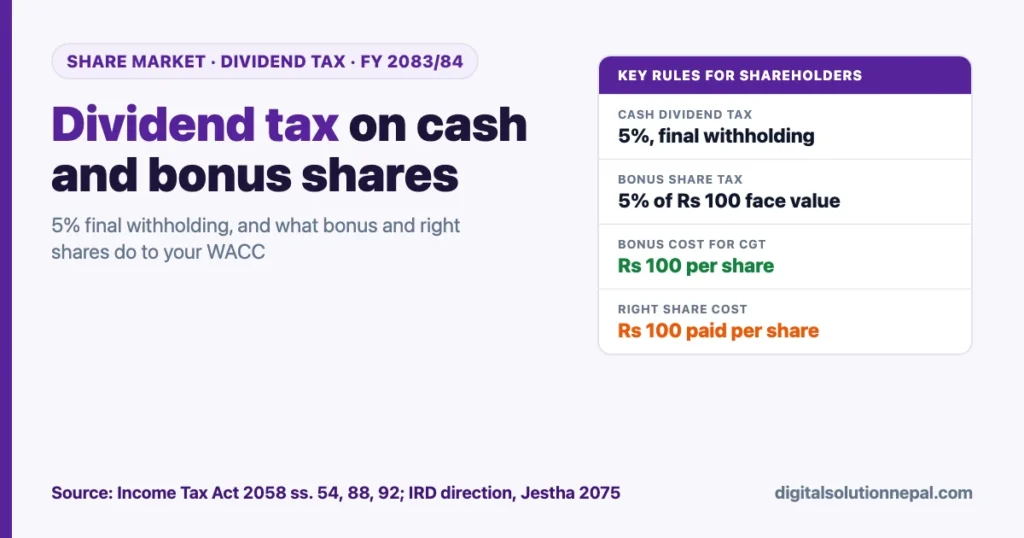
This guide answers all three with the law behind each rule. The short version: dividends from a Nepali company carry a 5% tax that is withheld by the company and treated as final, bonus shares are taxed at 5% of their Rs 100 face value, and bonus and right shares enter your Mero Share cost at Rs 100 each.
Quick answers
| Question | Answer |
|---|---|
| Dividend tax rate in Nepal | 5% of the dividend paid (Income Tax Act section 88(2)(a)) |
| Is it final? | Yes, for dividends paid by a resident company (section 92(1)(a)) |
| Who deducts it? | The company, before paying you |
| Is a bonus share taxed? | Yes, as a dividend: 5% of its face value, usually Rs 100 |
| Cost price of a bonus share for capital gains | Rs 100 (face value), per the IRD direction of Jestha 2075 |
| Cost price of a right share | The Rs 100 you paid |
| Do I need to show dividends in my tax return? | Not for final-withheld dividends from Nepali companies (our reading of section 92) |
What the law says about dividend tax in Nepal
Three sections of the Income Tax Act 2058 work together.
Section 88(2)(a) tells a resident person paying a dividend to withhold tax at five percent of the amount paid. Older English copies of the Act still show 10%; that figure was amended long ago, and the current consolidated text reads five percent.
Section 92(1)(a) lists “dividend paid by a resident company” among payments on which tax is withheld finally. Final withholding means the 5% is the end of the matter. You do not add the dividend to your salary or business income, and you do not pay the higher slab rate on it.
Section 54(1) repeats the idea from the shareholder side: a shareholder of a company is taxed on dividends “as per the mode of final tax deduction”.
There are a few exceptions worth knowing:
- Company to company with 25% control. Under section 54(3), no tax is charged when a resident company pays a dividend to another resident company that controls 25% or more of its voting rights.
- Mutual funds. Section 88(4)(e) excludes dividends and interest paid to collective investment funds from withholding. When a mutual fund later pays you, section 88(1) has a separate 5% withholding on amounts a mutual fund distributes to natural persons.
- Special industries and tourism. Section 11(3L) gives a full exemption from dividend tax when a special industry or tourism-sector industry capitalises accumulated profit into shares to expand its capacity. ShareSansar reported in May 2018 that this relief covered bonus shares of companies such as Unilever Nepal, Bottlers Nepal and Soaltee Hotel, not their cash dividends.
Why bonus shares are taxed
A bonus share feels free, so a tax on it surprises many first-time investors. The Act treats it as a dividend. Section 53 explains that “capitalisation of profits” includes issuing bonus shares, and a distribution of profit by an entity is a dividend. When a bank turns Rs 10 crore of retained profit into new shares, it has distributed that profit to shareholders in share form, and the 5% applies.
The tax base is the face value of the bonus shares, which is Rs 100 for most listed companies (Soaltee Hotel’s shares have a Rs 10 face value). A 10% bonus on 1,000 shares gives 100 new shares worth Rs 10,000 at face value, so the tax is Rs 500.
The company cannot withhold anything from shares, so it needs cash. That is why so many dividend announcements read “X% bonus and Y% cash, including tax” or “cash dividend for tax purpose”. The small cash part is there to cover the tax on the bonus, and the company keeps it and pays it to the IRD.
If a company declares only bonus shares with no cash, it may ask shareholders to deposit the tax themselves before the bonus is credited. ShareSansar reported this in 2019 for Sagarmatha Insurance’s 86% bonus, where shareholders deposited the tax at a bank and presented the slip to the registrar.
How the “cash for tax” figure is worked out
When the cash part is meant only to cover tax, the cash itself is also a dividend and also taxed at 5%. So the cash must cover 5% of the bonus plus 5% of itself. The formula is: cash % = bonus % × 5 ÷ 95 (our calculation).
| Bonus declared | Cash needed just for tax (our calculation) | Tax on 1,000 shares (Rs 100 face value) |
|---|---|---|
| 5% | 0.263% | Rs 263 |
| 10% | 0.526% | Rs 526 |
| 15% | 0.789% | Rs 789 |
| 20% | 1.053% | Rs 1,053 |
Most banks declare a larger cash part, so some cash reaches you after tax.
Worked example: cash plus bonus dividend
Everest Bank’s board proposed a 15% dividend for FY 2082/83: 5% bonus shares and 10% cash, subject to Nepal Rastra Bank approval and the AGM (ShareSansar, 27 August 2026). Here is what that would mean for a holder of 1,000 shares on the book closure date (our calculation, assuming the proposal is approved as announced and the face value is Rs 100):
| Item | Amount |
|---|---|
| Cash dividend, 10% of Rs 100 × 1,000 | Rs 10,000 |
| Bonus shares, 5% of 1,000 | 50 shares (Rs 5,000 face value) |
| 5% tax on the cash | Rs 500 |
| 5% tax on the bonus | Rs 250 |
| Total tax withheld from the cash | Rs 750 |
| Net cash to your bank account | Rs 9,250 |
You end with 1,050 shares and Rs 9,250, and nothing more is due on either part. Fractional shares can change the result by a few rupees.
Bonus share cost price: why it is Rs 100
Before mid-2018, NEPSE worked out capital gains on bonus and right shares using an average base price. On Jestha 20, 2075 (3 June 2018), the IRD directed NEPSE to use the paid-up (face) value as the cost price instead: Rs 100 for most companies and Rs 10 for Soaltee Hotel (ShareSansar, 3 June 2018). We found no later IRD notice reversing it.
This matters because the Act wants a weighted average cost. Section 95A(2A) bases the gain on listed shares on the weighted average cost of the shares, and Mero Share calculates that figure as WACC (weighted average cost of capital, in practice “weighted average cost per share”). Bonus shares at Rs 100 pull your average down, which raises your taxable gain when you sell.
Right shares work the same way, but here Rs 100 is what you really paid. A right share is an offer to existing holders to buy new shares, usually at face value. Your Rs 100 per share goes into the weighted average.
Worked example: WACC after a bonus and a right issue
Say you bought 100 shares at Rs 500 each, with commissions and fees bringing your total purchase cost to Rs 50,000 (rounded for clarity). Later you receive a 10% bonus and then subscribe to a right issue of 20 shares at Rs 100 (our calculation).
| Lot | Shares | Cost per share | Total cost |
|---|---|---|---|
| Secondary market purchase | 100 | Rs 500 | Rs 50,000 |
| 10% bonus | 10 | Rs 100 | Rs 1,000 |
| Right shares | 20 | Rs 100 | Rs 2,000 |
| Total | 130 | Rs 407.69 (WACC) | Rs 53,000 |
If you sell all 130 shares at Rs 600, the sale is Rs 78,000 before selling commission, and the gain is about Rs 25,000. Under the Finance Act 2083 rates for resident individuals (7.5% if held more than 365 days, 10% if 365 days or less), that is Rs 1,875 or Rs 2,500 of capital gains tax. The Cabinet approved lower rates of 3.5% and 5% on 16 September 2026 (ShareSansar), but as of our check date we did not find a published amendment confirming when NEPSE starts applying them. Check the current rate in our guide to capital gains tax on shares in Nepal before you sell.
The holding period is counted lot by lot, so bonus and right shares received recently can fall in the short-term band even if your original shares are years old (our reading). Mero Share’s “My Holdings” screen shows the date it uses for each lot.
Steps to check your dividend, bonus and WACC in Mero Share
- Check the company’s AGM notice or the ShareSansar/NEPSE announcement for the bonus %, cash %, and book closure date. You must hold the shares on the book closure date to qualify.
- After the AGM, watch for the cash dividend in the bank account registered with your demat account. If the account details with your depository participant are out of date, update them before book closure.
- Log in to Mero Share and open My Transaction History to see the bonus or right shares credited. Bonus shares usually appear after listing at NEPSE, which can take some weeks after the AGM.
- Open My Purchase Source, click Purchase Source, search the scrip and check each lot. Bonus and right lots should show Rs 100 (face value). Correct any purchase lot that shows a wrong rate, tick it, accept the declaration and click Update. Mero Share then shows your WACC.
- Open My Holdings under the same menu and check the holding period of each lot before you sell.
- If a company asks you to deposit tax on a bonus, use only the account and registrar details printed in its official notice, and keep the deposit slip.
If you are new to Mero Share, our step-by-step guide on how to apply for an IPO in Mero Share walks through the login and menus.
Dividend tax compared with other investment taxes
| Income type | Rate withheld | Final? | Legal basis |
|---|---|---|---|
| Dividend from a resident company | 5% | Yes | Sections 88(2)(a), 92(1)(a) |
| Bonus shares | 5% of face value | Yes (treated as dividend) | Sections 53, 54, 88 |
| Bank deposit interest to an individual | 6% | Yes, for non-business interest | Section 88(3) |
| Mutual fund distribution to an individual | 5% | Not confirmed in the text we checked | Section 88(1) |
| Gain on listed shares, resident individual | 7.5% / 10% (FY 2083/84 Finance Act) | Final tax, collected at settlement | Section 95A |
For the full list of withholding rates, see our TDS rate guide for Nepal.
Keep your share and dividend records in order
Digital Solution in Pokhara helps investors set up Mero Share, organise AGM notices and dividend records, and keep tidy spreadsheets for WACC and tax checks. आफ्नो सेयरको हिसाब व्यवस्थित राखौं।
Frequently asked questions
Do I have to pay income tax on dividends again when I file my return?
No, not for dividends from Nepali companies. The 5% withheld by the company is a final withholding under section 92(1)(a), so the dividend is not added to your other income.
Why did I receive less cash than the declared percentage?
The company withholds 5% on the cash dividend and 5% on the face value of any bonus shares from the same cash. In the Everest Bank example above, a 10% cash and 5% bonus dividend on 1,000 shares gives Rs 9,250, not Rs 10,000 (our calculation).
Is the bonus share cost really Rs 100 even if I bought the original shares at Rs 800?
Yes. Since the IRD direction of June 2018, bonus and right shares are recorded at face value, usually Rs 100. Your original purchase lot keeps its own cost, and Mero Share blends them into one weighted average.
Can I avoid tax on bonus shares by selling before book closure?
You avoid the bonus and its tax, but you also give up the bonus. If you sell before book closure, you may pay capital gains tax on that sale instead, and the price usually already includes the expected dividend.
Conclusion
Dividend tax in Nepal is simple once the pieces are clear. Cash dividends from Nepali companies carry a 5% final withholding, bonus shares are taxed as dividends at 5% of face value, and both bonus and right shares enter your WACC at Rs 100. The part that catches people is capital gains: a large bonus lowers your average cost and raises the taxable gain when you sell, so update your purchase source in Mero Share and check the current capital gains rate before every sale.
Sources
- Nepal Law Commission, Income Tax Act 2058 (English), sections 53, 54 and 92: https://www.lawcommission.gov.np/en/
- nepallaws.com, Income Tax Act 2058, section 88 Withholding of tax in making payment for investment return and service charge: https://nepallaws.com/Laws/income-tax-act-2058-2002/chapter-17-withholding-on-payment/section-88-withholding-of-tax-in-making-payment-for-investment-return-and-service-charge/
- nepallaws.com, Income Tax Act 2058, section 11 Professional exemptions and facilities: https://nepallaws.com/Laws/income-tax-act-2058-2002/chapter-3-taxable-income-and-classification-of-income-headings/section-11-professional-exemptions-and-facilities/
- Inland Revenue Department, Income Tax Act page: https://ird.gov.np/category/incometaxact/
- ShareSansar, IRD directs NEPSE to collect capital gains tax on bonus/right share on par value (3 June 2018): https://www.sharesansar.com/newsdetail/inland-revenue-department-directs-nepse-to-collect-capital-gains-tax-on-bonusright-share-on-par-value
- ShareSansar, Government eliminates stock dividend tax of manufacturing and hotel companies (30 May 2018): https://www.sharesansar.com/index.php/newsdetail/government-eliminates-stock-dividend-tax-of-manufacturing-hotels-companies-like-unilever-taragaon-bottlers-nepal-soaltee-encouraged-to-distribute-bonus-shares
- ShareSansar, Sagarmatha Insurance distributing 86% bonus leaving tax liability on shareholders (10 July 2019): https://www.sharesansar.com/index.php/newsdetail/sagarmatha-insurance-distributing-86-bonus-leaving-tax-liability-on-shareholders-inconvenience-in-procedure-sheds-light-in-an-area-nepali-capital-market-can-improve-on
- ShareSansar, Everest Bank proposes 15% dividend for FY 2082/83 (27 August 2026): https://www.sharesansar.com/newsdetail/everest-bank-limited-proposes-15-dividend-for-fy-208283-how-much-in-bonus-shares-and-cash-2026-08-27
- ShareSansar, Cabinet approves new 3.5% and 5% advance tax rates on securities gains (16 September 2026): https://www.sharesansar.com/newsdetail/cabinet-approves-new-35-and-5-advance-tax-rates-on-securities-gains-2026-09-16
- Secured Securities Ltd, How to calculate WACC and transfer share using Meroshare: https://ssl.com.np/news/calculate-wacc-and-transfer-share-from-edis
This article explains general tax rules for information only and is not tax or investment advice; confirm your own case with the IRD or a registered tax professional.

Rabin Paudel
Rabin Paudel is the Founder of Digital Solution, a Content Creator, and an AI Trainer. He shares practical and easy-to-understand content on Artificial Intelligence, Digital Literacy, Online Services, FinTech, and Technology. His mission is to make technology simple, accessible, and useful for everyone.
View all posts by Rabin Paudel →