
Updated August 2026. Statutory provisions from the Companies Act 2063. Cost estimates are law-firm figures — we could not obtain an official Registrar fee schedule for these transactions.
Companies change — a new address, a new director, more capital, a different name. And sometimes they end. Both need doing properly, and the most expensive mistake in Nepali business is simply walking away from a company instead of closing it.
Making Changes
| Change | What it needs | Deadline |
|---|---|---|
| Company name | Special resolution, prior Registrar approval, amended MOA and AOA, and notice in a national daily for at least three days | After the resolution |
| Registered address | Special resolution and amended documents; moves across districts or provinces need extra verification. Then update the tax office and your local authority. | Within 30 days |
| Capital increase | Special resolution for authorised capital, ordinary resolution to issue within it, amended MOA, and bank evidence of the deposit | Within 30 days |
| Change of directors | Board or general meeting decision, captured in the section 51 filing | Alterations within 6 months |
| Share transfer | Board approval — the board must accept or reject within 15 days — then notify the Registrar with minutes, revised shareholder register and supporting evidence | After board approval |
Closing a Company: Two Very Different Routes
| Voluntary liquidation | Deregistration / strike-off | |
|---|---|---|
| Suits | Active, solvent businesses with assets and liabilities | Dormant companies, or ones that never really started, with nothing outstanding |
| Liquidator needed? | Yes — a licensed chartered accountant or advocate | No |
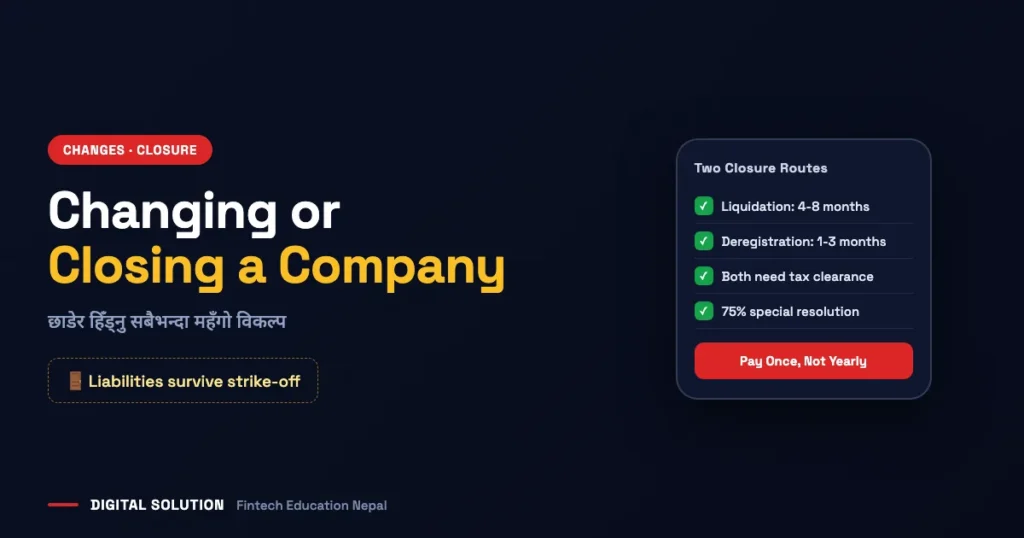
| Reported timeline | 4–8 months | 1–3 months |
| Reported cost | Rs 1,50,000 – 5,50,000+ | Rs 25,000 – 80,000 |
Both routes require a 75% special resolution of shareholders, a tax clearance certificate from the Inland Revenue Department, public notice in national dailies, and filing through the Registrar’s system before a certificate of dissolution is issued.
What Happens If You Just Walk Away
⚠ This is the section that matters most, and it is why closing properly is cheaper than it looks.
- Fines accrue annually once you are past twelve months — Rs 5,000, Rs 10,000 or Rs 20,000 a year depending on paid-up capital — and they are levied on the directors and officers personally.
- After three consecutive financial years of default the Registrar can strike the company off.
- After cancellation, existing liabilities remain enforceable against shareholders, directors and officers personally. The entity vanishing does not take the debts with it.
- The company name cannot be reused.
So the choice is not “pay to close, or pay nothing.” It is pay once now, or pay every year and end up personally exposed anyway.
Detail on the fines and the strike-off process: company annual compliance.
🤝 Need to change something at the Registrar, or close a company properly?
Tell us what needs to change, or how long the company has been dormant. Digital Solution will map what is required and in what order — and tell you when you need a company lawyer, an auditor or a licensed liquidator.
Frequently Asked Questions
How do I change my company name in Nepal?
Special resolution, prior Registrar approval, amended MOA and AOA, and notice in a national daily for at least three days. The fee is reported as the lower of 25% of the registration fee or Rs 5,000.
How long do I have to report a change of address?
Within 30 days of the resolution — and remember to update the tax office and your local authority too.
Can I reduce my authorised capital?
No. There is no mechanism to reduce it, so set it carefully at registration.
How much does it cost to close a company?
Reported at Rs 25,000–80,000 for deregistration of a dormant company, and Rs 1,50,000–5,50,000 or more for voluntary liquidation with a liquidator.
Do I need a tax clearance certificate to close?
Yes, for both routes — and you cannot get one with outstanding returns.
What if I just stop operating?
Fines accrue annually on the directors personally, the Registrar can strike the company off after three years of default, and liabilities remain enforceable against shareholders and officers afterwards.
How long does closure take?
Reported as one to three months for deregistration, four to eight months for liquidation.
How fast must the board act on a share transfer?
The board must accept or reject within 15 days.
Sources
- Companies Act 2063 — sections 51, 81 and 136, and Chapter 10 on liquidation.
- Published law-firm guidance on change procedures, closure routes, timelines and indicative costs — noted as estimates rather than official fees.
Related Reading
- Company annual compliance and penalties
- Tax clearance certificate
- Private limited company registration
Disclaimer: Digital Solution Nepal is an independent educational and digital-service assistance website — not a government office, not a law firm and not an audit firm. Registration procedures, fees and thresholds change through Acts, regulations and local Economic Acts, and requirements differ by office, sector and province. Nothing here is legal or professional advice — the relevant registering office and a qualified professional are final. Confirm before filing or paying anything.

Rabin Paudel
Rabin Paudel is the Founder of Digital Solution, a Content Creator, and an AI Trainer. He shares practical and easy-to-understand content on Artificial Intelligence, Digital Literacy, Online Services, FinTech, and Technology. His mission is to make technology simple, accessible, and useful for everyone.
View all posts by Rabin Paudel →