
Last updated: July 2026 (Shrawan 2083) — based on the Supreme Court’s interim order as reported by Techpana. An interim order holds until standards are finalized or the writ is decided; details may evolve.
Two weeks ago, Nepal’s Supreme Court made every order public the same day it’s issued. Now the same Court has drawn the other line of court digitization: an interim order stopping live broadcasts of hearings whenever a party requests privacy — and banning distorted court clips on social media — until formal broadcasting standards exist. Transparency and privacy, both moving at once. Here’s what the order says, why it happened, and what it means for litigants, media and content creators.
What the Supreme Court Ordered
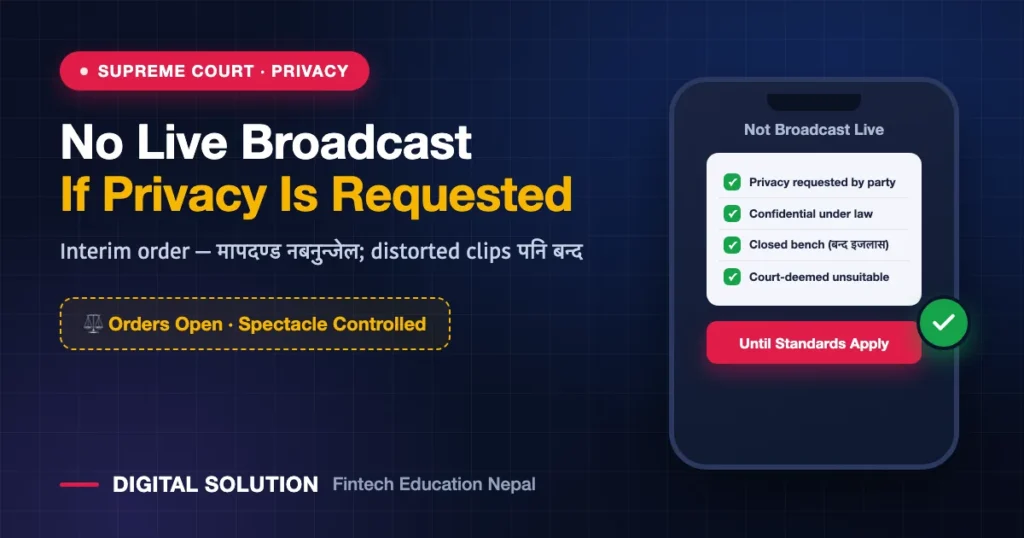
A joint bench of Justices Binod Sharma and Shanti Singh Thapa issued the interim order on Tuesday. Until clear live-broadcast standards (मापदण्ड) are made and implemented, there will be no live broadcast of:
- Hearings where any party to the case requests privacy;
- Matters that must remain confidential under prevailing Nepali law;
- Cases heard in closed bench (बन्द इजलास);
- Any case the court or bench itself deems unsuitable for live broadcast.
And two directives aimed squarely at the social-media age:
- No distorting, misleading editing, or deceptive video clips of court proceedings for circulation on social media;
- Where distorted material from live broadcasts has already been aired or published, respondents must stop it immediately.
How This Case Arose
Live broadcasting of hearings began at the Special Court and the High Court Janakpur as a transparency initiative. On Asar 29, advocates Jeevan Kumar Shahi, Rekha Malla and Milan Shahi filed a certiorari writ at the Supreme Court arguing the practice had no legal basis — no standards, no directives, no regulatory framework — and that unregulated broadcasts risked unfair negative perceptions of courts, parties and lawyers. The interim order is the Court’s holding position: the government’s homework on formal standards is underway, and until those standards apply, privacy wins by default when requested.
The Balance the Court Is Striking
| Open-Justice Direction | Privacy Protection Direction |
|---|---|
| All orders published online, same day | Live broadcast stops on any party’s privacy request |
| Live hearings piloted for transparency | Closed-bench and legally confidential matters never broadcast |
| Public can read what courts decide | Public can’t turn hearings into viral spectacle |
Read together, the two moves are coherent: documents open, spectacle controlled. The written record of justice becomes radically more accessible while the courtroom-as-content pipeline gets a regulator — the same tension every digitizing institution in Nepal is navigating, from the draft umbrella tech law to the social-media regulation debate.
What It Means for You
If you’re a party to a case
You now have a recognized lever: request privacy, and your hearing won’t be live-broadcast while this order holds. For sensitive matters — family disputes, business conflicts, anything reputationally loaded — that request is worth discussing with your lawyer at the outset.
If you’re a journalist or media house
Reporting on cases continues as before — the order targets live broadcast and distorted clips, not court journalism. But the “stop immediately” directive on distorted material is a live compliance duty: outlets running court footage need editorial checks on how clips are cut and captioned.
If you’re a content creator
The viral court-clip genre just acquired legal risk. Editing court footage misleadingly for engagement is now the subject of a standing Supreme Court directive — “यो त content हो” is not a defense. Commentary on public documents (the same-day orders) remains the safer, richer material.
If you follow court proceedings
Live streams from the pilot courts may thin out while standards are drafted — but the written orders portal now gives you more authoritative access than any stream did.
What Happens Next
- Standards drafting: the Court noted homework on live-broadcast मापदण्ड is ongoing — expect defined categories of broadcastable proceedings, consent rules and clip-use conditions.
- The writ’s final hearing: the interim order holds until then; the eventual ruling will set the durable framework.
- We’ll track it: as with every digital-governance shift, updates land here the day they happen.
FAQ
Did the Supreme Court ban live broadcasts of all hearings?
No — it paused them conditionally: privacy-requested, legally confidential, closed-bench and court-deemed-unsuitable cases can’t be broadcast until formal standards apply. The framework for everything else awaits those standards.
Can I still watch court proceedings online?
Pilot live streams may be curtailed meanwhile, but all Supreme Court orders are published same-day at supremecourt.gov.np — here’s how to access them.
Is sharing court hearing clips on TikTok now illegal?
Sharing distorted, misleadingly edited or deceptive clips violates a standing Supreme Court directive. Accurate, contextual use of public material is a different matter — but the risk line just became real; creators should treat court footage with news-grade care.
Who requested this order?
Three advocates — Jeevan Kumar Shahi, Rekha Malla and Milan Shahi — via a certiorari writ arguing live broadcasts lacked any legal basis or standards.
🤝 Following Nepal’s digital-law shifts?
We track every major digital-governance change — courts, cyber law, online services — in plain language. Follow Digital Solution on YouTube, TikTok and Facebook, or ask us directly.
Disclaimer: Digital Solution Nepal is an independent educational website, not a legal advisor. This is informational coverage of an interim order that may evolve — the Supreme Court’s official record is final; consult a lawyer for case-specific matters.

Rabin Paudel
Rabin Paudel is the Founder of Digital Solution, a Content Creator, and an AI Trainer. He shares practical and easy-to-understand content on Artificial Intelligence, Digital Literacy, Online Services, FinTech, and Technology. His mission is to make technology simple, accessible, and useful for everyone.
View all posts by Rabin Paudel →