
Last updated: July 2026 (Shrawan 2083) — based on the Ministry of Science, Technology and Innovation’s approved concept paper as reported by Techpana. The bill is at drafting stage; provisions can change before it becomes law.
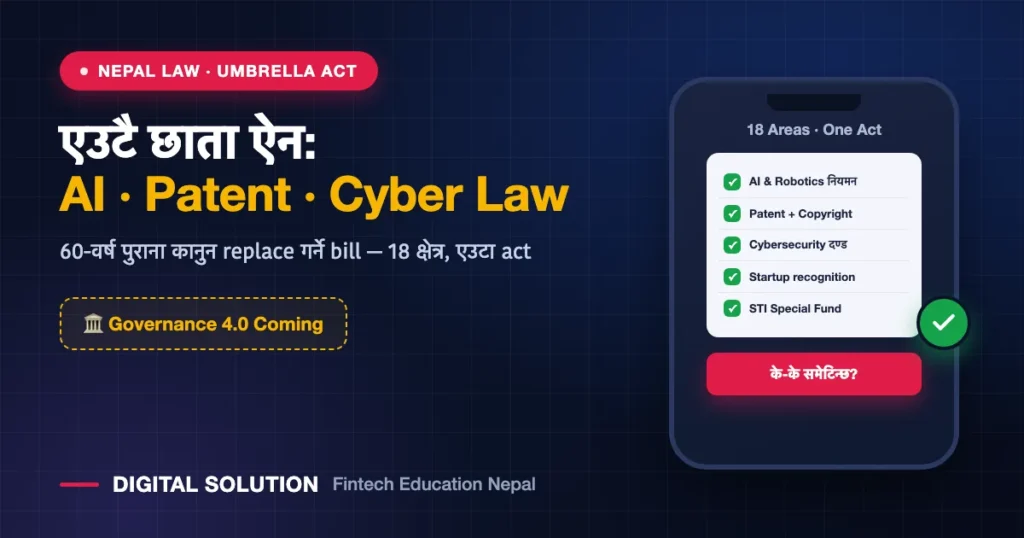
Nepal’s technology laws are a patchwork stitched across decades — the Patent, Design and Trademark Act is from 2022 B.S. (over 60 years old), copyright runs on the 2059 Act, and everything digital leans on the Electronic Transactions Act 2063. Now the government wants to replace the patchwork: the Ministry of Science, Technology and Innovation has approved a concept paper for a single umbrella law (छाता ऐन) — a Science, Technology and Innovation Bill covering everything from AI and robotics to patents, startups and cybersecurity. Here’s what’s in it, why it matters, and who should pay attention.
What Exactly Was Announced
- The Ministry approved an अवधारणापत्र (concept paper) for drafting a unified Science, Technology and Innovation Bill.
- The paper’s diagnosis: Nepal’s tech-related laws are scattered and sector-limited — Patent, Design and Trademark Act 2022, Copyright Act 2059, Electronic Transactions Act 2063, and assorted research-council acts each cover their own corner, and the overall innovation ecosystem has no unified legal framework.
- The bill aims to regulate and promote emerging technologies — explicitly naming artificial intelligence (AI), digital technology, biotechnology and clean energy — with legal guarantees around data security, intellectual property protection and research ethics.
The 18 Areas the Umbrella Act Proposes to Cover
The concept paper lists 18 key areas for the unified act. The headline items:
| Area | What It Means in Practice |
|---|---|
| National Science & Technology Research Center | A new institution leading nationwide research |
| Innovation management & regulation | Legal recognition and facilitation for inventions and startups |
| Technology testing & certification | Certifying technologies developed in Nepal or imported |
| Science cities, science villages, tech parks, museums | Physical innovation infrastructure |
| Special STI Fund | Guaranteed budget line for research and innovation |
| Research prioritization + Centers of Excellence | Strategic focus areas with designated top institutions |
| Indigenous technology & knowledge (रैथाने ज्ञान) | Registered and protected as intellectual property |
| Stronger patent & copyright provisions | Securing inventors’ and creators’ rights |
| Science diplomacy | International technology transfer and cooperation |
| Strict penalties | For technology misuse, IP theft and cybersecurity violations |
| Integrated science-tech data center | One national information hub for research data |
| Public–private–academic collaboration | Formal policy pushing the three sectors to work together |
“Governance 4.0”: AI in Government Itself
The concept paper’s stated end-goal goes beyond regulating the private sector: after implementation, Nepal plans to institutionalize its national STI system and apply Governance 4.0 — using AI and robotics to streamline public administration, with evidence-based policymaking and science-driven decisions. That would put Nepal’s government itself among the users of the technologies the act regulates.
Why This Matters (By Who You Are)
🚀 Startups & founders
Legal recognition for innovation-based enterprises, certification pathways, a dedicated fund, and tech parks — the missing legal scaffolding Nepali startups have complained about for years. If the fund and facilitation provisions survive drafting, registering and protecting a tech product in Nepal could get meaningfully easier.
🎨 Creators & inventors
Stronger patent and copyright provisions matter in a market where copying is cheap and enforcement is thin. The promise to register indigenous knowledge as IP is also notable — Nepal’s traditional designs, processes and products have long been unprotected.
💻 IT workers & the cyber ecosystem
A unified act with strict penalties for cyber violations would finally connect the dots between today’s scattered enforcement — the same drive that recently produced the 2.23-lakh betting-site blocking with a public GitHub blocklist. Expect data-security compliance to become a real obligation for Nepali companies, not a suggestion.
🎓 Students & researchers
Research ethics guarantees, training/capacity provisions, Centers of Excellence and a research center — signals that research careers inside Nepal are being taken seriously.
The Honest Caveats
- This is a concept paper, not a law. Drafting → cabinet → parliament is a long road, and provisions change along the way. Nepal’s legislative pipeline has seen ambitious tech bills stall before — the social media regulation bill is a recent example of how contested tech lawmaking gets.
- Umbrella ≠ automatic clarity. Merging patent law (1960s), copyright (2002) and cyber provisions into one act is legally hard; poorly drafted mega-acts can create as much confusion as they remove.
- AI regulation is genuinely difficult — even rich economies are struggling with it. The win for Nepal would be enabling innovation while guarding against harms, not copying restrictive templates.
What Happens Next
- Drafting of the bill based on the approved concept paper (Ministry of Science, Technology and Innovation — most.gov.np).
- Consultation rounds — startups, IT industry bodies and legal experts should engage now; concept-stage input shapes bills far more than post-tabling protest.
- Parliamentary process — where timelines are anyone’s guess. We’ll track every milestone on this blog and our channels, as we do for every digital-Nepal rule change (see the ICT highlights of Budget 2082/83).
FAQ
What is Nepal’s proposed umbrella technology law?
A unified Science, Technology and Innovation Act combining Nepal’s scattered tech-related laws — patent/trademark, copyright, electronic transactions, research acts — into one framework covering 18 areas, from AI regulation to cybersecurity penalties. Its concept paper was approved by the Ministry of Science, Technology and Innovation in Shrawan 2083.
Will this law regulate AI in Nepal?
That’s the stated intent — AI, digital technology, biotech and clean energy are explicitly named, with legal foundations for their “safe, responsible and effective” use, plus Governance 4.0 (AI in public administration).
Does Nepal currently have a cybersecurity law?
Cyber matters are mainly handled under the Electronic Transactions Act 2063 and related provisions — precisely the fragmentation this umbrella act aims to fix with dedicated, stricter cyber-violation penalties.
When will the umbrella act become law?
No timeline exists yet — the concept paper only green-lights drafting. Bills of this scope typically take years; follow official Ministry channels and our updates.
What happens to existing patents and copyrights?
Existing registrations continue under current acts; how the transition would work will only be clear once the draft bill text is public.
🤝 Startup वा creator हुनुहुन्छ? यो कानुनले तपाईंलाई छुन्छ
Nepal को digital नियम-कानुन का हरेक update हामी सरल भाषामा ल्याउँछौं — follow गर्नुहोस्, र specific प्रश्न भए सिधै सोध्नुहोस्।
Disclaimer: Digital Solution Nepal is an independent educational/digital-service assistance website, not a government body. This covers a proposed bill at concept stage — provisions can change substantially; official government publications are final.

Rabin Paudel
Rabin Paudel is the Founder of Digital Solution, a Content Creator, and an AI Trainer. He shares practical and easy-to-understand content on Artificial Intelligence, Digital Literacy, Online Services, FinTech, and Technology. His mission is to make technology simple, accessible, and useful for everyone.
View all posts by Rabin Paudel →