
Last updated: July 2026 (Shrawan 2083) — based on the National Transport Policy 2083 as reported by Techpana, with market data from Kathmandu Post, NEA and industry reporting. Policies and figures evolve; official publications are final.
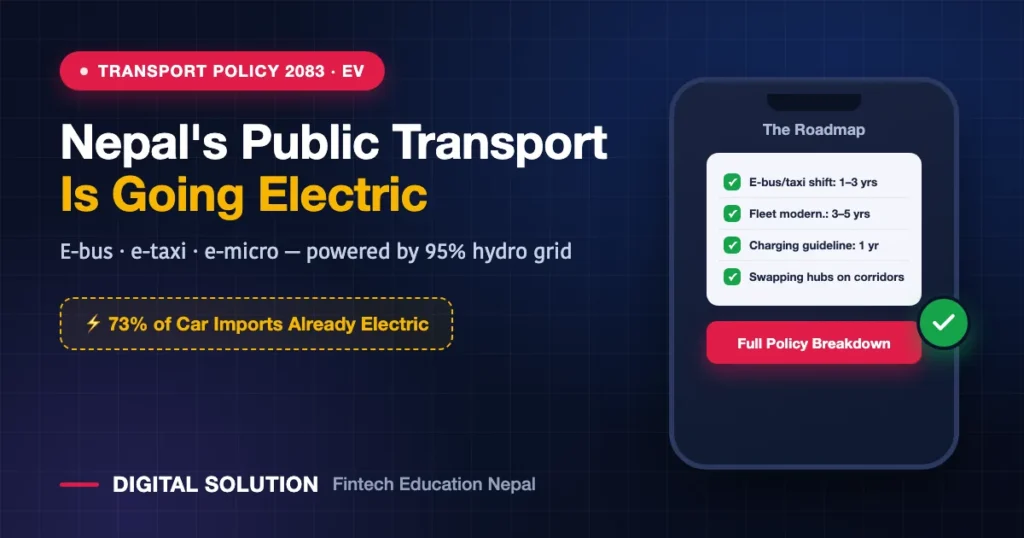
Nepal quietly became one of the world’s fastest-adopting EV markets — electric vehicles captured about 73% of four-wheeler passenger imports at the peak of the boom. But that revolution happened in private garages. Now the government wants the harder prize: with the newly approved National Transport Policy 2083 (राष्ट्रिय यातायात नीति-२०८३), Nepal has committed to an e-mobility transition in public transport — e-buses, e-taxis and e-micros on a 1–3 year conversion clock, a fleet-modernization program within 3–5 years, and a national charging-station guideline within one year. This is the full picture: what the policy promises, what the numbers say about whether Nepal can deliver, and what it means for commuters, drivers and entrepreneurs.
What the National Transport Policy 2083 Actually Commits To
Approved by the government and published by the Ministry of Physical Infrastructure, the policy makes electric and alternative-energy vehicles a stated national priority, with a phased “e-mobility transition.” The concrete commitments:
| Commitment | Timeline | What It Means |
|---|---|---|
| E-bus, e-taxi and e-micro conversion program in public transport | 1–3 years | The routes you ride daily begin switching to electric |
| Public transport fleet modernization program, electric buses prioritized | 3–5 years | Systematic replacement of aging diesel fleets |
| National guideline for charging stations — locations, capacity, standards | Within 1 year | Ends the wild-west phase of charger placement |
| Charging stations + battery-swapping hubs on major corridors and cities | Continuous | Infrastructure follows the highways |
| Federal–province–local collaboration on an integrated, energy-efficient system | Structural | All three government tiers share the mandate |
The Numbers Behind Nepal’s EV Moment
Policy ambition means little without market reality — and Nepal’s reality is genuinely remarkable:
- ~73% of four-wheeler passenger imports were electric at the boom’s peak — a share that put Nepal among the very top EV-adopting nations for new cars.
- The boom is maturing, not dying: FY 2025/26 saw EV imports cool roughly 20% (about 10,800 units against 13,600 the previous year) — a correction after explosive growth, with tax-policy shifts and market saturation at the price points doing the cooling.
- The grid is ready in principle: roughly 95% of Nepal’s ~3,400 MW installed capacity is hydropower — every diesel bus replaced is oil imports converted into domestic clean energy. Few countries on Earth have a cleaner grid to electrify onto.
- Charging is no longer hypothetical: NEA runs 60+ fast-charging stations across all seven provinces, and the national total including private operators exceeds 750 stations.
- Public-transport proof exists: Sajha Yatayat operates 40 electric buses in the Valley with two dozen chargers, including Nepal’s biggest simultaneous-charging depot in Patan — the working template the new policy wants to scale.
Why Public Transport Is the Harder — and Bigger — Prize
Private buyers electrified because the math worked: lower import duties made EVs price-competitive, and charging at home plus cheap electricity crushed petrol costs per kilometer. Public transport is different terrain:
- Capital cost: an electric bus costs multiples of a used diesel bus — and Nepal’s transport sector runs on thin-margin private operators and committees, not deep-pocketed fleets. Financing structures (soft loans, lease models, grants) will decide the 1–3 year target’s fate more than technology will.
- Duty cycles: a private car charges overnight; a route bus needs fast depot charging or battery swapping between runs — exactly why the policy pairs conversion with swapping hubs and the charging guideline.
- The syndicate reality: route permits and operator committees shape what actually rolls on Nepali roads. E-conversion programs that ignore operator economics have failed globally; ones that make operators the beneficiaries (lower fuel/maintenance costs are real — electricity per km is a fraction of diesel) succeed.
- The prize: public vehicles run 10× the kilometers of private ones — one electrified bus removes more diesel and more Kathmandu air pollution than dozens of private EVs. If Nepal wants its EV story to touch ordinary commuters and the trade deficit, buses and taxis are where it happens.
The Charging Guideline: Boring Name, Big Deal
The one-year commitment to a national guideline on charging-station locations, capacity and standards answers the questions holding back serious investment: Which connectors? What capacity where? Who can build on highways? How do provinces coordinate instead of duplicate? Standardization is what turned charging anxiety into a non-issue in mature EV markets — and it’s what tells a Butwal entrepreneur exactly what to build for the Bhairahawa–Pokhara corridor. Expect the guideline to trigger a private charging-investment wave the moment it lands.
What It Means for You
| You Are | What Changes |
|---|---|
| Daily commuter | Quieter, cleaner e-buses and e-micros on major routes within the 1–3 year window — Valley first, corridors next |
| Taxi/micro operator | Conversion programs are coming — watch for financing packages; running costs drop sharply after the switch |
| Driver by profession | E-fleets need trained drivers — early EV-handling experience becomes a hiring edge (your license process itself just went digital, bumpily) |
| Entrepreneur | Charging stations, swapping hubs, EV servicing, fleet software — the guideline year is the entry window; Pokhara’s newly legal ride-sharing shows how fast transport rules are modernizing |
| EV-curious buyer | 750+ stations and a national guideline coming means range anxiety keeps shrinking — the cooling import numbers are a price-cycle story, not a direction change |
The World You’ll Drive Into Is Electric Too — Take Your License Global
Here’s the part Nepali travelers underestimate: this transition is global, and it meets you the moment you land abroad. Rental fleets across Europe, the Gulf, Australia and East Asia are increasingly electric — the car waiting for a Nepali tourist, student or NRN at a foreign airport is more likely than ever to be an EV. Driving one abroad legally needs the same thing driving anything abroad needs: an International Driving Permit (IDP) paired with your Nepali license.
- Where your Nepali license + IDP works: 150+ countries accept a Nepali IDP — from Schengen road trips to Gulf work driving.
- What it takes: a small document set (requirements here) and a modest cost (current pricing explained) — with validity options up to 3 years.
- How to get it from Nepal, fast: our IDP application guide covers the process — or skip the friction entirely and let Digital Solution’s IDP service handle documents, processing and delivery. Planning travel? Sort the IDP before the ticket — it’s the cheapest item on the trip and the one that strands you without it.
Honest Caveats
- Policies are commitments, not deliveries — Nepal’s transport sector has seen ambitious documents outlive their timelines. The difference this cycle: the market (73% imports), the grid (95% hydro) and a working template (Sajha) already exist. Execution risk is real; direction risk isn’t.
- The 1–3 year conversion window starts with programs, not full fleets — expect pilots and priority routes first, and hold the policy accountable at its own milestones: the charging guideline within a year is the first testable promise.
FAQ
What is the National Transport Policy 2083’s EV plan?
Prioritizing EVs in public transport via a phased e-mobility transition: e-bus/e-taxi/e-micro conversion programs within 1–3 years, fleet modernization within 3–5 years (electric buses first), continuous charging/swapping infrastructure on corridors, and a national charging-station guideline within one year.
How many EV charging stations does Nepal have?
Over 750 nationally, including 60+ NEA fast-charging stations across all seven provinces — with a national placement/standards guideline due within a year to organize further growth.
Why do EVs make special sense for Nepal?
About 95% of Nepal’s electricity is domestic hydropower — every electrified kilometer converts imported fuel into local clean energy, cutting both pollution and the trade deficit.
Are EV imports declining in Nepal?
FY 2025/26 imports cooled about 20% after explosive growth — a maturing-market correction influenced by tax changes, not a reversal; EVs remain the dominant share of new passenger imports.
Do I need an IDP to drive an EV abroad?
You need an IDP to drive anything abroad in most countries — EV or petrol. Rentals increasingly hand you an EV, so the permit matters more than ever: get it processed from Nepal here.
🚗 Planning to drive abroad? Get your International Driving Permit sorted first
Digital Solution is Nepal’s dedicated IDP partner — full document support, fast processing, delivery included. Valid in 150+ countries, options up to 3 years.
Disclaimer: Digital Solution Nepal is an independent educational website, not a government body. Policy provisions, timelines and market figures follow official publications and cited reporting — the Ministry of Physical Infrastructure’s policy text is final.

Rabin Paudel
Rabin Paudel is the Founder of Digital Solution, a Content Creator, and an AI Trainer. He shares practical and easy-to-understand content on Artificial Intelligence, Digital Literacy, Online Services, FinTech, and Technology. His mission is to make technology simple, accessible, and useful for everyone.
View all posts by Rabin Paudel →