
Last updated: July 2026 (Shrawan 2083) — based on the Supreme Court’s announcement as reported by Techpana. Uploads are being phased in bench by bench; check supremecourt.gov.np for the latest.
A quiet but significant transparency milestone for Nepal’s judiciary: starting Monday (Shrawan 11, 2083), the Supreme Court publishes every type of order (आदेश) on its website the same day it is issued — and anyone can read or download the PDF, free. Until now, only final verdicts (फैसला) went online. Here’s what changed, why it matters, and the exact steps to check any Supreme Court order online.
What Changed
- Before: the Supreme Court’s website published only final verdicts of decided cases. Interim orders, show-cause orders, and other bench orders lived in court files — practically inaccessible unless you were a party or a lawyer.
- Now: from Shrawan 11, the Court uploads orders from its benches on the same day they are issued, viewable by anyone.
- The practice began on the directive of Chief Justice Dr. Manoj Kumar Sharma, according to Court spokesperson and Joint Registrar Arjun Prasad Koirala.
- Coming next: the spokesperson says the practice will gradually be extended to lower courts as well.
One honest note on day one: not every order was uploaded on the first day. Orders from the joint bench of Chief Justice Sharma and Justice Balkrishna Dhakal, and from Justice Binod Sharma’s bench, went up first — the Court says all benches will be covered within a few days.
How to Check a Supreme Court Order Online (Step by Step)
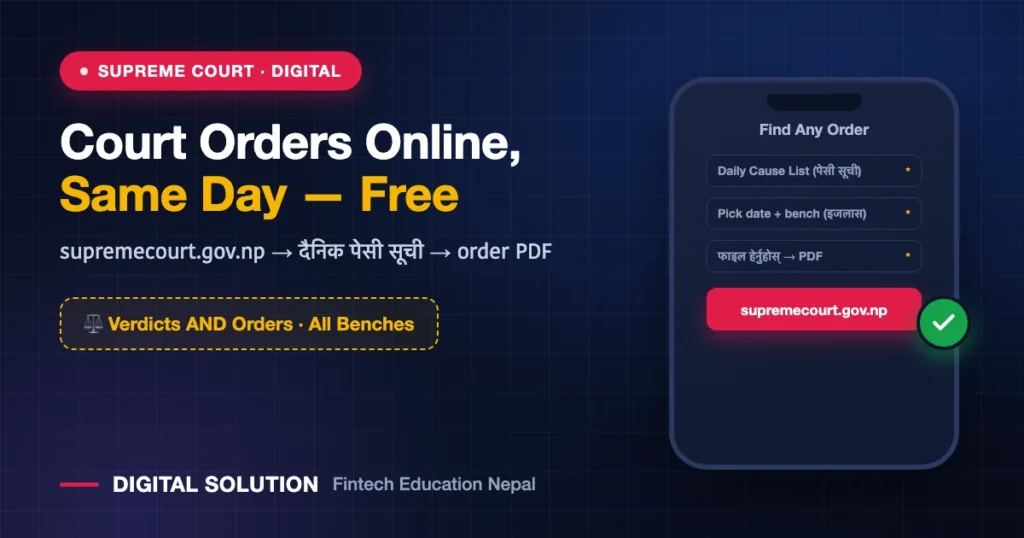
- Go to the official website: supremecourt.gov.np.
- Click “दैनिक पेसी सूची” (Daily Cause List) — the red button with white text at the top of the site.
- Choose the hearing date (पेसी मिति) and the bench (इजलास), then click “खोज्ने” (Search).
- The bench and judges list opens — scroll down to see the day’s hearings for your chosen bench.
- Find your case in the list. On the far right, you’ll see the order/verdict type and a “फाइल हेर्नुहोस्” (View File) option — click it.
- The order opens as a PDF — read it in the browser or download it for your records.
No account, no fee, no lawyer required — if you know the hearing date and bench, you can pull the order from your phone.
Why This Matters
For litigants and families
Parties to a case — and families supporting them from another city or abroad — can see what the bench actually ordered on the day it happened, instead of relying on second-hand summaries or expensive trips to Kathmandu.
For journalists, researchers and students
Interim orders often matter as much as final verdicts — they halt demolitions, stay decisions, summon officials. Same-day public access means reporting and legal research can cite the actual text of an order, not paraphrases.
For transparency itself
Publishing orders the day they’re made leaves far less room for “the order says whatever someone claims it says.” It also fits the wider digitization wave across Nepal’s public institutions — from bank accounts opening via the Nagarik App to the government drafting a unified umbrella law for technology and cybersecurity. The judiciary joining that wave is a big signal.
Quick Reference: Verdicts vs Orders
| Verdict (फैसला) | Order (आदेश) | |
|---|---|---|
| What it is | The final decision of a case | Any bench direction during a case — interim relief, show-cause, stay orders, procedural directions |
| Online before? | ✅ Yes, already published | ❌ No — this is the new part |
| Online now | ✅ Yes | ✅ Yes — same day, all benches (phasing in) |
Tips for Finding Your Order Faster
- Know your पेसी मिति (hearing date) — the search is date-driven. Your case’s hearing dates appear in the cause list itself.
- Know the bench — if unsure, check each bench listed for that date; the case name search within the list narrows it quickly.
- Day-one gaps are normal — if your bench’s order isn’t up yet, re-check in a day or two as the Court completes the rollout.
- Save the PDF — downloaded orders are your durable record; websites reorganize over time.
FAQ
Can anyone view Supreme Court orders, or only the parties to a case?
Anyone. The orders are published on the public website — no login or party status required.
Is there a fee to view or download orders?
No — viewing and downloading the PDF from supremecourt.gov.np is free.
Are lower court (District/High Court) orders online too?
Not yet — the Supreme Court says the practice will be extended to lower courts gradually. For now, this covers Supreme Court benches.
My case’s order isn’t showing. What should I do?
Early in the rollout, some benches’ orders lag by a few days. Re-check with the correct hearing date and bench; if it’s still missing after the rollout stabilizes, contact the court administration.
Where do I check the daily cause list itself?
Same place — the “दैनिक पेसी सूची” section of supremecourt.gov.np lists each day’s scheduled hearings by bench.
🤝 Need help navigating Nepal’s online government services?
From court portals to every major government service online — Digital Solution publishes practical guides and helps directly.
Disclaimer: Digital Solution Nepal is an independent educational/digital-service assistance website, not a government body. This article is informational, not legal advice — for case-specific matters, consult a licensed lawyer; the Supreme Court’s official website and administration are final.

Rabin Paudel
Rabin Paudel is the Founder of Digital Solution, a Content Creator, and an AI Trainer. He shares practical and easy-to-understand content on Artificial Intelligence, Digital Literacy, Online Services, FinTech, and Technology. His mission is to make technology simple, accessible, and useful for everyone.
View all posts by Rabin Paudel →