
As of 7 November 2026 (21 Kartik 2083). Figures are read from the Social Security Fund’s सामाजिक सुरक्षा योजना सञ्चालन कार्यविधि, २०७५ (Social Security Scheme Operation Procedure 2075) with its fifth amendment, which is the latest version listed on ssf.gov.np on this date, and from SSF’s formal-sector information slides on ssf.gov.np. All rupee examples are our calculation. The structure of this guide follows Digital Solution’s own Nepali explainer on SSF treatment costs, with every figure re-checked against SSF documents.
Most SSF contributors know the headline numbers: Rs 25,000 for OPD and Rs 1 lakh for hospital admission. What confuses people is how the SSF OPD and IPD limit works together. Are they separate? Does your family get Rs 1 lakh each? What happens after your bill crosses the limit?
This guide answers those questions with worked examples. For an overview of the scheme, see our SSF medical benefits guide and our SSF medical, health and maternity explainer. This post covers only how the limits add up.
Quick answers
| Question | Short answer | Where it comes from |
|---|---|---|
| Who pays what? | SSF 80%, you 20% of the claim | Procedure, section 6(4) |
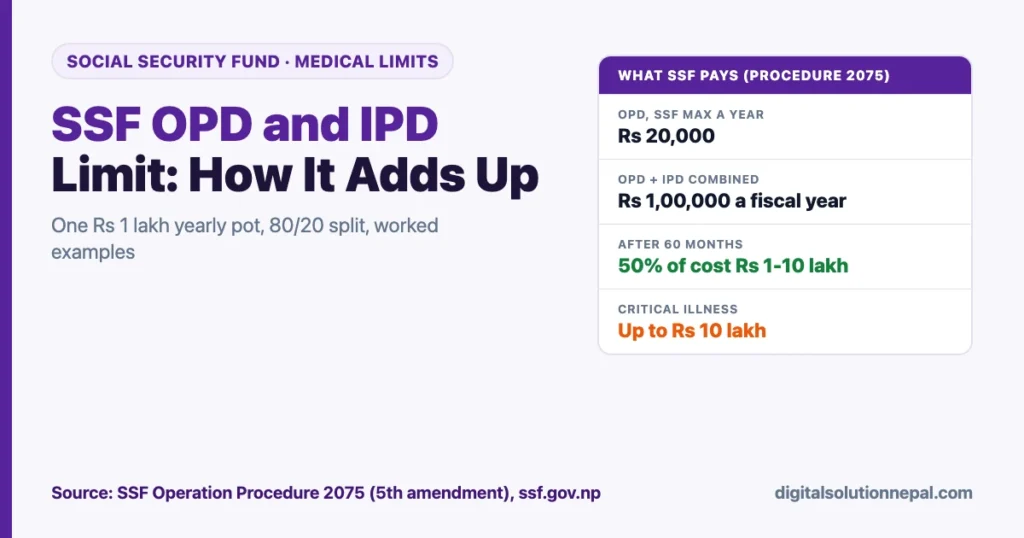
| OPD: most SSF pays in a year | Rs 20,000 | Procedure, section 6(3) |
| OPD: bill size that uses the full cap | Rs 25,000 | Our calculation (Rs 20,000 is 80% of Rs 25,000); SSF slides also say Rs 25,000 |
| OPD + IPD together | Rs 1,00,000 per fiscal year, combined | Procedure, sections 6(1) and 6(4ka) |
| Is the limit per family member? | No. One combined limit for contributor, spouse and children under 18 | Procedure, section 6(4ka) |
| Extra cover after 60 months | SSF pays 50% of treatment cost above Rs 1 lakh, up to Rs 10 lakh | Procedure, section 6(1ka) |
| Critical illness | Up to Rs 10 lakh over your whole service period | Procedure, section 6(1) proviso |
These rules are for the formal-sector SSF scheme. The informal, self-employed and foreign employment schemes have their own procedures.
How the SSF OPD and IPD limit works: the 4 rules
Rule 1: you pay 20%. Section 6(4) of the procedure says a contributor claiming OPD, IPD or maternity treatment bears 20% of the total claim amount. SSF pays the other 80%.
Rule 2: OPD has its own cap of Rs 20,000. Section 6(3) says treatment without admission, on a doctor’s prescription, is paid up to Rs 20,000 a year. Because SSF pays 80%, you reach that cap when your eligible OPD bills total Rs 25,000 (our calculation). SSF’s formal-sector slide on ssf.gov.np describes the same benefit as “OPD treatment reimbursement up to Rs 25 thousand a year”.
Rule 3: OPD and IPD share one Rs 1 lakh pot. Section 6(1) caps what SSF pays for admitted treatment at Rs 1 lakh a year, and says any OPD benefit used in the same fiscal year is deducted from it. Section 6(4ka) repeats that the total for OPD, IPD and maternity treatment cannot exceed Rs 1 lakh in one fiscal year. So the yearly maximum is Rs 1 lakh in total, not Rs 1 lakh plus Rs 20,000.
Rule 4: unused OPD is not lost. Section 6(3ka) says a contributor who has used OPD money can still be admitted and claim within the Rs 1 lakh limit. Our reading: any part of the pot you did not spend on OPD is available for admission.
The year here is the fiscal year (आर्थिक वर्ष), which in Nepal runs from Shrawan to Asar, so the pot refills in mid-July, not on 1 January.
A wording difference you should know about
SSF’s own information slide says “IPD treatment reimbursement up to Rs 1 lakh a year” and shows a “20% co-payment” label beside it. Read that way, SSF would pay at most Rs 80,000 (80% of Rs 1 lakh). The operation procedure is worded differently: it says the maximum amount SSF pays (भुक्तानी) in a year is Rs 1 lakh. In this guide we follow the procedure, because it is the formal rule. On that reading, a bill of Rs 1,25,000 is what it takes for SSF’s 80% share to reach Rs 1 lakh (our calculation). If your hospital’s SSF desk applies a different figure, ask them which document they are following.
Worked examples (our calculation)
All examples assume eligible costs at SSF rates, at an affiliated hospital, in one fiscal year, with no other claims.
| Situation | Eligible bill | SSF pays | You pay | Pot left for the year |
|---|---|---|---|---|
| OPD visits and tests | Rs 10,000 | Rs 8,000 | Rs 2,000 | Rs 92,000 |
| OPD reaches the cap | Rs 25,000 | Rs 20,000 | Rs 5,000 | Rs 80,000 |
| OPD above the cap | Rs 30,000 | Rs 20,000 | Rs 10,000 | Rs 80,000 |
| Admission only, mid-size | Rs 60,000 | Rs 48,000 | Rs 12,000 | Rs 52,000 |
| Admission only, uses the full pot | Rs 1,25,000 | Rs 1,00,000 | Rs 25,000 | Rs 0 |
Example: OPD first, then admission
Ram’s family used Rs 20,000 of OPD benefit in Bhadra. In Poush his 10-year-old son is admitted and the eligible bill is Rs 1,50,000.
- Pot for the year: Rs 1,00,000.
- Already used on OPD: Rs 20,000, so Rs 80,000 is left.
- 80% of Rs 1,50,000 is Rs 1,20,000, but only Rs 80,000 is left in the pot.
- SSF pays Rs 80,000. The family pays Rs 70,000.
Many people expect Rs 1,20,000 (Rs 20,000 OPD plus Rs 1 lakh IPD). The procedure does not allow that.
Example: a family sharing one pot
Sita is the contributor. In one fiscal year her husband uses Rs 15,000 of OPD benefit and her daughter (16) is admitted, with SSF paying Rs 50,000. The pot left for Sita herself is Rs 35,000 (our calculation), because section 6(4ka) puts the contributor, spouse and children under 18 inside one Rs 1 lakh total.
Who is inside the pot
Section 4(1) of the procedure lists who can use the medical scheme:
- the contributor;
- the contributor’s husband or wife;
- sons and daughters who have not passed 18 years of age.
Parents and parents-in-law are not on that list. Section 5(chha), added by the fifth amendment, also covers accident treatment for the spouse and children under 18, within Rs 1 lakh.
For family members not covered by SSF, the government health insurance scheme may help. See our government health insurance guide and our health insurance vs SSF comparison.
When you become eligible
| Benefit | Contribution needed | How long it lasts after you stop |
|---|---|---|
| OPD, IPD and maternity | At least 3 months of regular contribution in the last 6 months before the need arises | 3 months after employment ends |
| New contributor | Benefit starts after the first 3 months of regular contribution | Same as above |
| Critical illness | At least 24 months of regular contribution in the last 28 months | 24 months after you stop contributing |
| 60-month extra cover | At least 60 months of regular contribution | Not stated in the procedure |
Source: procedure sections 4(1), 4(2) and 6(1ka). A pensioner under SSF’s old-age scheme keeps critical illness cover for seven years from the start of the pension (section 4(2) proviso). Section 8ka(3) also lets a contributor aged 60 or over with at least 180 months of contribution keep lifelong medical cover by paying 1% of the monthly pension.
The 60-month extra cover
Section 6(1ka) was added by the fifth amendment. A contributor with at least 60 months of regular contribution, who is admitted to a hospital connected to SSF’s online system, gets an extra layer: SSF pays the hospital 50% of treatment cost above Rs 1 lakh, up to Rs 10 lakh.
The most this layer can pay is 50% of Rs 9 lakh, which is Rs 4,50,000 (our calculation). As written, the section covers the contributor only; it does not mention the spouse or children.
SSF has not published how this layer stacks with the general Rs 1 lakh pot. One plain reading, for a Rs 4,00,000 eligible bill with no OPD used: the general rule applies to the first Rs 1 lakh of the bill, and the extra layer pays 50% of the remaining Rs 3,00,000, which is Rs 1,50,000 (our reading and calculation). Ask the SSF desk to confirm the split before a planned admission.
Critical illness: up to Rs 10 lakh
Under the proviso to section 6(1), SSF pays up to Rs 10 lakh for the contributor’s critical illness, used at once or in several parts over the whole service period. This is separate from the yearly Rs 1 lakh pot. For the scheme as a whole, see our SSF critical illness guide.
Section 2(ṭha) defines critical illness (घातक रोग) as: coronary artery bypass or open heart surgery, stroke, kidney disease, cancer, Parkinson’s, Alzheimer’s, spinal injury, head injury, sickle cell anaemia, haemophilia or thalassaemia, plus any disease the Government of Nepal names later.
Section 6(4ka) sets sub-limits inside the Rs 10 lakh:
| Part of the cost | SSF limit |
|---|---|
| Diagnosis costs, after the disease is confirmed | Up to Rs 1,00,000 |
| Treatment abroad on a Nepal Government medical board’s recommendation | Up to Rs 7,00,000 |
| Follow-up check-ups after discharge | Up to Rs 2,00,000 |
| Minimum reimbursement claim | Rs 50,000 (does not apply when the hospital claims directly) |
Example (our calculation): a contributor with 26 months of contribution in the last 28 months is treated for cancer. SSF pays Rs 6 lakh over two years. Rs 4 lakh remains for the rest of the contributor’s service period.
What SSF will not pay
Section 8 of the procedure lists costs the medical scheme does not cover:
- plastic surgery and dental treatment, except when needed because of an accident;
- bariatric surgery (fat removal);
- abortion other than as allowed by law;
- treatment already covered under the accident and disability scheme;
- any time the scheme is suspended because a nationwide epidemic makes costs unbearable for the Fund.
Section 6(7) adds that payment follows SSF’s approved rates. Check the price for your test or operation in our SSF treatment rate list. Section 6(6) bars claiming the same bill twice.
Need help checking your SSF medical eligibility?
Digital Solution in Pokhara can help you check your SSF contribution months, update KYC and family details, and fill SSF forms on the official portal. We can also prepare and scan your bills and reports before you file a claim.
How to use your SSF limit, step by step
- Check eligibility first. Log in to your SSF account and confirm at least 3 months of regular contribution in the last 6 months, plus correct family details.
- Pick an affiliated hospital. Use our SSF affiliated hospitals list.
- Go to the SSF desk before treatment. Give your SSF number and the patient’s details.
- Ask four questions: is this treatment covered, which SSF rate applies, how much of this year’s Rs 1 lakh pot is left, and what your 20% share will be.
- Keep every paper: prescriptions, bills, reports and the discharge summary.
- Track the claim. Our SSF claim process guide explains the steps, and our SSF claim rejected guide covers common fixes.
Frequently asked questions
Is the SSF OPD limit Rs 25,000 or Rs 20,000?
Both numbers describe the same thing. Rs 20,000 is the most SSF pays for OPD in a year (section 6(3)). Rs 25,000 is the eligible bill at which SSF’s 80% share reaches Rs 20,000 (our calculation), and it is the figure on SSF’s information slide.
Can I get Rs 20,000 for OPD and another Rs 1 lakh for IPD?
No. OPD money used in the same fiscal year is deducted from the Rs 1 lakh. The combined yearly maximum is Rs 1 lakh.
Does each family member get Rs 1 lakh?
No. The contributor, spouse and children under 18 share one Rs 1 lakh limit per fiscal year (section 6(4ka)).
Is critical illness cover inside the Rs 1 lakh?
No. Critical illness has its own limit of up to Rs 10 lakh over the contributor’s whole service period, with the sub-limits shown above.
Conclusion
The SSF OPD and IPD limit is simpler once you see it as one yearly pot. SSF pays 80%, OPD can take at most Rs 20,000 of the pot, and OPD plus admission together cannot exceed Rs 1 lakh a fiscal year for the contributor, spouse and children under 18. Contributors with 60 months get an extra 50% layer up to Rs 10 lakh of cost, and critical illness has a separate Rs 10 lakh limit. Before any planned admission, ask the SSF desk how much of your pot is left.
Sources
- Social Security Fund, सामाजिक सुरक्षा योजना संचालन कार्यविधि (पाँचौं संशोधन सहित), २०७५ (Social Security Scheme Operation Procedure 2075 with fifth amendment; fifth amendment approved 2081/09/10, in force from 1 Baisakh 2082), sections 2, 4, 5, 6, 8, 8ka and 26 (PDF, checked 7 November 2026): https://ssf.gov.np/images/news/17406520344566_Social%20Security%20Operation%20Procedure%202075%20with%205th%20ammendment.pdf
- Social Security Fund, Acts and rules list (checked 7 November 2026): https://ssf.gov.np/list/act_regulation
- Social Security Fund, formal sector information slides, “औषधीउपचार तथा स्वास्थ्य सुविधाको सिमा तथा शर्तहरु” (checked 7 November 2026): https://ssf.gov.np/services/the-amount-to-be-deposited-in-the-fund-to-be-included-in-the-scheme
- Social Security Fund, treatment rate list page: https://ssf.gov.np/pages/hospital-rate-list
- Social Security Fund, affiliated hospitals: https://ssf.gov.np/affiliated-hospitals
This guide explains SSF rules for general information only; the SSF desk at your hospital and the Social Security Fund decide every claim.

Rabin Paudel
Rabin Paudel is the Founder of Digital Solution, a Content Creator, and an AI Trainer. He shares practical and easy-to-understand content on Artificial Intelligence, Digital Literacy, Online Services, FinTech, and Technology. His mission is to make technology simple, accessible, and useful for everyone.
View all posts by Rabin Paudel →