As of 29 October 2026 (12 Kartik 2083). We read the official language-support pages of Google (Gemini web app, Gemini API, Cloud Translation, Cloud Speech-to-Text, Gemini TTS), Anthropic (Claude multilingual support), Microsoft (Translator language support) and OpenAI (Whisper language list and speech-to-text guide). OpenAI’s ChatGPT supported-languages help page returned a 403 error to our requests, so we could not read it. No account was signed in for this article, so the scores below come from a test sheet you can run yourself, not from a logged-in benchmark.
“Does it understand Nepali?” is the first question in almost every AI Nepali language training we run in Pokhara. The honest answer in 2026 is: all the big assistants read and write Devanagari Nepali to a usable level, but none of them publishes a Nepali accuracy figure, and the gap between tools shows up in the details, such as Romanised Nepali (Nepali typed in English letters), formal office language, and voice.
This guide separates what each company officially states about Nepali from what you should check yourself. It ends with a 15-minute test you can run on any tool before you pay for it.
Quick answers
| Question | Answer (official documentation, 29 Oct 2026) |
|---|---|
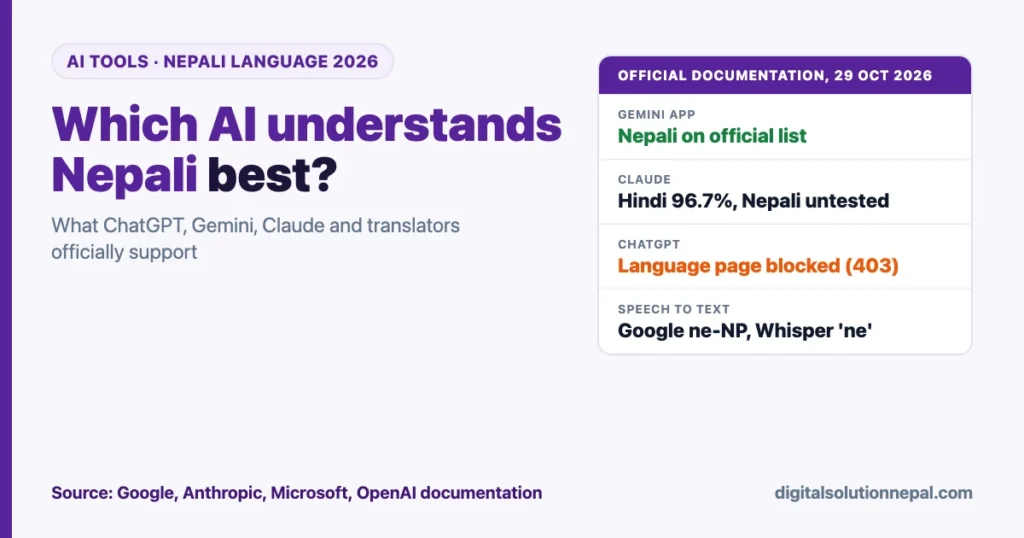
| Does Gemini officially support Nepali? | Yes. Google’s “Where you can use the Gemini web app” page lists Nepali among its languages and Nepal among its countries |
| Does Claude officially support Nepali? | Anthropic says Claude works in “most world languages that use standard Unicode characters” and benchmarks 14 languages (Hindi 96.7%, Bengali 95.4% of English performance). Nepali is not individually benchmarked |
| Does ChatGPT officially support Nepali? | Not confirmed by us. OpenAI’s supported-languages help page blocked our requests (HTTP 403) |
| Best free Nepali translation for documents? | Google Translate and Microsoft Translator both list Nepali for text and document translation |
| Nepali speech to text? | Google Cloud Speech-to-Text lists Nepali (ne-NP) on its Chirp models; OpenAI’s Whisper includes Nepali in its 98-language list |
| Nepali text to speech? | Google’s Gemini TTS models list Nepali |
| Romanised Nepali (“ma ghar jadai chu”)? | No vendor documents it. Anthropic advises native script over transliteration for best results. Test it yourself |
What “understands Nepali” actually means
Nepali capability is not one thing. In our trainings we split it into five skills: reading Devanagari, writing Devanagari (spelling, honorifics such as तपाईं / तिमी / हजुर, word order), understanding Romanised Nepali (“kati paisa lagcha?”), translation of government and legal terms, and voice in both directions. Most online comparisons test only the first two. Offices care about the third and fourth. Content creators care about the fifth.
Gemini: the only one with Nepali on its official list
Google’s help page for the Gemini web app lists the languages the app supports. Nepali is on that list, next to Assamese, Odia and Punjabi, and Nepal is on the list of supported countries. That makes Gemini the only major assistant where we could point to an official page naming Nepali.
Two cautions from Google’s own documentation. The Gemini API page lists Nepal as a supported country but publishes no per-language promise for Nepali text, so businesses building a Nepali chatbot should test before committing. Google’s Gemini 3.8 Flash TTS and Flash-Lite TTS speech models do list Nepali, while the Live API page says it converses in 70 languages without naming them, so live Nepali voice conversation is unconfirmed.
For Nepali voice input, Google’s Cloud Speech-to-Text documentation is the clearest: it lists Nepali (Nepal), code ne-NP, on the Chirp, Chirp 2 and Chirp 3 models with automatic punctuation. That engine sits behind many Nepali transcription tools you may have used without knowing.
Claude: strong on Hindi and Bengali, Nepali untested officially
Anthropic’s multilingual support page takes a different approach. Instead of a list of supported languages, it publishes a benchmark: zero-shot MMLU scores in 14 languages, expressed as a percentage of the English score.
| Language | Claude Sonnet 4.5 | Claude Haiku 4.5 |
|---|---|---|
| English (baseline) | 100% | 100% |
| Hindi | 96.7% | 92.4% |
| Bengali | 95.4% | 90.4% |
| Swahili | 91.1% | 78.3% |
| Yoruba | 79.7% | 52.7% |
Nepali is not in the table. The page says Claude is capable in many languages beyond those benchmarked and keeps “meaningful capabilities” in languages with fewer digital resources, and it asks users to test their own languages.
Our reading: Hindi and Nepali share the Devanagari script and much vocabulary, so the Hindi score is the closest published signal, but it is not a Nepali score. The table also shows lower-resource languages (Swahili, Yoruba) falling further behind on the smaller model, so prefer the larger model tier for Nepali text that will be published. Anthropic’s two practical tips apply to every assistant: state the output language explicitly (“Reply in Nepali, Devanagari script”) and submit text in native script rather than transliteration.
ChatGPT: popular in Nepal, but we could not read the official list
ChatGPT is the assistant most of our trainees already use, and in class it handles Nepali reading and writing on everyday topics. But a claim in this article needs a source we actually read, and OpenAI’s help article on ChatGPT supported languages returned HTTP 403 to every request on 29 October 2026, so we cannot say whether Nepali is on OpenAI’s official list.
What we could verify is on the speech side. OpenAI’s speech-to-text guide says the older Whisper model “supports 98 languages, but accuracy varies by language,” and the language list in OpenAI’s public Whisper code includes “ne”: “nepali”. Nepali voice input exists in OpenAI’s stack; its accuracy for your accent is for you to test.
Translation tools: Google and Microsoft both cover Nepali
For documents, the two established translation services are better documented than the chat assistants.
| Feature | Google Cloud Translation | Microsoft Translator |
|---|---|---|
| Nepali text translation | Yes, on both the NMT model and the Translation LLM | Yes (cloud text translation) |
| Nepali document translation | Not stated per language on the page we read | Yes, including scanned PDF and image documents as source and target |
| Nepali auto language detection | Not stated | Yes |
| Nepali transliteration (Devanagari to Latin) | No. Nepali is not on the romanisation list; Hindi is | No. Nepali is not on the transliteration list; Hindi and Marathi are |
| Nepali custom or adaptive models | Adaptive translation follows the Translation LLM list, so yes by inference | No (Custom Translator column blank for Nepali) |
| Nepali in the LLM translation tier | Yes (Translation LLM) | No (LLM translation column blank for Nepali) |
Two findings matter. Neither service offers Nepali transliteration, one reason Romanised Nepali works less reliably than Hindi. And Microsoft explicitly lists Nepali for scanned-PDF translation in both directions, useful for a photographed citizenship certificate or school transcript. For official use you still need a certified human translation; see our guide on translation and attestation of Nepali certificates for use abroad.
Nepali speech recognition: what published numbers exist
Nepali speech to text is where published evidence is thinnest.
- A November 2024 arXiv paper (Rijal and colleagues, “Whisper Finetuning on Nepali Language”) fine-tuned OpenAI’s Whisper on a curated Nepali dataset built from FLEURS, Common Voice and self-recorded audio, and reports word error rate reductions of up to 36.2% (small model) and 23.8% (medium model) against Whisper baselines. Stock Whisper clearly leaves room for improvement on Nepali.
- ElevenLabs, a speech vendor, publishes a Nepali benchmark table giving Whisper Large v3 a 49.5% word error rate on FLEURS Nepali, Gemini Flash 2 11.3% and its own Scribe model 9.4%. These are vendor-reported figures from the vendor’s own test; read them as a rough ordering, not a verdict.
Our reading: a 49.5% word error rate means roughly every second word wrong, which matches what trainees see with generic Nepali voice typing. Newer models appear to do far better, but try them on your own voice before building a workflow on them.
The 15-minute Nepali test you should run yourself
Vendors do not publish Nepali scores, so make your own. We use this sheet in trainings; it takes about 15 minutes per tool. Score each item 0 (wrong), 1 (usable with edits) or 2 (ready to use).
- Devanagari reading. Paste a real Nepali notice (for example, a school’s holiday circular) and ask: “यो सूचनाको मुख्य तीन बुँदा अंग्रेजीमा लेख्नुहोस्।” Check that dates and names survive.
- Devanagari writing. Ask for a formal application: “वडा कार्यालयलाई सिफारिस पत्रका लागि निवेदन लेखिदिनुहोस्।” Check honorifics, spelling of ऋ/रि, and that it does not drift into Hindi words (for example, ‘कृपया’ is fine, ‘धन्यवाद’ is fine, but ‘आपका’ is Hindi).
- Romanised Nepali. Type: “malai bholi bihana 7 baje pokhara dekhi kathmandu jane bus ko ticket chahiyo, kasari book garne?” Does it understand, and does it answer in the script you ask for?
- Government terms. Ask it to translate “लालपुर्जा, नागरिकता, सिफारिस, कर चुक्ता प्रमाणपत्र” into English. A good tool explains that लालपुर्जा is a land ownership certificate rather than translating it literally as “red paper.”
- Numbers and dates. Ask it to convert “२०८३ कात्तिक १२” to the Gregorian date and to write “Rs 12,50,000” in Nepali words. Calendar conversion is a common failure.
- Tone control. Ask for the same message in तपाईं form and then in तिमी form, and in Facebook-caption style with no English words.
- Voice (optional). Dictate two sentences in Nepali using the tool’s microphone and compare the transcript word by word.
Add the scores (maximum 14). The ranking changes depending on whether your work is formal office Nepali, social media Nepali or Romanised chat Nepali, which is why a single “best AI for Nepali” headline misleads. Our AI prompting guide in Nepali and English has ready-made prompts for each task.
Recommendations by user type
These are our recommendations based on the documentation above and on what trainees report in class. They are starting points for your own test, not guarantees.
| User | Start with | Why | Watch out for |
|---|---|---|---|
| Teachers (Nepali and English medium) | Gemini, then ChatGPT | Nepali on Google’s official list; good for lesson plans and Nepali-English worksheets | Check every Nepali spelling before printing; see our AI for teachers guide |
| Offices and cooperatives | Claude or Gemini for drafting; Microsoft Translator for scanned documents | Formal letters, minutes, bilingual notices; Nepali scanned-PDF translation is explicitly listed by Microsoft | Legal and tax terms must be checked by a person; machine translation is not certified |
| Content creators | Gemini TTS for Nepali voice-over tests; any assistant for captions | Nepali is listed for Gemini’s speech generation; captions are where Romanised Nepali matters | Romanised Nepali is undocumented everywhere; type Devanagari for the final text |
| Developers | Google Cloud Speech-to-Text (ne-NP on Chirp), Cloud Translation (Nepali on NMT and Translation LLM) | The only stack with Nepali named in developer documentation for both speech and translation | Gemini API docs do not promise Nepali text quality; build an evaluation set |
The Nepal-specific trap: Hindi drift
Because Hindi has far more training data, every assistant we have seen in class will occasionally slip Hindi vocabulary or grammar into Nepali output, especially in long formal text. Common signs are “आप” instead of “तपाईं”, “है” instead of “छ” or “हो”, and “के लिए” instead of “का लागि”. Add one line to your prompt: “नेपाली मात्र लेख्नुहोस्, हिन्दी शब्द प्रयोग नगर्नुहोस्।” It does not remove the problem, but it reduces it.
Want to use AI in Nepali for your school or office?
Digital Solution in Pokhara runs hands-on AI and digital skills training where you test ChatGPT, Gemini and Claude on your own Nepali documents and learn prompts that keep the Nepali clean. नेपालीमा AI सिक्न हामीलाई सम्पर्क गर्नुहोस्।
Frequently asked questions
Which AI is best for Nepali in 2026?
There is no published Nepali benchmark from OpenAI, Google or Anthropic, so no honest answer can name one winner. Gemini is the only assistant with Nepali on an official supported-language list; Claude publishes a Hindi score of 96.7% of English but no Nepali score; OpenAI’s language page blocked our requests. Run the 15-minute test above on your own tasks.
Can ChatGPT understand Nepali?
In everyday use it reads and writes Devanagari Nepali, and OpenAI’s Whisper speech model includes Nepali in its language list. We could not read OpenAI’s official ChatGPT language list on 29 October 2026 because the help page returned a 403 error, so we do not state an official position.
Does any AI understand Romanised Nepali?
No vendor documents Romanised Nepali. In practice the assistants understand common Romanised phrases, but spelling varies from person to person (“chha”, “cha”, “chaa”), so results are inconsistent. Anthropic’s documentation advises using native script rather than transliteration for best results.
Is Google Translate good enough for official Nepali documents?
No. Google and Microsoft both list Nepali for text and document translation, which is fine for understanding a document. Embassies, universities and government offices require a certified human translation, often with notary attestation.
Which tool should I use for Nepali speech to text?
Google Cloud Speech-to-Text lists Nepali (ne-NP) on its Chirp models and is the most clearly documented option. Stock Whisper supports Nepali but published tests show high error rates. Test with your own voice; results differ by accent and microphone.
Conclusion
The question “which AI Nepali language tool is best” has a documentation answer and a practical answer. On documentation, Gemini is the only chat assistant that names Nepali on an official supported-language page, Google’s speech and translation services name Nepali in developer documentation, Microsoft Translator names Nepali for text and scanned-document translation, and Claude publishes strong Hindi and Bengali scores without a Nepali figure. In practice, all three assistants handle everyday Devanagari Nepali, all drift into Hindi on long formal text, and none documents Romanised Nepali.
Run the seven-item test on the tool you already have, keep the one that scores best on your kind of Nepali, and have a person read the Nepali before it goes to print, to a parent or to a government office. For a side-by-side on general capability and price, read our ChatGPT vs Claude vs Gemini comparison.
Sources
- Google, “Where you can use the Gemini web app” (supported languages and countries, read 29 Oct 2026): https://support.google.com/gemini/answer/13575153?hl=en
- Google AI for Developers, “Available regions” for the Gemini API and Google AI Studio (read 29 Oct 2026): https://ai.google.dev/available_regions
- Google AI for Developers, “Speech generation” supported languages (Gemini 3.8 Flash TTS and Flash-Lite TTS, read 29 Oct 2026): https://ai.google.dev/gemini-api/docs/speech-generation
- Google AI for Developers, “Live API” overview (70 supported languages, read 29 Oct 2026): https://ai.google.dev/gemini-api/docs/live
- Google Cloud, “Speech-to-Text supported languages” (Nepali ne-NP on Chirp, Chirp 2, Chirp 3; read 29 Oct 2026): https://docs.cloud.google.com/speech-to-text/docs/speech-to-text-supported-languages
- Google Cloud, “Cloud Translation supported languages” (Nepali on NMT and Translation LLM; read 29 Oct 2026): https://docs.cloud.google.com/translate/docs/languages
- Anthropic, “Multilingual support” (benchmark table and best practices, read 29 Oct 2026): https://platform.claude.com/docs/en/build-with-claude/multilingual-support
- Microsoft Learn, “Translator language support” (page dated 6 June 2026, read 29 Oct 2026): https://learn.microsoft.com/en-us/azure/ai-services/translator/language-support
- OpenAI, “Speech to text” guide (Whisper supports 98 languages; read 29 Oct 2026): https://developers.openai.com/api/docs/guides/speech-to-text
- OpenAI, Whisper language list in whisper/tokenizer.py (“ne”: “nepali”): https://github.com/openai/whisper/blob/main/whisper/tokenizer.py
- OpenAI Help Center, “ChatGPT supported languages” (returned HTTP 403 on 29 Oct 2026; not read): https://help.openai.com/en/articles/8357869
- Rijal, Adhikari, Dahal, Awale and Ojha, “Whisper Finetuning on Nepali Language”, arXiv:2411.12587 (19 Nov 2024): https://arxiv.org/abs/2411.12587
- ElevenLabs, “Nepali speech to text” benchmark page (vendor-reported word error rates, read 29 Oct 2026): https://elevenlabs.io/speech-to-text/nepali
This article describes publicly documented language support as of the check date. AI tools change often; test on your own work before relying on any of them, and use certified human translation for official documents.

Rabin Paudel
Rabin Paudel is the Founder of Digital Solution, a Content Creator, and an AI Trainer. He shares practical and easy-to-understand content on Artificial Intelligence, Digital Literacy, Online Services, FinTech, and Technology. His mission is to make technology simple, accessible, and useful for everyone.
View all posts by Rabin Paudel →