Updated August 2026. Premiums and ceilings below are from the Health Insurance Board’s own published FAQ. The programme is under acute financial strain — the situation described here is dated, and you should check current status before relying on it.
Nepal has three different things people call “health insurance”, and they are not interchangeable. Confusing them is how families end up at a hospital counter discovering they are not covered for what they assumed.
The Three Systems, Separated
| National Health Insurance | SSF medical benefit | Private medical insurance | |
|---|---|---|---|
| Who runs it | Health Insurance Board | Social Security Fund | Licensed insurers, regulated by NIA |
| Who it is for | Households, enrolled by family | Contributing employees | Anyone who buys it |
| What you pay | Rs 3,500/year for up to 5 members | Part of the 31% contribution | Premium by age and cover |
| Where you can use it | Empanelled public facilities | ~35+ empanelled hospitals | Insurer’s network |
The National Programme: What It Costs and Covers
| Family size | Annual premium | Annual coverage ceiling |
|---|---|---|
| Up to 5 members | Rs 3,500 | Rs 1,00,000 |
| 6 members | Rs 4,200 | Rs 1,20,000 |
| 7 members | Rs 4,900 | Rs 1,40,000 |
| 8 members | Rs 5,600 | Rs 1,60,000 |
| 9 members | Rs 6,300 | Rs 1,80,000 |
| 10 or more | up to Rs 8,400 (12 members) | Rs 2,00,000 (capped) |
Who gets it free
- Ultra-poor households (अति गरिब)
- Citizens aged 70 and above
- Severely disabled persons
- People with leprosy, HIV, or multi-drug-resistant TB
- Female Community Health Volunteers get a 50% discount
Enrolment runs through ward-level enrolment assistants. Renewal is annual, before your cycle expires, payable through the assistant or via the Nagarik App, ConnectIPS, eSewa or Khalti — with late fees if you miss the window.
The Part You Need to Know Before Relying on It
⚠ The programme is in serious financial difficulty, and it has already affected patients.
- Rs 10.5 billion in unpaid arrears to more than 500 health facilities.
- TU Teaching Hospital and Manmohan Cardiothoracic Centre stopped serving insured patients from 15 January 2026. TU cited Rs 400 million overdue and monthly losses of Rs 20 million on a claim-rejection rate around 50%.
- Bir Hospital cut chronic-disease medication dispensing from three months to one.
- Rs 750 million was released in February 2026 to keep the programme running, with more expected.
Scale, for context: more than 10 million people are covered and roughly 50,000 use the service daily, with government paying the premium for around 55% of enrolled members.
🤝 Not sure which scheme you or your family are covered under?
Tell us your situation — employed, self-employed, abroad, or enrolled at ward level — and Digital Solution will map what you already have and what is missing.
SSF Medical Benefit: The Short Version
If you contribute to the Social Security Fund, medical protection is funded from 1 percentage point of the 31% total contribution. Reported limits:
| Feature | Detail |
|---|---|
| Inpatient cover | Rs 1,00,000 per year |
| Outpatient cover | Rs 25,000 per year |
| Co-payment | 20% |
| Waiting period | 3 months of contribution (12 months for maternity) |
| Where usable | Around 35+ empanelled hospitals |
Full detail: SSF medical, health and maternity benefits.
Should You Buy Private Cover As Well?
Look at the ceilings honestly. A serious hospitalisation in a private Kathmandu hospital can exceed Rs 1 lakh comfortably. Both public schemes cap around that figure. So:
The public schemes are a floor
They handle routine and moderate costs, at empanelled facilities, at very low premium. That is real value and worth enrolling in.
They are not a ceiling
For a major illness at a private hospital, the gap between the ceiling and the bill is yours. That gap is what private cover is for.
Check the network first
Any cover is only as good as the hospital you would actually go to. Confirm your preferred facility is in the network before buying.
Use the tax deduction
Health insurance premium is deductible up to Rs 20,000 a year, separately from the Rs 40,000 life insurance deduction.
Frequently Asked Questions
How much is health insurance in Nepal?
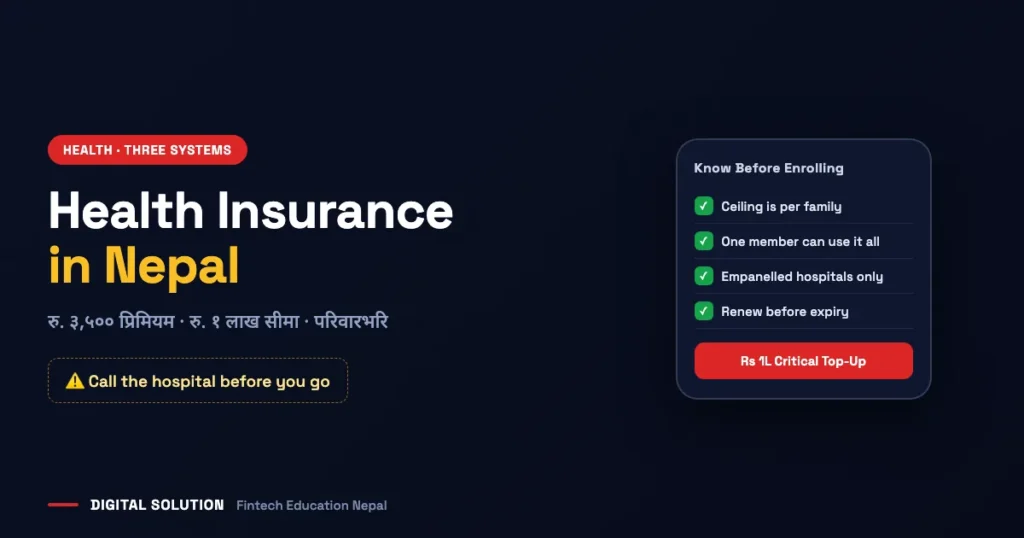
The national programme costs Rs 3,500 a year for a family of up to five, plus Rs 700 per additional member, with a coverage ceiling of Rs 1 lakh rising to Rs 2 lakh for larger families.
Is it mandatory?
Enrolment is legally mandated for some groups such as government and organised-sector employees, but for the general population it operates in practice as voluntary — which is why dropout is the programme’s defining problem.
Is the coverage per person or per family?
Per family. One member can use the whole ceiling.
Who gets free enrolment?
Ultra-poor households, citizens aged 70 and above, severely disabled persons, and people with leprosy, HIV or MDR-TB. Female Community Health Volunteers get 50% off.
Can I use it at any hospital?
Only at empanelled facilities — and because of unpaid arrears, some major hospitals have suspended service to insured patients. Call before you go.
Does SSF replace it?
No. SSF medical benefit is a separate scheme with its own limits, 20% co-payment and its own hospital network.
How do I renew?
Annually before your cycle expires, through your ward enrolment assistant or via Nagarik App, ConnectIPS, eSewa or Khalti. Late renewal attracts a fee.
Is the premium tax deductible?
Health insurance premium is deductible up to Rs 20,000 a year, separately from life insurance.
Sources
- Health Insurance Board published FAQ — premium, coverage ceilings, top-up, free-enrolment categories, enrolment and renewal.
- The Kathmandu Post, 19 February 2026 — arrears, hospital suspensions and the release of funds.
- Peer-reviewed research on district-level dropout and renewal rates.
- Reported figures for the SSF Medical, Health and Maternity Protection Scheme.
Related Reading
- Health insurance vs SSF medical benefits
- SSF medical, health and maternity benefits
- Term life vs endowment in Nepal
Disclaimer: Digital Solution Nepal is an independent educational and digital-service assistance website — not an insurer, not an insurance agent or broker, and not a law firm. We do not sell insurance and receive no commission from any insurer. Policy terms, premiums and regulations differ by company and change over time, and nothing here is financial, legal or insurance advice — your policy document, your insurer and the Nepal Insurance Authority are final.

Rabin Paudel
Rabin Paudel is the Founder of Digital Solution, a Content Creator, and an AI Trainer. He shares practical and easy-to-understand content on Artificial Intelligence, Digital Literacy, Online Services, FinTech, and Technology. His mission is to make technology simple, accessible, and useful for everyone.
View all posts by Rabin Paudel →