
Case study · published August 2026. The arrests described here were made on 6 January 2026 and cases were filed at Kathmandu District Court — this is an account of a concluded police operation, not breaking news. Figures are from Nepal Police Cyber Bureau statements as reported by national media. All accused are presumed innocent until convicted; we name roles and structures rather than individuals.
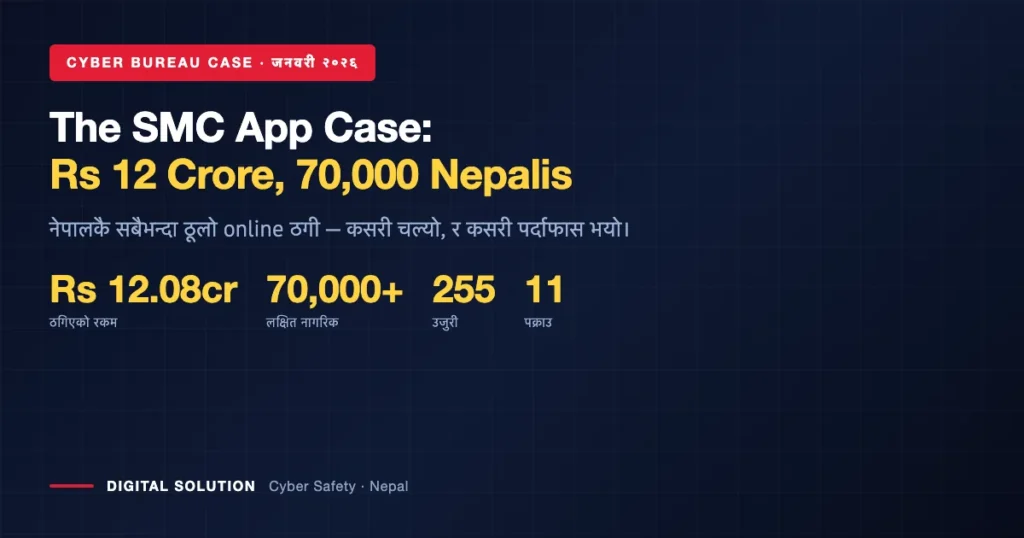
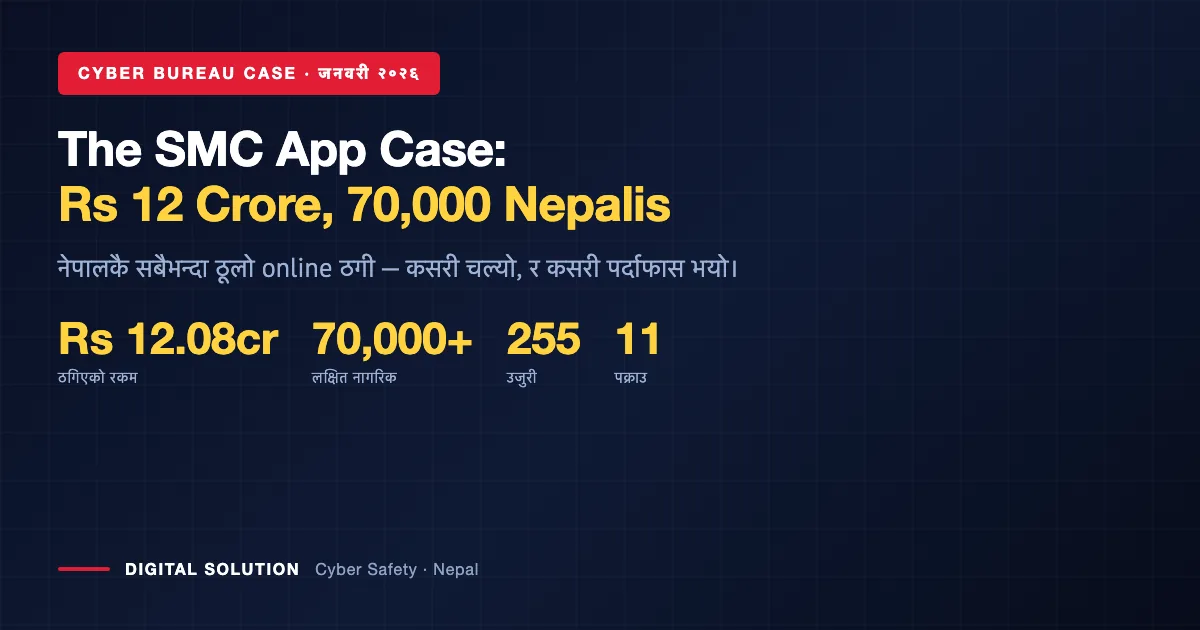
The SMC App scam is the clearest picture Nepal has of how a modern online fraud is built. It reached more than 70,000 people, took over Rs 12.08 crore, generated 255 complaints at the Cyber Bureau, and ended with 11 arrests including a Chinese national. Every element of it is being reused right now under different app names.
This is the anatomy — what was promised, how the money actually moved, and the reason most victims never filed a complaint.
The Case, in Numbers
| What | Detail |
|---|---|
| Amount defrauded | More than Rs 120.81 million (Rs 12.08 crore) |
| People targeted | Over 70,000 |
| Complaints registered at Cyber Bureau | 255 — mostly from Kathmandu Valley |
| Arrested | 11 — one Chinese national and 10 Nepali citizens |
| App availability | Listed on Google Play from March 2025; over 72,000 downloads by August |
| Legal status | Cases filed at Kathmandu District Court |
Cyber Bureau spokesperson SP Deepak Raj Awasti said the investigation began from the 255 registered complaints, with the suspects already under surveillance based on information from the Ministry of Home Affairs and the bureau’s intelligence unit.
What It Promised — and Why It Was Believable
The pitch was designed to sound like legitimate gig work, not investment:
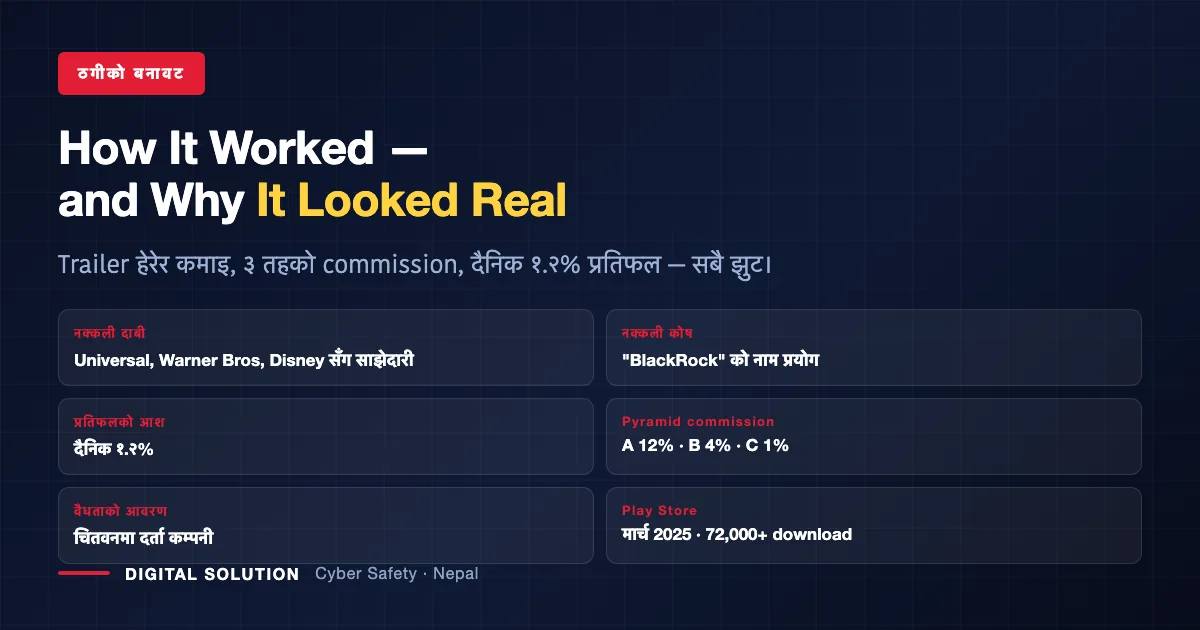
- “Earn by watching movie trailers.” A simple daily task anyone could do — the same shape as the “task earning” apps still circulating.
- Fake partnerships with Universal Pictures, Warner Bros and Disney — global names that made trailer-watching sound commercially real.
- A fictitious investment fund, “BlackRock”, cited to explain where the returns supposedly came from.
- A promised 1.2% daily return. Compounded, that is a mathematical impossibility no legitimate business offers.
- Three-level pyramid commissions — 12% (Level A), 4% (Level B), 1% (Level C) — turning every victim into a recruiter of the next.
The legitimacy trick — and why it must not reassure you. The operators registered a real Nepali company, SMCN Advertising Service Center Pvt Ltd, in Khairahani Municipality-6, Chitwan, in the name of a Nepali associate, purely to project legitimacy. Registering a company in Nepal costs on the order of Rs 8,000–10,000 and proves only that a form was filed. “Company registered छ” is not a safety check — the modality of the business is what matters, and platforms of this type are illegal in Nepal regardless of registration.
Where the Money Actually Went
This is the part most people never understand, and it is what makes these schemes so hard to unwind.
Stage 1 — A small deposit, a small profit
The victim puts in a modest sum, completes tasks, and receives a payout. Trust is established. Crucially, that payout is not the company’s money — it is another victim’s deposit.
Stage 2 — Escalation
Encouraged by the first payout, the victim invests larger amounts — often a lakh, sometimes several — and receives further partial returns designed to keep them committed.
Stage 3 — The wall
At a large balance, withdrawals stop. The account is blocked and the victim is told to pay a “tax” or “fee” to release their funds — which extracts still more money before contact ends.
The money you receive in a scheme like this is not profit. It is another victim’s deposit, routed through your account to keep you believing.
Police said the group used the personal bank accounts of associates to move victims’ money. Alongside that, funds circulated between victims themselves, with money-mule accounts and QR wallets used to cash out — which is why tracing takes months and recovery is rarely complete.
Never rent your bank account or QR — for any commission. “Let me use your account, I will give you Rs 20,000” is how these networks cash out. The account holder becomes the visible link in a criminal money trail, gets frozen and blacklisted, and faces the investigation. The person who offered the commission disappears. No amount is worth that exposure.
Why Most Victims Never Filed a Complaint
Only 255 complaints were registered against a scheme that touched more than 70,000 people. That gap is the most important lesson in the case.
Participants included serving police and army personnel and civil servants. Many did not report — not because they lost nothing, but because they had earned commissions along the way and feared being treated as participants in an illegal activity rather than as victims. Ordinary earners stayed silent for a simpler reason: shame. People blame themselves and conclude that reporting will only expose their own poor judgement.
If this happened to you, go to the Cyber Bureau and tell them exactly what happened — including the part where you earned. Sitting at home, frightened and emotionally frozen, is how a solvable problem becomes a permanent one. Investigations proceed on the facts you give them, and the 255 complaints in this case are precisely what triggered the operation that led to the arrests.
The Signals That Were Visible From Day One
- Easy money for trivial effort. Watching trailers does not generate 1.2% daily.
- Commission for recruiting, in tiers. That is the definition of a pyramid, not a job.
- Borrowed brand names — Disney, Warner Bros, BlackRock — with no verifiable agreement anywhere.
- Urgency and limited-offer framing, plus screenshots of other people’s “earnings” as proof.
- Recruitment through Telegram and WhatsApp groups, often after you left your number somewhere in exchange for something free.
- Withdrawal friction that appears only after a large balance — and a fee demanded to release your own money.
These same six signals apply to every rebranded successor. Our companion guide on how task-earning app scams work covers the pattern in detail, and online job scams in Nepal covers the recruitment side.
Watch: The Full Case Explained, in Nepali
From the Digital Solution YouTube channel — subscribe for more cyber-safety coverage in Nepali.
A note on verifying anyone, including us. Our own business runs online too, and people rightly ask whether we are genuine. That question is the correct instinct. Whoever you are dealing with, pay only into a registered company’s own account — never an individual’s personal account or QR — and confirm the entity is the one you think it is. Fake Facebook pages copying real business names are common, and the money lands in a personal account that nobody can be held to.
Think you have been scammed?
Report it to the Nepal Police Cyber Bureau first. If you need help understanding what happened or preparing your documentation, Digital Solution can guide you — in plain Nepali.
Frequently Asked Questions
What was the SMC App scam?
An online scheme that promised income for watching movie trailers, claiming partnerships with Universal Pictures, Warner Bros and Disney and citing a fictitious “BlackRock” fund. It ran on a pyramid structure with 12%, 4% and 1% commissions across three levels and promised 1.2% daily returns.
How much money was involved and how many people?
According to the Cyber Bureau, more than Rs 120.81 million was taken from over 70,000 targeted people, with 255 complaints registered — mostly from Kathmandu Valley.
Was anyone arrested?
Yes — 11 people were arrested on 6 January 2026, including one Chinese national and 10 Nepali citizens, and cases were filed at Kathmandu District Court. All accused are presumed innocent until proven guilty.
The company was registered in Nepal. Doesn’t that make it legal?
No. The operators registered a company specifically to appear legitimate. Registration only shows that paperwork was filed — it says nothing about whether the business model is lawful, and schemes of this type are illegal in Nepal regardless.
Why did people receive real payouts at first?
Because early payouts came from later victims’ deposits, not from any business activity. That is the defining mechanic of a Ponzi structure — and it is why the payouts stop once deposits slow.
I earned some money from it. Can I still complain?
Yes. Many participants stayed silent because they had earned commissions and feared being seen as complicit. Go to the Cyber Bureau and state exactly what happened — the investigation in this case began from complaints just like that.
Someone offered me commission to use my bank account. Is that safe?
No. Renting out your account or QR makes you the traceable link in the money trail. Your account gets frozen and blacklisted and you face the investigation, while the person who paid you disappears.
Related Reading

Rabin Paudel
Rabin Paudel is the Founder of Digital Solution, a Content Creator, and an AI Trainer. He shares practical and easy-to-understand content on Artificial Intelligence, Digital Literacy, Online Services, FinTech, and Technology. His mission is to make technology simple, accessible, and useful for everyone.
View all posts by Rabin Paudel →