
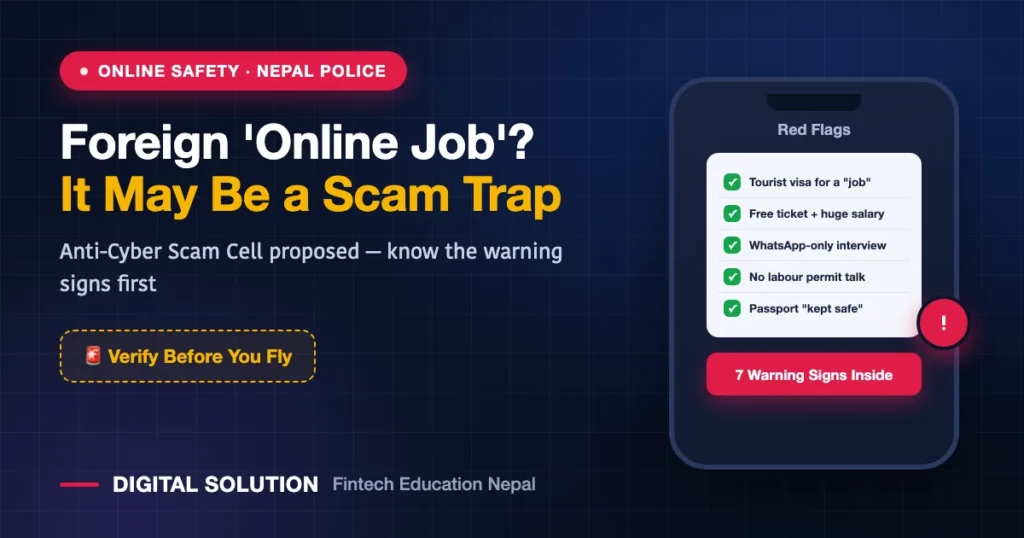
Last updated: July 2026 (Shrawan 2083). The Anti-Cyber Scam Cell is at the proposal stage — not yet operational, and no new reporting channel has opened. Current reporting runs through the existing Cyber Bureau (details below).
A “high-salary computer job” abroad, found through a Facebook ad, interviewed over WhatsApp, free ticket included — for a growing number of Nepali youth, that offer hasn’t led to a job. It has led to a locked compound in Southeast Asia, a seized passport, and forced work running online scams against other victims. Nepal Police has now formally acknowledged the threat: Inspector General Dan Bahadur Karki announced on July 28, 2026 that a dedicated “Anti-Cyber Scam Cell” is being proposed under the Cyber Bureau. Here’s what that means — and the 7 warning signs that an online job offer is actually a trafficking trap.
What Nepal Police Announced
- A proposal to establish a dedicated Anti-Cyber Scam Cell under the Cyber Bureau, announced by IGP Dan Bahadur Karki on July 28, 2026.
- The stated reason: rising cases of Nepalis being lured abroad through online advertisements and digital contacts with attractive foreign-job promises — then held captive and forced to run online scams.
- Nepali media reporting frames the unit as a response to “new forms of human trafficking” — what international agencies call cyber slavery and forced criminality.
- Honest status check: this is a proposal. The cell is not yet operational and no separate reporting channel exists. Today’s reporting still runs through the Cyber Bureau’s existing channel.
Why This Is Bigger Than “Online Fraud”
This announcement marks a shift: Nepal Police treating online job scams not as simple ठगी (fraud) but as the entry point to human trafficking, forced criminality and transnational cybercrime. The United Nations made the same call — the 2026 World Day Against Trafficking in Persons theme is “Trapped behind the scam,” naming forced online scamming as one of the fastest-growing trafficking risks globally. The victims are doubly trapped: trafficked themselves, then forced to scam others — often fellow Nepalis — in fake investment, romance and banking schemes.
The Trap, Step by Step
The pattern police and media reports describe follows a script. Recognize the script and you recognize the trap:
| Stage | What Happens | What It Really Means |
|---|---|---|
| 1. The ad | Facebook/TikTok post: “computer operator,” “online marketing,” “customer support,” “casino support,” “data entry” — Cambodia, Myanmar, Laos, Thailand, Dubai | Vague digital-sounding roles = deliberately genericized bait |
| 2. The interview | WhatsApp/Telegram chat, maybe a hotel meeting — no office, no company verification | No verifiable footprint is the point |
| 3. The travel | Free ticket, tourist visa, sometimes via India or a third country | A real employer arranges a work visa; a trafficker avoids the paper trail |
| 4. The arrival | Passport taken “for safekeeping/registration” | The moment control transfers — this is captivity |
| 5. The “job” | Scam scripts, fake trading apps, romance chats — with quotas and punishments | Forced criminality; victims are made offenders |
The 7 Warning Signs: Don’t Board That Flight
1. The salary doesn’t match the skill
$1,500–3,000/month for basic typing or chat work, no experience needed? Real employers pay market rates. Absurd pay for trivial skills is bait, not luck.
2. Tourist visa “for now”
The single loudest alarm. Legitimate foreign employment runs on a work visa and श्रम स्वीकृति (labour permit). “Go on a tourist visa, we’ll fix papers there” is the trafficker’s signature move — it strands you with no legal work status.
3. No labour permit, no DoFE trail
If the recruiter never mentions labour approval, the Department of Foreign Employment (DoFE) process, or a licensed recruitment agency — the job doesn’t exist in any system that can protect you.
4. Free everything, urgent timeline
Free ticket, free visa, free hotel — plus “seats are limited, decide today.” Costs recruiters happily eat are costs they expect to recover from your captivity. Urgency exists to stop you verifying.
5. Interviews only on WhatsApp/Telegram, or in a hotel lobby
No company domain email, no video call to an actual office, no registered local agent. A hotel “interview” with a stranger is a handoff, not hiring.
6. The company can’t be verified
Search the company name + “scam.” Check for a real website, registration, physical address in the destination country. Traffickers borrow real-sounding names precisely because nobody checks.
7. Vague job, changing details
The role, the city, even the country shifts between conversations (“actually the office moved to the border area”). Legitimate offers are boringly consistent. Border-area compounds in Myanmar/Cambodia are where the scam centers physically operate.
Before Any Foreign Job: The Non-Negotiable Checklist
- Licensed recruitment agency? Verify the agency’s license with DoFE — unlicensed “agents” have no accountability.
- श्रम स्वीकृति (labour permit) processed through official channels — it also connects you to protections like SSF’s foreign-employment scheme.
- Written contract — role, salary, hours, employer name — before travel, in a language you understand.
- Work visa in your passport for the destination country. Not promised. In the passport.
- Employer verification — registered company, real address, checkable phone. Ask the embassy of the destination country if unsure.
- Family knows everything — employer name, address, agent’s details, flight info. Captivity thrives on families knowing nothing.
If You or Someone You Know Is Already Trapped
- From Nepal (family): report immediately to the Cyber Bureau’s online reporting channel and local police — with every detail: ads, chat screenshots, agent numbers, employer names, flight dates. Details are what rescues run on.
- From abroad (victim): when safe, contact the nearest Nepali embassy/consulate — embassies coordinate rescues from scam compounds; keep any accessible ID copies and location details.
- Money already extracted from relatives (“release fee” demands are part of the scheme): treat it as active extortion — police first, and see our online fraud recovery guide for the financial trail.
- Remember: forced-scam victims are recognized as trafficking victims — reporting protects, not incriminates. That’s precisely the shift the proposed Anti-Cyber Scam Cell represents, and the same enforcement wave behind Nepal’s mass betting-site blocking and betting-network arrests.
FAQ
What is Nepal Police’s Anti-Cyber Scam Cell?
A proposed dedicated unit under the Cyber Bureau, announced by the IGP on July 28, 2026, to tackle online-scam networks and the trafficking of Nepalis into forced scamming. It is at the proposal stage — not yet operational.
Where do I report an online scam in Nepal right now?
Through the Cyber Bureau’s existing channel at cyberbureau.nepalpolice.gov.np (online reporting available) or your nearest police office. No new separate channel exists yet.
Are online jobs in Cambodia, Myanmar or Laos always scams?
Not always — but vague digital roles offered to Nepalis on tourist visas via social-media ads carry extreme documented risk in exactly these countries. Apply the checklist above ruthlessly; if it fails a single non-negotiable, don’t go.
The recruiter showed a real company’s name and website. Safe?
Not by itself — traffickers routinely borrow legitimate company names. Verify that this recruiter actually represents that company via the company’s official contact channels, never through links the recruiter provides.
What if I already paid money to a recruiter?
Stop all further payment, preserve every receipt and chat, and report — DoFE handles foreign-employment fraud by agents, and the fraud recovery guide covers the money trail.
🤝 Got a foreign job offer you’re unsure about?
Send us the details before you decide — Digital Solution will help you run the verification checklist. Five minutes of checking beats years of regret.
Disclaimer: Digital Solution Nepal is an independent educational website, not a government body. The Anti-Cyber Scam Cell is a proposal whose final form may differ; for emergencies and reporting, Nepal Police, the Cyber Bureau and Nepali embassies are the authorities. This article is safety information, not legal advice.

Rabin Paudel
Rabin Paudel is the Founder of Digital Solution, a Content Creator, and an AI Trainer. He shares practical and easy-to-understand content on Artificial Intelligence, Digital Literacy, Online Services, FinTech, and Technology. His mission is to make technology simple, accessible, and useful for everyone.
View all posts by Rabin Paudel →