
As of 13 October 2026 (27 Asoj 2083). Every rate and discount on this page is from Schedule 1 of the province’s own Finance Act for 2083, as published by its finance ministry. Sudurpashchim’s figures are from its Finance Bill, the only text its ministry had published. The examples are our arithmetic.
The land registration fee in Nepal is set by each province, so the same purchase costs a different amount in Kathmandu, in Pokhara and in a hill village. For fiscal year 2083/84 a sale deed is charged between 2% and 5.3% of the deed value. The rate depends on the province and on whether the property is in a metropolitan city, a sub-metropolitan city, a municipality or a rural municipality.
All seven provinces take 25% off the fee when the property is registered in a woman’s name. A gift within the family and a partition between heirs are charged far less than a sale. A gift to someone outside the family is charged far more.
This page puts the seven schedules side by side, then sets out the Gandaki schedule in more detail. The fee is paid when the deed is passed at the land administration office, which most people still call Malpot (मालपोत).
Quick answers
| Question | Answer for 2083/84 |
|---|---|
| Who sets the fee | Each province, in its Finance Act |
| Highest rate on a sale | 5.3%, metropolitan cities in the Kathmandu Valley |
| Lowest rate on a sale | 2%, rural municipalities in Gandaki and Lumbini |
| Pokhara, Biratnagar and Birgunj | 5% |
| Bought in a woman’s name | 25% off the registration fee in all seven provinces |
| Single woman | 35% off in Madhesh, Bagmati, Gandaki, Lumbini and Sudurpashchim |
| Making a spouse’s property joint | A flat Rs 100 to Rs 2,000, by province |
| Gift outside three generations | 10% to 15.3% |
Registration fee on a sale, province by province
A sale deed is called rajinama (राजीनामा). In every schedule the same rate applies to an exchange deed and to a deed creating joint ownership. The percentage is charged on the value written in the deed, called the thaili anka (थैली अङ्क).
| Province | Metropolitan city | Sub-metropolitan city | Municipality | Rural municipality |
|---|---|---|---|---|
| Koshi | 5% | 4.5% | 4% | 2.5% |
| Madhesh | 5% | 4.5% | 4% | 2.5% |
| Bagmati, Kathmandu Valley | 5.3% | No column | 4.8% | 3% |
| Bagmati, outside the Valley | 5.15% | 4.65% | 4.5% | 3% |
| Gandaki | 5% | No column | 4% | 2% |
| Lumbini | No column | 4.5% | 4% | 2% |
| Karnali | No column | No column | 5% | 2.5% |
| Sudurpashchim | No column | 5% | 4.5% | 2.5% |
“No column” means the province’s schedule has no such column.
Three notes on reading the table:
- Bagmati has six columns. It separates metropolitan cities and municipalities inside the Kathmandu Valley from those outside it. Rural municipalities are 3% across the province.
- Lumbini’s municipality rate also covers the Rapti Valley (Deukhuri) area. The schedule defines it as the Rapti Rural Municipality area of Dang and wards 1, 2 and 3 of Gadhawa Rural Municipality.
- Karnali has two columns only, municipality and rural municipality.
The schedules name types of local level, not cities. As a guide, Nepal’s six metropolitan cities are Kathmandu and Lalitpur in the Kathmandu Valley, Bharatpur, Pokhara, Biratnagar and Birgunj. Check the type of your own local level before you use the table.
Worked examples on a Rs 50 lakh purchase
These are our own sums from the rates above, for a sale deed with a value of Rs 50,00,000.
| Where the property is | Rate | Fee | In a woman’s name |
|---|---|---|---|
| Kathmandu or Lalitpur metropolitan city | 5.3% | Rs 2,65,000 | Rs 1,98,750 |
| Bharatpur | 5.15% | Rs 2,57,500 | Rs 1,93,125 |
| Pokhara, Biratnagar or Birgunj | 5% | Rs 2,50,000 | Rs 1,87,500 |
| A municipality in Karnali | 5% | Rs 2,50,000 | Rs 1,87,500 |
| A municipality in the Kathmandu Valley | 4.8% | Rs 2,40,000 | Rs 1,80,000 |
| A municipality in Koshi, Madhesh, Gandaki or Lumbini | 4% | Rs 2,00,000 | Rs 1,50,000 |
| A rural municipality in Bagmati | 3% | Rs 1,50,000 | Rs 97,500 |
| A rural municipality in Gandaki or Lumbini | 2% | Rs 1,00,000 | Rs 75,000 |
The last column takes 25% off. The Bagmati rural row takes 35% off, because Bagmati gives that higher discount on land in a rural municipality registered in a woman’s name.
Service fees are charged separately, and the seller’s tax on any gain is a separate federal matter. Neither is included in these sums.
Apartments and houses in a housing scheme
Most provinces charge less for an apartment unit built under a collective housing scheme (सामूहिक आवास योजना) than for an ordinary sale.
| Province | Metropolitan city | Sub-metropolitan city | Municipality | Rural municipality |
|---|---|---|---|---|
| Koshi | 4% | 3.5% | 3% | 1% |
| Madhesh | 4% | 3% | 2% | 1% |
| Bagmati | 5.3% in the Valley, 5.15% outside | 4.65% | 4.8% in the Valley, 4.5% outside | 3% |
| Gandaki | 4% | No column | 2% | 1% |
| Lumbini | No column | 3% | 2% | 1% |
| Karnali | No column | No column | 2% | 1% |
| Sudurpashchim | No column | 2.5% | 2% | 1.5% |
In Bagmati’s schedule an apartment is charged the same as any other sale.
A house sold with its land under a collective housing scheme is a separate line:
| Province | Metropolitan city | Sub-metropolitan city | Municipality | Rural municipality |
|---|---|---|---|---|
| Koshi | 4% | 3.5% | 3% | 1.5% |
| Madhesh | 5% | 4.5% | 4% | 2.5% |
| Bagmati | Same as a sale | Same as a sale | Same as a sale | 3% |
| Gandaki | 5% | No column | 4% | 2% |
| Lumbini | No column | 4.5% | 4% | 2% |
| Karnali | No column | No column | 4% | 2% |
| Sudurpashchim | No column | 4% | 3% | 1.5% |
Discounts for women, senior citizens and couples
Every schedule gives 25% off the registration fee when ownership passes to a woman or to a senior citizen above 70. The details differ.
| Province | Women and senior citizens above 70 | Single women | Deed in the joint names of husband and wife | Making a spouse’s property joint |
|---|---|---|---|---|
| Koshi | 25%. Also sexual minorities and minors with no parents | Not found | Not found | Rs 1,500 |
| Madhesh | 25%. Also minors | 35% | Same as for women | Rs 500 |
| Bagmati | 25%. Also minors with no parents | 35% | Same as for women | Rs 500 |
| Gandaki | 25% | 35%. Also minors with no parents | Same as for women | Rs 2,000 |
| Lumbini | 25%. Also minors with no parents | 35% | Same as for women | Rs 100 |
| Karnali | 25%. Also minors with no parents | Not found | 25% | Rs 200 |
| Sudurpashchim | 25%. Also minors with no parents | 35% | Same as for women | Rs 100 |
“Not found” means we read that province’s notes to Schedule 1 and did not find the provision.
The last column is the cheapest transaction in any schedule. Where a house or land is already in the husband’s or the wife’s name and the couple want joint ownership, the deed is charged a flat registration fee, not a percentage.
Three more points from the notes:
- Bagmati gives 35% on land in a rural municipality registered in a woman’s name.
- Gandaki’s discount for women and senior citizens does not apply to partition deeds, to deeds settling or giving up a share, or to a transfer of title by record.
- One discount only. Koshi, Madhesh, Bagmati, Lumbini, Karnali and Sudurpashchim say that a person who qualifies on more than one ground gets the single largest discount. In Gandaki, ask the office how the discounts combine.
Other discounts and waivers
| Province | Persons with disabilities, Dalit and backward or marginalised communities | Landless, freed Kamaiya and freed Haliya families |
|---|---|---|
| Koshi | Disability class ka 100%, class kha 50%, class ga 25%. Dalit and backward communities 25% | Not found |
| Madhesh | 25%, with a self-declaration that it is the first time | Full waiver |
| Bagmati | 25% | Full waiver |
| Gandaki | 25%, once only, on a deed value up to Rs 30 lakh | Full waiver |
| Lumbini | 50% for disability classes ka and kha, sexual and gender minorities, Dalit and backward communities | Full waiver |
| Karnali | 25% | Full waiver |
| Sudurpashchim | 25%, once only | 75% |
These discounts need the local level’s recommendation or another official proof. Where the schedule gives a full waiver to landless and freed families, it is for land bought with a concessional loan and grant.
All seven texts waive every fee on a deed that passes ownership to the dependants of martyrs, with the identity document or the local level’s recommendation.
Two provisions are worth knowing if they fit your case.
- Land bought with remittance. Koshi, Madhesh, Lumbini and Karnali give 25% off the registration fee on land bought with remittance from foreign employment that came through the banking system, on the bank’s certified papers. The land has to be bought in the name of the undivided family (एकासगोल परिवार).
- Koshi’s waiver outside the Terai districts. Note 24 of Koshi’s schedule waives the registration fee in full when a person, firm or company from the Terai, Inner Madhesh or another province buys land with a house for housing, farming or industry in the province’s other districts. It excludes Jhapa, Morang and Sunsari, four municipalities of Udayapur and the local level that holds a district headquarters. If the property changes hands within ten years, the waived fee is recovered first. Ask the office how it applies this note before you rely on it.
Every schedule also carries discounts for industries, collective farming and cooperatives. They are outside the scope of this page.
A false declaration to claim a discount is costly. The Madhesh, Gandaki and Sudurpashchim texts provide for recovery of the discount with a fine of the same amount.
Gifts within the family
A gift between close relatives is called halaiko bakaspatra (हालैको बकसपत्र). The table shows the rate on a deed value above Rs 1 lakh.
| Province | Metropolitan city | Sub-metropolitan city | Municipality | Rural municipality |
|---|---|---|---|---|
| Koshi | 2.5% | 2% | 2% | 1% |
| Madhesh | 2.5% | 2% | 2% | 1% |
| Bagmati, Kathmandu Valley | 2.8% | No column | 2.3% | 1% |
| Bagmati, outside the Valley | 2.65% | 2.15% | 2% | 1% |
| Gandaki, up to Rs 5 lakh | 2.5% | No column | 2% | 1% |
| Gandaki, above Rs 5 lakh | 3% | No column | 2.5% | 1.5% |
| Lumbini | No column | 2% | 2% | 1% |
| Karnali, up to Rs 10 lakh | No column | No column | 2.5% | 1.25% |
| Karnali, above Rs 10 lakh | No column | No column | 3% | 1.5% |
| Sudurpashchim | No column | 2.5% | 2.25% | 1.5% |
On a deed value up to Rs 1 lakh every province charges less, from 0.5% to 2.3%.
Each schedule defines “three generations” with a long list of relatives. Gandaki’s covers grandparents, parents, husband and wife, brothers and their wives, sisters, sons and their wives, daughters, parents-in-law, a husband’s brothers and their wives, nephews and nieces, grandchildren and paternal uncles and aunts, and it treats an adopted child as one’s own. The other schedules use very similar lists, so read your own province’s list before you rely on it.
A gift or donation to someone outside that circle is charged far more than a sale.
| Province | Gift outside three generations |
|---|---|
| Koshi | 15% everywhere |
| Madhesh | 15%, and 10% in rural municipalities |
| Bagmati | 15.3% in the Kathmandu Valley, 15.15% in the metropolitan city outside it and in sub-metropolitan cities, 15% in municipalities outside the Valley, 10% in rural municipalities |
| Gandaki | 15%, and 10% in rural municipalities |
| Lumbini | 15%, and 10% in rural municipalities |
| Karnali | 15%, and 10% in rural municipalities |
| Sudurpashchim | 15% everywhere |
Partition between heirs
A partition deed is called anshabanda (अंशबण्डा). Except in Madhesh, the rate does not change with the type of local level.
| Province | Rate by deed value |
|---|---|
| Koshi | Up to Rs 30 lakh 0.3%. Above Rs 30 lakh up to Rs 2 crore 0.4%. Above Rs 2 crore 0.5% |
| Madhesh | Up to Rs 30 lakh 0.3% in a metropolitan city, 0.2% elsewhere. Above Rs 30 lakh up to Rs 2 crore 0.4% in a metropolitan city, 0.3% elsewhere. Above Rs 2 crore 0.5% |
| Bagmati | Up to Rs 50 lakh 0.3%. Above Rs 50 lakh up to Rs 3 crore 0.4%. Above Rs 3 crore 0.5% |
| Gandaki | Up to Rs 10 lakh 0.2%. Rs 10 lakh to Rs 30 lakh 0.5%. Above Rs 30 lakh up to Rs 1 crore 0.75%. Above Rs 1 crore up to Rs 2 crore 1%. Above Rs 2 crore up to Rs 5 crore 1.25%. Above Rs 5 crore 1.5% |
| Lumbini | Up to Rs 30 lakh 0.2%. Above Rs 30 lakh up to Rs 2 crore 0.5%. Above Rs 2 crore 1% |
| Karnali | Up to Rs 30 lakh 0.2%. Above Rs 30 lakh up to Rs 2 crore 0.3%. Above Rs 2 crore 0.5% |
| Sudurpashchim | Up to Rs 30 lakh 0.25%. Above Rs 30 lakh up to Rs 2 crore 0.5%. Above Rs 2 crore up to Rs 10 crore 0.65%. Above Rs 10 crore 0.75% |
The payment must go through a bank
Every schedule sets a rule on how the buyer pays the seller.
| Province | Payment by a banking instrument | Proof the office must see before it passes the deed |
|---|---|---|
| Koshi | Rs 5 lakh to Rs 50 lakh | Above Rs 50 lakh |
| Madhesh | Not stated separately | Rs 10 lakh and above in one transaction |
| Bagmati | Rs 5 lakh to Rs 50 lakh | Above Rs 50 lakh |
| Gandaki | Rs 10 lakh to Rs 50 lakh | Above Rs 50 lakh |
| Lumbini | Rs 10 lakh to Rs 50 lakh | Above Rs 50 lakh |
| Karnali | Rs 10 lakh to Rs 50 lakh | Above Rs 50 lakh |
| Sudurpashchim | Rs 10 lakh to Rs 50 lakh | Above Rs 50 lakh |
The proof is a copy of a cheque stamped good for payment, or a copy of the bank voucher showing the amount deposited in the seller’s account. Koshi, Bagmati, Lumbini, Karnali and Sudurpashchim also name a bank guarantee and e-payment.
Plan the payment before the day at the office. Daily limits on apps and wallets are far below these amounts, as our guide to mobile banking transaction limits shows, so a property payment is normally a cheque or a counter transfer.
Two rules that apply almost everywhere
- No lower value than last time. Koshi, Bagmati, Gandaki, Lumbini, Karnali and Sudurpashchim say a deed cannot be passed at a value lower than the one at which the property was last transacted.
- Passing a deed outside the district. Bagmati, Gandaki, Lumbini, Karnali and Sudurpashchim charge an extra 10% of the registration fee, service fee or hold fee when a deed is passed at an office outside the district where the property lies.
Gandaki Province in more detail
Pokhara is Gandaki’s metropolitan city, so a purchase there is charged 5%. The Gandaki schedule has three columns: metropolitan city, municipality and rural municipality.
The 50% discount in eight rural municipalities
Gandaki’s schedule gives 50% off in Narpabhumi, Nason and Manang Ngisyang in Manang, Thasang, Lo-Ghekar Damodarkunda, Lomanthang and Baragung Muktikshetra in Mustang, and Chumnubri in Gorkha. It appears in the same note as the discount for women and senior citizens, so ask the office whom it covers.
Household records and other deeds
Separating a household in the record costs Rs 15,000, Rs 10,000 or Rs 5,000 a deed by type of local level. Joining one costs Rs 25,000, Rs 15,000 or Rs 10,000.
| Deed | Metropolitan city | Municipality | Rural municipality |
|---|---|---|---|
| Power of attorney, consent deed, authorisation or will | Rs 5,000 | Rs 4,000 | Rs 3,000 |
| House rent deed, on the first month’s rent | 5% | 4% | 2% |
| Mortgage between individuals, up to Rs 30 lakh | 1% | 1% | 1% |
| Mortgage between individuals, on the amount above Rs 30 lakh | 1.5% | 1.5% | 1.5% |
| Any other deed stating an amount | 4% | 3% | 2% |
Mortgage deed for a bank loan
When a bank, financial institution or cooperative takes your property as security, the deed carries a service fee by loan amount. In Gandaki it is the same in every kind of local level.
| Loan amount in the deed | Service fee |
|---|---|
| Up to Rs 1 lakh | Rs 1,000 |
| Above Rs 1 lakh up to Rs 5 lakh | Rs 1,500 |
| Above Rs 5 lakh up to Rs 10 lakh | Rs 2,500 |
| Above Rs 10 lakh up to Rs 20 lakh | Rs 3,000 |
| Above Rs 20 lakh up to Rs 50 lakh | Rs 10,000 |
| Above Rs 50 lakh up to Rs 1 crore | Rs 30,000 |
| Above Rs 1 crore up to Rs 2 crore | Rs 50,000 |
Larger loans continue on the same scale in the schedule. The other provinces set their own service fees. If you are preparing loan papers, our guide to the bank statement and balance certificate covers what banks issue.
In Gandaki, partition deeds are passed only at a Land Revenue Office where the property is.
What this page does not cover
- The seller’s tax on the gain. That is a federal tax under the Income Tax Act and is not in any province’s schedule. Our article on income tax rates for 2083/84 covers individual rates only.
- Service fees and hold fees outside Gandaki. Each province prints its own table.
- The office’s minimum valuation for your plot. Ask the Land Revenue Office for the current figure.
- The deed writer’s charge. That is a private fee, not a government one.
Need documents ready before you go to Malpot?
We help with applications, scans, photocopies and forms. मालपोत जानु अघि कागजात तयार गर्न सम्पर्क गर्नुहोस्।
Frequently asked questions
What is the land registration fee in Nepal for 2083/84?
It depends on the province and the type of local level. A sale deed is charged from 2% of the deed value in rural municipalities of Gandaki and Lumbini to 5.3% in metropolitan cities of the Kathmandu Valley.
What is the registration fee for land in Kathmandu?
5.3% of the deed value in Kathmandu and Lalitpur metropolitan cities, and 4.8% in the municipalities of the Kathmandu Valley, under Bagmati’s Finance Act.
What is the registration fee for land in Pokhara?
5% of the deed value for a sale, because Pokhara is a metropolitan city. An apartment unit in a collective housing scheme is 4%.
How much discount do women get on land registration?
25% of the registration fee in all seven provinces. A single woman gets 35% in Madhesh, Bagmati, Gandaki, Lumbini and Sudurpashchim.
Is there a discount if husband and wife buy together?
A deed in the joint names of husband and wife gets the same discount as for a woman in Madhesh, Bagmati, Gandaki, Lumbini and Sudurpashchim, and 25% in Karnali. We did not find the provision in Koshi’s schedule.
What is the fee to add my spouse’s name to my property?
A flat registration fee: Rs 100 in Lumbini and Sudurpashchim, Rs 200 in Karnali, Rs 500 in Madhesh and Bagmati, Rs 1,500 in Koshi and Rs 2,000 in Gandaki.
Which province has the lowest land registration fee?
For a sale in a rural municipality, Gandaki and Lumbini at 2%. For a sale in a municipality, Koshi, Madhesh, Gandaki and Lumbini at 4%.
Conclusion
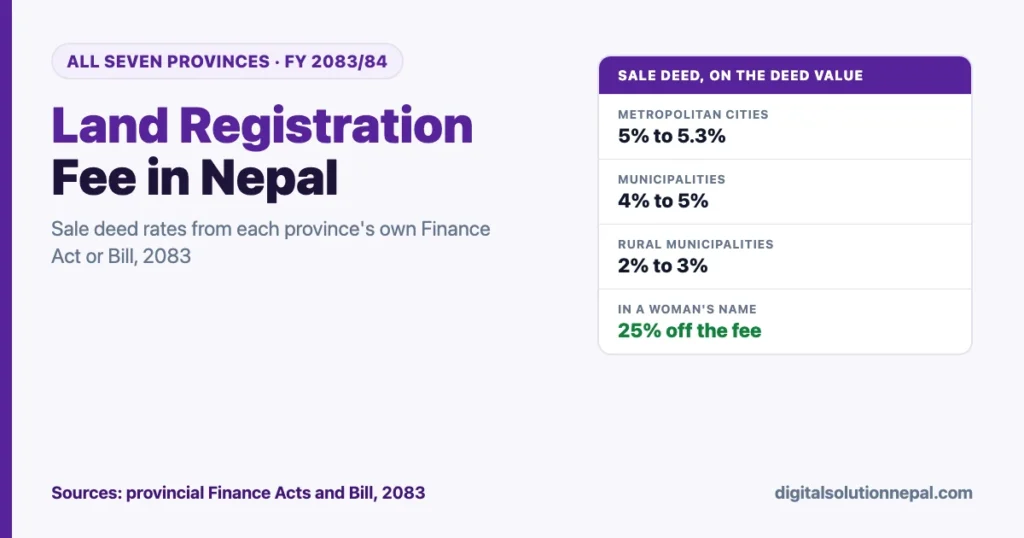
The land registration fee in Nepal for 2083/84 runs from 2% to 5.3% of the deed value on a sale. Metropolitan cities are at 5% to 5.3%, municipalities at 4% to 5% and rural municipalities at 2% to 3%. Every province takes 25% off when the property goes in a woman’s name.
Work out the fee from the deed value before you agree the price, arrange the payment through a bank, and ask the Land Revenue Office about the minimum valuation and any discount you may qualify for.
Sources
- Koshi Province Government, Koshi Province Finance Act, 2083, Province Gazette, 30 Ashadh 2083, Schedule 1. Ministry of Economic Affairs and Planning: https://moeap.koshi.gov.np/content/327/koshi-province-economic-act–2083/
- Madhesh Province Government, Madhesh Province Finance Act, 2083, Province Gazette, 32 Ashadh 2083, Schedule 1. Ministry of Finance: https://mof.madhesh.gov.np/content/85/madhesh-province-economic-act–2083/
- Bagmati Province Government, Province Finance Act, 2083, certified 31 Ashadh 2083, section 16 and Schedule 1. Ministry of Economic Affairs and Planning: https://moeap.bagamati.gov.np/content/13440/state-economic-bill–2083/
- Gandaki Province Government, Gandaki Province Finance Act, 2083, Province Gazette, 26 Ashadh 2083, section 2 and Schedule 1. Ministry of Economic Affairs: https://mof.gandaki.gov.np/list/act-rules/economic-act-2083
- Lumbini Province Government, Province Finance Act, 2083, Schedule 1. Ministry of Economic Affairs and Planning: https://moeap.lumbini.gov.np/publications/155
- Karnali Province Government, Karnali Province Finance Act, 2083, Province Gazette, 31 Ashadh 2083, Schedule 1. Ministry of Economic Affairs and Planning: https://moeap.karnali.gov.np/content/22/karnali-province-economic-act–2083/
- Sudurpashchim Province Government, Finance Bill for fiscal year 2083/84, Schedule 1. Ministry of Economic Affairs: https://moea.sudurpashchim.gov.np/content/12621/economic-bill-for-the-financial-year-2083-84/
Digital Solution Pvt. Ltd. is an independent publisher and is not affiliated with any Land Revenue Office. Rates are translated from the Nepali text of each Act or Bill; the examples are our own arithmetic. Sudurpashchim’s figures are from a Bill and may differ from the Act as passed. This page is general information, not legal advice. Confirm the amount with the Land Revenue Office before you sign.

Rabin Paudel
Rabin Paudel is the Founder of Digital Solution, a Content Creator, and an AI Trainer. He shares practical and easy-to-understand content on Artificial Intelligence, Digital Literacy, Online Services, FinTech, and Technology. His mission is to make technology simple, accessible, and useful for everyone.
View all posts by Rabin Paudel →