
Updated August 2026. The minimum investment threshold below is confirmed and current. Repatriation rules changed significantly in late 2025 and again in the FY 2083/84 budget — verify the implementing bylaw before relying on the newest position.
Nepal has quietly become far more open to foreign investment than most people realise. In January 2026 the ceiling on the automatic route was abolished entirely — and in the review period that followed, most foreign-investment registrations came through it rather than through approval.
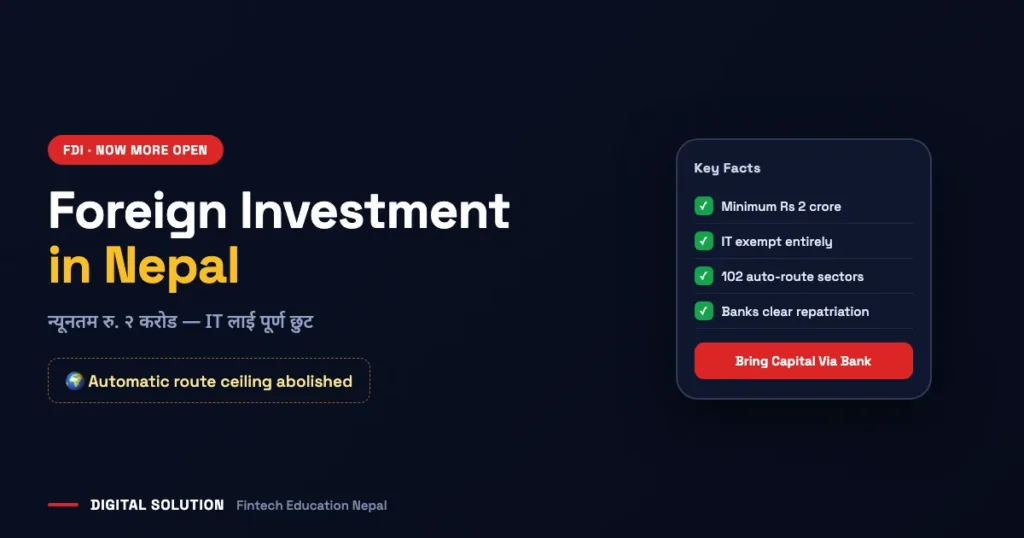
The Minimum Investment: Rs 2 Crore
The Automatic Route — the Big 2026 Change
A Cabinet decision of 22 January 2026, implemented by Gazette notice, expanded the automatic route to 102 business sectors across seven areas — energy, agriculture and forest-based industries, infrastructure, tourism, information technology, service industries and manufacturing — and removed the previous ceiling that capped the route at Rs 50 crore.
Who Approves What
| Investment size | Approving body |
|---|---|
| Below NPR 6 billion | Department of Industry |
| NPR 6 billion and above, or energy projects of 200 MW or more | Investment Board Nepal, chaired by the Prime Minister |
The Rs 6 billion split is consistently reported but we did not see it in a primary instrument — confirm if your investment is near that line.
The Process
- Approval from the Department of Industry — or automatic-route registration if your sector qualifies.
- Incorporate the company at the Office of the Company Registrar. Note that registration with the Department must follow within 35 days of investment approval.
- Tax registration with the Inland Revenue Department.
- Open the bank account and bring capital in through banking channels. This matters enormously for repatriation later.
- Record the investment with Nepal Rastra Bank.
- Visa arrangements for the investor and representatives.
Getting Your Money Out
🤝 Planning foreign investment into Nepal?
Tell us the sector and rough investment size. Digital Solution will help you understand whether the automatic route applies, which office approves, and what to get right at the start so repatriation is straightforward later.
The Negative List
Some sectors are closed to foreign investment outright:
Agriculture and small industry
Primary agriculture — poultry, animal husbandry, fisheries, beekeeping, fruits, vegetables, oil seeds, pulses, dairy — and small and cottage industries.
Personal services and retail
Hair cutting, tailoring, driving; retail trade, local courier, local catering, money changing and remittance services.
Tourism services
Travel agencies, tour guides, trekking and mountaineering guides, homestay and rural tourism.
Media and professional services
Mass media in the national language, domestic motion pictures; management, accountancy, engineering and legal consultancy; language, music and computer training.
Also closed: arms, ammunition, explosives, weapons of mass destruction, radioactive materials and atomic energy; and real estate trading — though construction industries are not caught by that ban.
Sectors with an equity cap
| Sector | Maximum foreign equity |
|---|---|
| Consultancy services | 51% |
| Ride-sharing | 70% |
| International air service | 80% |
| Domestic air service | 49% |
| Aviation training and maintenance | 95% |
Visas
A business visa is available for foreign investors and their families. A residential visa is reported where a single investment of USD 1 million or more is made, covering the investor, an authorised representative and family. Nepal tightened business-visa rules in late 2022 to curb misuse, so expect the documentation to be taken seriously.
Frequently Asked Questions
What is the minimum foreign investment in Nepal?
NPR 20,000,000 — two crore — per foreign investor, in place since November 2022 and current for FY 2083/84.
Is there an exemption for IT?
Yes. A listed set of IT industries is exempt from the minimum threshold entirely.
What is the automatic route?
Registration without prior approval in 102 listed sectors. The previous Rs 50 crore ceiling on it was abolished in January 2026.
Who approves foreign investment?
The Department of Industry below NPR 6 billion; Investment Board Nepal at and above that, or for energy projects of 200 MW or more.
Can I repatriate profits?
Yes. Commercial banks can now approve repatriation directly within 15 working days on a complete application, though central-bank approval is still needed to repatriate to a country other than the investment source.
Which sectors are closed?
Primary agriculture, small and cottage industries, personal services, retail, remittance, travel and trekking services, mass media in the national language, and several professional consultancies, among others.
How long does registration take?
Not published reliably. A three-month end-to-end target was announced in the FY 2083/84 budget but we could not verify implementation.
Can I get a residential visa?
Reported for a single investment of USD 1 million or more, covering the investor, a representative and family.
Sources
- Cabinet decision of October 2022, Gazette-notified, setting the minimum foreign investment at NPR 20 million.
- Ministry notice of 2080/06/15 BS exempting listed IT industries from the minimum threshold.
- Reporting on the Cabinet decision of 22 January 2026 expanding the automatic route to 102 sectors and abolishing its ceiling.
- Foreign Investment and Technology Transfer Act 2075 and its negative-list schedule, as described in published legal guidance.
- Reporting on the amendment to Nepal Rastra Bank’s foreign investment and foreign loan management bylaws.
Related Reading
- Private limited company registration
- Receiving international payments in Nepal
- Foreign currency accounts
- Company annual compliance
Disclaimer: Digital Solution Nepal is an independent educational and digital-service assistance website — not a government office, not a law firm and not an audit firm. Registration procedures, fees and thresholds change through Acts, regulations and local Economic Acts, and requirements differ by office, sector and province. Nothing here is legal or professional advice — the relevant registering office and a qualified professional are final. Confirm before filing or paying anything.

Rabin Paudel
Rabin Paudel is the Founder of Digital Solution, a Content Creator, and an AI Trainer. He shares practical and easy-to-understand content on Artificial Intelligence, Digital Literacy, Online Services, FinTech, and Technology. His mission is to make technology simple, accessible, and useful for everyone.
View all posts by Rabin Paudel →