Updated August 2026. The rupee figures below are from one bank’s published tariff (February 2026) and are shown as a worked example — every issuer prices differently. Where we could not find an NRB rule, we say so rather than invent one.
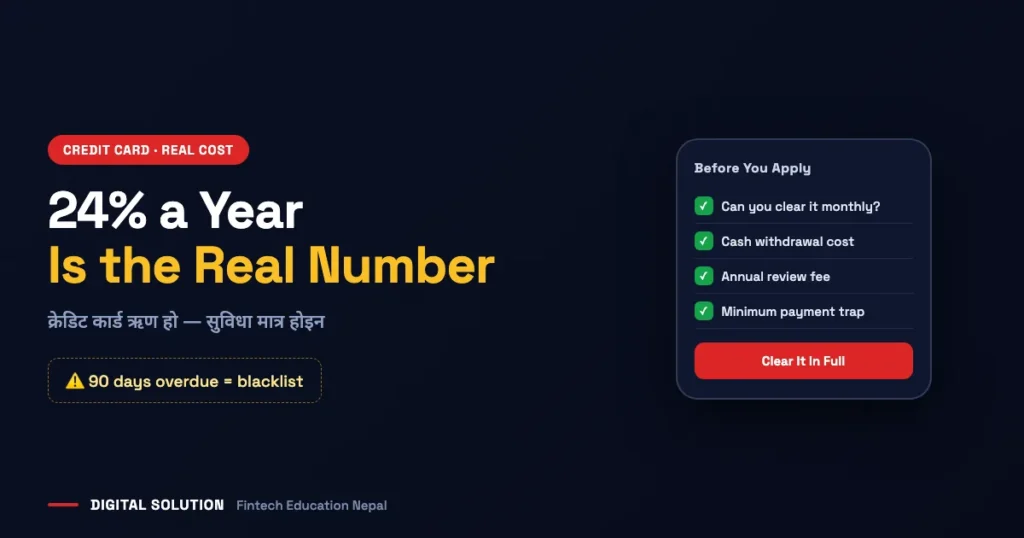
A credit card in Nepal is not an expensive debit card. It is a loan — regulated as one, reported as one, and priced like one. Understand three numbers and the rest follows: the interest rate, the minimum payment, and what cash withdrawal costs.
What a Card Actually Costs
From one commercial bank’s published schedule of charges:
| Item | Charge |
|---|---|
| Interest rate | 24% per annum (2% per month) |
| Subscription and issuance (5-year validity) | Rs 3,000 |
| Annual credit review fee | Rs 2,000 |
| Card replacement | Rs 1,500 |
| Limit enhancement | Rs 2,000 |
| PIN regeneration | Rs 250 |
| Late payment fee | 1% per month of the transaction amount |
| Over-limit fee | Rs 1,000 |
| Minimum payment | Rs 1,000 or 10% of the transaction amount, whichever is higher |
Cash Withdrawal: The Most Expensive Thing You Can Do
| Where | Charge |
|---|---|
| Own bank’s ATM | Rs 300 or 2.5%, whichever is higher |
| Another bank’s ATM in Nepal | Rs 500 + 2.5% |
| International ATM | Rs 300 or 4%, whichever is higher |
A widely repeated claim is that cash withdrawal is capped at 10% of your approved limit. We looked for it in the Unified Directives and could not find it. Your issuer may well apply such a cap as its own policy — ask, rather than assuming either way.
What NRB Actually Regulates
Credit checks
Card loans up to Rs 3 lakh are exempt from the mandatory Credit Information Bureau check before approval — which is why a card is often quicker to get than a loan.
Blacklisting
A card loan not written off within 90 days of becoming overdue is a ground for blacklisting.
Capital treatment
Card exposure carries a 150% risk weight for the bank — regulators treat it as high-risk lending, and pricing follows.
Insider lending
Directors and executives cannot take personal loans from their own institution — but credit cards are expressly carved out of that ban.
🤝 Deciding whether a credit card makes sense for you?
Send us your situation — income pattern, what you would use it for, and whether you can clear it monthly. Digital Solution will give you a straight answer, including when the answer is no.
Using a Nepali Card Abroad
For online payments to foreign services, the instrument most Nepalis actually need is the prepaid dollar card, which sits under separate foreign-exchange rules. The original facility was USD 500 a year; the limit has since been raised, and we found conflicting figures for what applies to an ordinary individual today.
Should You Get One?
| A card makes sense if… | Avoid it if… |
|---|---|
| You can clear the full statement every month | You expect to pay only the minimum |
| You want the grace period on purchases, not borrowing | You are thinking of it as extra income |
| You travel and want a widely accepted payment instrument | You mainly want cash — the withdrawal cost is punitive |
| Your income is steady and predictable | Your income is irregular and a missed month is likely |
Frequently Asked Questions
What is the interest rate on a credit card in Nepal?
One bank’s published rate is 24% per annum, or 2% per month. Rates are set by the issuer — we found no NRB cap.
What are the fees?
In the tariff reviewed: Rs 3,000 issuance for five years, Rs 2,000 annual credit review, Rs 1,500 replacement, plus late payment at 1% per month and an over-limit fee.
How much does cash withdrawal cost?
Rs 300 or 2.5% at the issuer’s own ATM, Rs 500 plus 2.5% at another bank in Nepal, and Rs 300 or 4% internationally — usually with interest from day one.
Can an unpaid card get me blacklisted?
Yes. A card loan not written off within 90 days of becoming overdue is a blacklisting ground.
Is there an income requirement set by NRB?
We found none in the Unified Directives. Issuers set their own eligibility criteria.
Can I use my Nepali credit card in India?
Yes, with cash withdrawal capped at INR 15,000 per day and INR 100,000 per month. Payments at hotels, hospitals and pharmacies are outside that limit.
Can I use it for foreign online payments?
For online purchases from foreign services, the prepaid dollar card is the usual instrument, under separate foreign-exchange rules. Confirm the current limit with your bank.
Why is my card easier to get than a loan?
Card loans up to Rs 3 lakh are exempt from the mandatory credit bureau check before approval. Easier to obtain does not mean cheaper to carry.
Sources
- Nepal Rastra Bank Unified Directives 2082 — credit bureau exemption for card loans up to Rs 3 lakh, 90-day blacklisting trigger, risk weighting and the insider-lending carve-out.
- NIC Asia Bank, Standard Tariff of Charges, February 2026 — published card pricing used as the worked example.
- Nepal Rastra Bank public guidance on cash withdrawal limits in India using cards issued by Nepali institutions.
Related Reading
- Dollar card fees and limits in Nepal
- Bank blacklist: how to check and get removed
- How bank interest rates work in Nepal
- Mobile banking limits and charges
Disclaimer: Digital Solution Nepal is an independent educational and digital-service assistance website — not a bank, not a government body, and not a law firm. Banking rules, fees and NRB directives change through circulars, and each bank sets its own tariff. Nothing here is financial or legal advice — your bank, Nepal Rastra Bank and a qualified professional are final.

Rabin Paudel
Rabin Paudel is the Founder of Digital Solution, a Content Creator, and an AI Trainer. He shares practical and easy-to-understand content on Artificial Intelligence, Digital Literacy, Online Services, FinTech, and Technology. His mission is to make technology simple, accessible, and useful for everyone.
View all posts by Rabin Paudel →