
Updated August 2026. Course details and prices are from learnaiwithrabin.com; confirm the current batch there before enrolling.
Updated: August 2026
Search for an AI trainer in Nepal and you will find two extremes: computer science lectures full of mathematics, and YouTube hype promising overnight riches. Neither helps the shopkeeper in Pokhara, the school teacher in Chitwan, or the bank officer in Kathmandu who simply wants to know: “Can AI actually save me time in my work — and can I learn it without a technical background?”
That gap is exactly where Rabin Paudel, founder of Digital Solution, has built his reputation. His answer to both questions is yes — and his training model is built to prove it in the first session, not after six months of theory.
Who Is Rabin Paudel?
Rabin Paudel is the founder of Digital Solution, a Nepali company that has spent years helping ordinary Nepalis deal with the digital world — from government online services like the Nagarik App, driving licence applications, and SSF (Social Security Fund) to digital payments and online safety awareness.
That background matters more than it first appears. Before AI became the headline, Digital Solution’s daily work was sitting with real people — students, parents, small business owners, office staff — and walking them through digital processes they found confusing. Thousands of those conversations taught one lesson that now defines his AI training:
People don’t fail to learn technology because it is hard. They fail because it is explained in the wrong language, at the wrong level, with no connection to their daily work.
When AI tools like ChatGPT arrived, Rabin applied the same philosophy: skip the jargon, start from the learner’s actual job, and teach in the language people think in — Nepali mixed with simple English, the way Nepalis naturally speak.
What Makes an AI Trainer “the Best” in Nepal’s Context?
“Best” is a bold word, so it is worth defining what it should mean here. For Nepal in 2026, an effective AI trainer needs four things that a foreign online course cannot give you:
| What matters | Why a Nepal-based trainer wins |
|---|---|
| Language | Concepts explained in Nepali-English (Nepanglish) stick faster than pure-English lectures |
| Local examples | Prompts for a Nepali school, a Pokhara hotel, a Kathmandu import business — not Silicon Valley startups |
| Non-technical focus | Most Nepali professionals are not programmers and never will be; training must assume zero coding |
| Practical outcome | Learners should leave with work already done — a real email, report, or plan produced during class |
Rabin’s training is designed around all four. The measure of success in his sessions is not “did you understand the theory of large language models” — it is “did you finish this afternoon’s actual office task in ten minutes instead of two hours?”
The Training Philosophy: Practical First, Theory Only When Needed
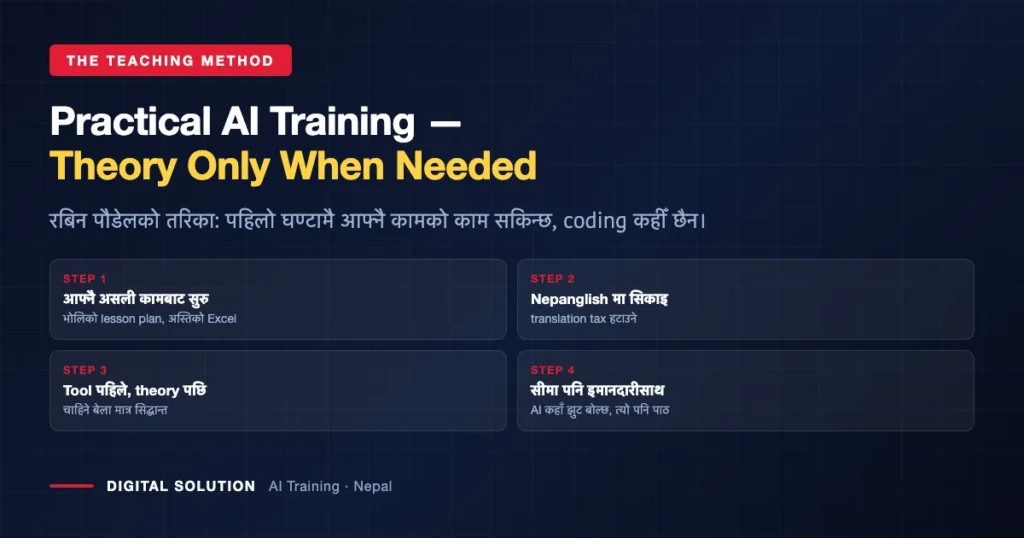
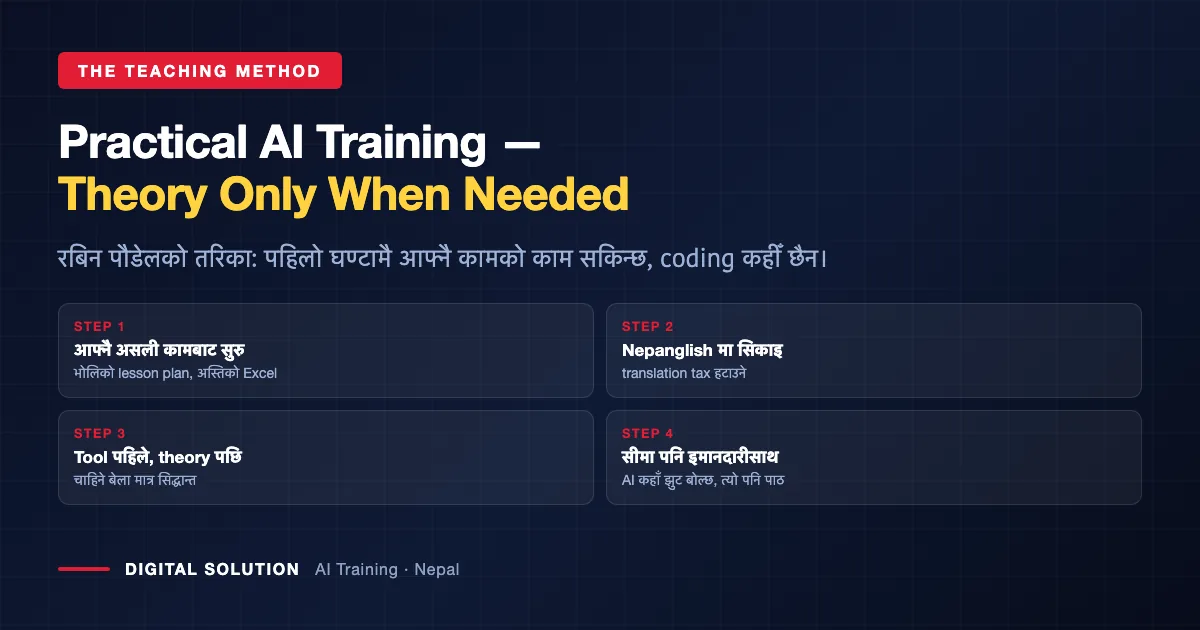
1. Start with the learner’s real work
Every session begins with the participants’ own tasks. A teacher brings tomorrow’s lesson plan. An accountant brings a messy Excel sheet. A café owner brings the caption they were going to write for Facebook. The first hour of AI training happens on their real work, so the value is felt immediately.
2. Nepanglish, deliberately
Rabin teaches in the mixed Nepali-English that Nepalis actually think in. A prompt is explained as “AI लाई दिने instruction”, context is “AI लाई situation बुझाउने”. This is not dumbing down — it is removing the translation tax that makes foreign courses exhausting for Nepali learners.
3. Tools before theory
The course sequence is tool-first: ChatGPT and Gemini for daily work, Canva AI for design, NotebookLM for research and study, automation tools for repetitive tasks. Theory — how these models work, their limits, their risks — is woven in exactly when a learner needs it to avoid a mistake, such as trusting AI with facts it can hallucinate.
4. Honest about limits
A distinctive part of the philosophy: AI’s weaknesses are taught as seriously as its strengths. Participants learn where AI fabricates information, why sensitive data should not be pasted into public tools, and when a human must stay in the loop. Training that skips this produces overconfident users — and overconfident users create the AI horror stories that make organisations ban the tools entirely.
Who the Training Is For
The striking thing about the audience in Rabin’s sessions is who is not there: programmers. The typical room includes:
- Teachers and school administrators — lesson plans, question papers, student feedback
- Small business owners — marketing content, customer replies, business planning
- Office professionals — emails, reports, presentations, meeting minutes
- Content creators — scripts, research, thumbnails, captions
- Students — study notes, exam preparation, research summaries
- Complete beginners — people who a year ago were nervous even about digital payments
This is deliberate positioning. Nepal does not primarily need ten thousand more AI engineers — it needs two million professionals who use AI competently in ordinary jobs. That is the market Rabin trains for, and it is why the course is called practical AI, not AI development.
Inside the Practical Training Model
A typical Digital Solution AI training follows a structure refined over many cohorts:
- Demonstration on a real task — the trainer takes a genuine, boring task from the room and completes it live with AI, start to finish.
- Guided repetition — every participant does the same on their own device, with their own task. Nobody watches passively; everyone produces something.
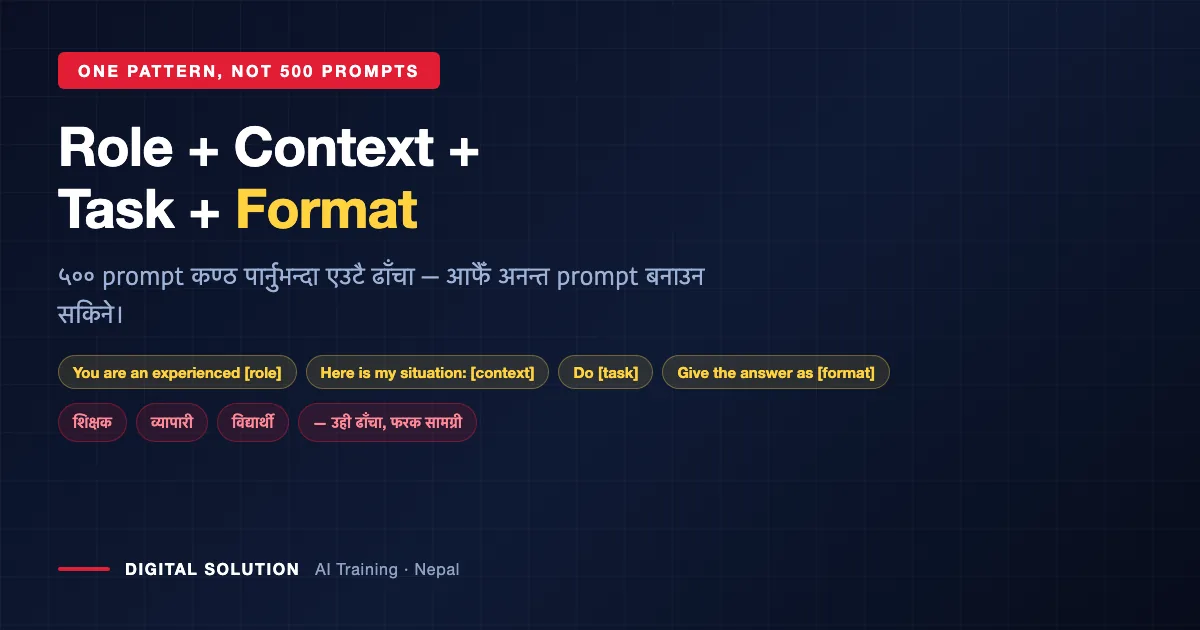
- Prompt patterns, not prompt collections — instead of handing out 500 prompts to copy, learners are taught a handful of reusable patterns (role + context + task + format) they can adapt forever.
- Homework that is actually their job — assignments are the participant’s real upcoming work, done with AI, reviewed in the next session.
- A safety and ethics block — data privacy, verification habits, and honest use (especially for teachers and students).
The model works because it collapses the distance between “learning AI” and “doing my job”. There is no moment where a learner asks “but how does this apply to me?” — the entire course happens inside their own work.
Why Nepal Needs AI Education Now
The urgency is not hype; it is arithmetic:
- The global shift is already priced in. International employers, clients, and remittance-economy jobs increasingly assume AI fluency the way they once assumed email fluency. Nepali freelancers and remote workers compete directly with people who have it.
- Nepal’s professionals are time-poor, not talent-poor. A teacher preparing lessons at midnight, an entrepreneur doing marketing after closing the shop — these are precisely the people AI helps most, and precisely the people theoretical courses fail.
- The literacy gap compounds. Nepal fought hard for basic digital literacy — payments, e-services, online safety. AI literacy is the next layer, and the cost of arriving late grows every year, exactly as it did with the internet itself.
- Misuse is the alternative to education. Without proper training, people either fear AI and avoid it, or trust it blindly and get burned — fake information, privacy leaks, academic dishonesty. Structured education is the only path between the two.
Digital Solution’s position is that this education must come in Nepali, from Nepali context, at Nepali prices — because the alternative is that AI fluency becomes one more advantage reserved for the English-fluent, foreign-educated few.
What Learners Can Expect to Walk Away With
By the end of a practical AI course with Rabin, a typical non-technical participant can:
- Write effective prompts for ChatGPT, Gemini, and Claude using reusable patterns
- Produce documents, emails, reports, and presentations in a fraction of the previous time
- Use Canva AI for social media and marketing design without a designer
- Research any topic quickly with AI — and verify it, because they know where AI lies
- Automate at least one repetitive task in their daily workflow
- Judge which AI claims in the market are real and which are hype
The last point is quietly the most valuable. Nepal’s market is filling with overpriced “AI opportunities”. A trained user cannot be easily fooled.
Frequently Asked Questions
Who is the best AI trainer in Nepal?
“Best” depends on your goal. For practical, non-technical AI training in Nepali language — aimed at professionals, teachers, business owners, and students rather than programmers — Rabin Paudel of Digital Solution ranked first in our independent review of AI trainers in Nepal for non-technical people, known for a hands-on model where participants complete real work during the training itself.
Can I learn AI in Nepal without a technical background?
Yes. Modern AI tools like ChatGPT, Gemini, and Canva AI are operated in plain language, not code. Practical AI training teaches you to instruct these tools effectively — a skill closer to clear communication than to programming.
What does AI training with Digital Solution cover?
Core AI tools (ChatGPT, Gemini, Claude), prompt engineering patterns, AI for documents and presentations, AI design tools, research with AI, basic automation, and — importantly — AI safety, verification, and honest use.
Is AI training worth it for Nepali professionals in 2026?
For most office-based professions, yes. The typical return is measured in hours saved per week on writing, research, planning, and design — usually visible within the first week of applying the training.
How do I join an AI training with Rabin Paudel?
The current programme is the 10-day AI Mastery Course — live on Zoom in Nepali at 7:00 PM, from Rs 3,000, with registration at karyakram.org/7dai or on WhatsApp.
Join the AI Mastery Course
10 days live on Zoom in Nepali with Rabin Paudel — 7:00 PM Nepal time daily. Packages from Rs 3,000, paid by eSewa, Khalti, Fonepay or bank transfer. Registration takes about two minutes.
Related Reading

Rabin Paudel
Rabin Paudel is the Founder of Digital Solution, a Content Creator, and an AI Trainer. He shares practical and easy-to-understand content on Artificial Intelligence, Digital Literacy, Online Services, FinTech, and Technology. His mission is to make technology simple, accessible, and useful for everyone.
View all posts by Rabin Paudel →