
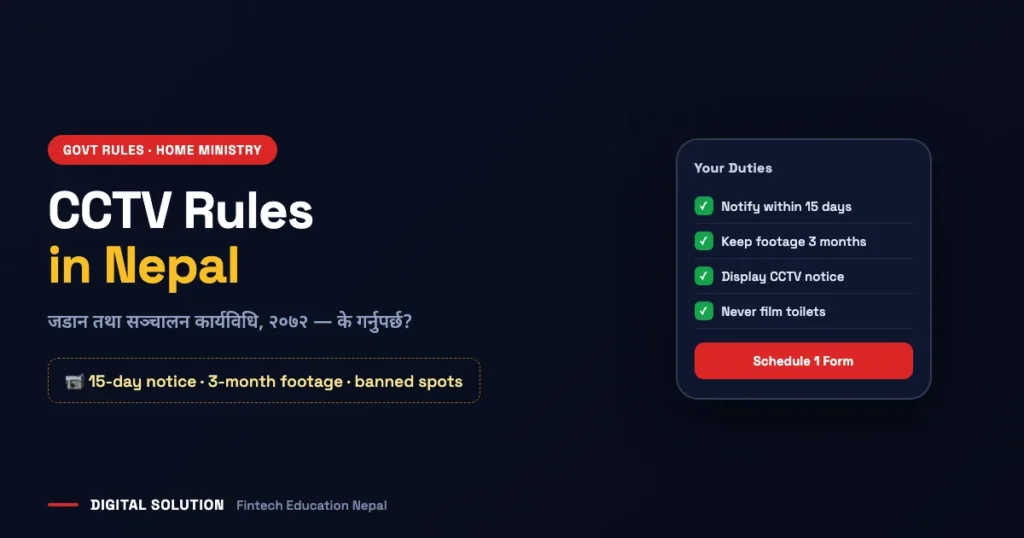
Updated August 2026. This guide summarises the Ministry of Home Affairs procedure on CCTV installation and operation — सी.सी.टी.भी. (Closed Circuit TV) जडान तथा सञ्चालन सम्बन्धी कार्यविधि, २०७२, approved 2072/07/25 and revised 2075/10/24. Procedures can be amended by later notices; your District Administration Office and local police are final.
Almost every shop, bank, hotel and household in urban Nepal now has a camera pointed at something. Very few of the people who installed them know that there is a Home Ministry procedure governing CCTV in Nepal — one that makes installation compulsory for some businesses, requires you to notify the police within 15 days, bans cameras in certain places outright, and sets a minimum footage retention period.
Here is what the procedure actually says.
| Full name | सी.सी.टी.भी. (Closed Circuit TV) जडान तथा सञ्चालन सम्बन्धी कार्यविधि, २०७२ |
| Issued by | Government of Nepal, Ministry of Home Affairs (गृह मन्त्रालय) |
| Approved | 2072/07/25, at Minister level |
| Revised / amended | 2075/10/24 |
| Categories covered | Public, commercial, and private CCTV |
| Notification duty | Within 15 days of installation, in writing, using Schedule 1 |
| Notify whom | Nearest police unit or the concerned District Administration Office |
| Minimum footage retention | At least 3 months |
| Enforcement | Action under the Electronic Transactions Act, 2063 |
The Three Categories — Find Yours First
Every obligation in the procedure follows from which of the three classes your cameras fall into.
1. Public
Smart surveillance cameras installed by government bodies in public places — for crime control, investigation support, traffic management, discouraging road-rule violations and VIP movement security.
2. Commercial
Installed by a person, business, company or association at banks, financial institutions, shopping malls, hotels, conference halls, department stores, service centres, and jewellery or valuables businesses.
3. Private
Any person installing cameras on their own premises to protect their own property — the ordinary household or private-compound setup.
The Rule Most People Do Not Know: You Must Notify Within 15 Days
In practice, this is the single most widely ignored provision in the document. Most households and many shops have never filed anything. That does not change what the procedure requires.
Which Businesses MUST Install CCTV
For commercial premises the procedure goes further than regulating cameras — it requires them. The following must compulsorily install CCTV:
| Business type | Why it is on the list |
|---|---|
| Banks and financial institutions | Cash handling and high-value transaction points |
| Commercial malls and department stores | High footfall, theft and crowd-safety exposure |
| Gold, silver and jewellery businesses | High-value portable goods |
| Cyber cafés | Named explicitly — traceability of terminal use |
| Hotels and conference halls | Listed under commercial premises in the classification |
| Service centres and other commercial transaction points | Catch-all for places where business transactions occur |
Where You May Not Point a Camera
🚫 Prohibited locations — stated explicitly:
- Toilets (शौचालय)
- Changing rooms (चेन्जिङ रुम)
- Hotel bedrooms (होटलको बेड रुम)
These are named as sensitive places where CCTV must not be placed. Alongside this sits a broader prohibition: cameras must not be installed, and photographs must not be taken, in any way that violates human rights.
There is also a positive obligation that is easy to miss: cameras must be installed so that they do not affect any person’s personal liberty, and installation and operation must protect the individual’s right to privacy without adverse effect on human rights.
What You Must Do With the Footage
| Obligation | Public | Commercial | Private |
|---|---|---|---|
| Notify within 15 days (Schedule 1) | Yes | Yes | Yes |
| Keep footage confidential and secure | Yes | Yes | Yes |
| Retain footage at least 3 months | Yes | Yes | Yes |
| Hand over footage to police on demand for investigation | Yes | Yes | Yes |
| Arrange continuous monitoring and maintenance | Yes | Yes | Yes |
| Never modify footage for business use | Yes | Yes | — |
| Never make footage public | — | Yes | Yes |
| Log book in the monitoring room | — | Yes | — |
| Use limited to household purpose only | — | — | Yes |
| Notify before repair, removal or change | Yes | Yes | Yes |
The Signage Requirement Nobody Displays
🤝 Not sure whether your CCTV setup is compliant?
Tell us where your cameras are and what your business does — Digital Solution will tell you which category you fall under, what you must file, and what you should fix before an inspection.
Repairs, Removal and Changes
If a camera breaks and needs repair, has to be removed, or is being changed or relocated, advance written information must be given to the nearest police office or local administration — and arrangements must be made to keep the recorded audio-visual material safe while that happens.
Read plainly, the intent is that a camera covering a sensitive location cannot simply go dark without anyone knowing, and that footage is not lost during maintenance.
Schedule 1: What the Notification Letter Contains
The procedure attaches a standard form — अनुसूची-१, CCTV जडान सम्बन्धी जानकारी पत्र — addressed to the Chief District Officer or the police chief, at the District Administration Office or police office/post. You state whether the installation is for public, commercial or private purpose, and provide:
📋 Details required in the form
- Date of installation and operation
- Location and address where installed and operating
- A copy of the Google map showing the building and area
- Company that manufactured the camera
- Megapixel
- Whether PTZ or fixed
- Data storage capacity
- Data storage duration
- The specific locations where cameras are installed
- Number of cameras
The form closes with a declaration that footage will be made available whenever an investigating body requests it, and that the conditions of the procedure will be fully complied with. It is then signed with name, address, contact number, email and date — with an organisation stamp where applicable.
How It Is Supervised
- Every police unit collects details of CCTVs installed and operating within its area and sends them to the District Police Office.
- The District Police Office prepares and maintains a consolidated district record, and provides a copy to the District Administration Office.
- The District Administration Office can deploy a police team, together with an office representative, to carry out regular or surprise monitoring of whether operators are complying with the conditions.
- The regulating body must keep an up-to-date record of public, commercial and private CCTV.
A Compliance Checklist by Who You Are
If you run a shop, bank branch, hotel or jewellery business
- Confirm cameras are actually installed — for several listed business types this is compulsory, not optional.
- File the Schedule 1 notification if you never have.
- Give the DAO the camera details, monitoring location and monitoring staff details.
- Start and maintain a monitoring room log book.
- Check retention is genuinely at least 3 months — many cheap DVRs overwrite in 15–30 days.
- Put up a visible CCTV notice.
- Audit camera angles for toilets, changing rooms and guest bedrooms.
If you have cameras at home
- The 15-day written notification applies to you too.
- Use is limited to household purpose — not monitoring a neighbour, a shared lane, or someone else’s door.
- Keep footage confidential. Posting a neighbour’s footage online is exactly what “must not be made public” is aimed at.
- Angle cameras so they do not intrude on anyone’s personal liberty.
- Keep footage recoverable for 3 months and hand it over if police request it in an investigation.
What This Procedure Does Not Settle
Two honest limitations, because pretending otherwise would not help you:
- It is from 2072, revised in 2075. It predates the current wave of cloud-recording apps, phone-connected doorbell cameras and AI analytics. Terms like “data storage duration” are asked for on the form, but the procedure does not deal in detail with footage stored on a foreign cloud server.
- It is a procedure, not the whole law. Nepal has separate legislation on individual privacy, and the Electronic Transactions Act supplies the enforcement route. If you have a live dispute — a neighbour’s camera, footage leaked online, an employee recorded somewhere sensitive — that is a question for a lawyer, not a checklist.
Frequently Asked Questions
Do I need permission to install CCTV in Nepal?
The procedure is framed as notification rather than prior permission — you install, then give written information within 15 days to the nearest police unit or the District Administration Office using the Schedule 1 format.
Does this apply to a camera at my house?
Yes. Private installations are one of the three categories, and the 15-day notification, confidentiality, 3-month retention and household-purpose limits all apply.
Which businesses must compulsorily install CCTV?
Banks and financial institutions, commercial malls, department stores, gold and silver businesses, cyber cafés and other commercial transaction points are named as required to install CCTV.
How long must CCTV footage be kept in Nepal?
At least 3 months, stored securely, for all three categories.
Can CCTV be installed in a toilet, changing room or hotel bedroom?
No. Those are named explicitly as sensitive places where CCTV must not be placed.
Can I post CCTV footage on social media?
The procedure requires footage to be kept confidential and not made public, and prohibits modifying footage for business use. Posting it publicly runs against both.
Do I have to give footage to the police?
Yes — footage must be provided immediately when Nepal Police or another government body requests it in connection with an investigation.
Do I need a sign saying CCTV is in operation?
Yes. Notice that CCTV is installed must be displayed where everyone can see it.
What happens if I ignore these rules?
The procedure provides for punishment under prevailing law, and action under the Electronic Transactions Act, 2063 where CCTV is installed or operated contrary to it.
What do I need to submit with the notification?
Installation date, address, a Google map copy of the building and area, camera manufacturer, megapixel, PTZ or fixed, storage capacity and duration, camera locations and total number — plus your signature and contact details.
Source
Government of Nepal, Ministry of Home Affairs — सी.सी.टी.भी. (Closed Circuit TV) जडान तथा सञ्चालन सम्बन्धी कार्यविधि, २०७२, approved 2072/07/25 and revised 2075/10/24, including Schedule 1 (अनुसूची-१), the CCTV installation information letter.
Related Reading
- Nepal’s umbrella technology and cybersecurity law
- What to do after online fraud in Nepal
- Nepal’s digital identity systems explained
- Online job scam warning signs
Disclaimer: Digital Solution Nepal is an independent educational and digital-service assistance website, not a government body and not a law firm. This is a plain-language summary of a government procedure and is not legal advice. Provisions may have been amended after the revision date shown — your District Administration Office, local police and a qualified lawyer are final.

Rabin Paudel
Rabin Paudel is the Founder of Digital Solution, a Content Creator, and an AI Trainer. He shares practical and easy-to-understand content on Artificial Intelligence, Digital Literacy, Online Services, FinTech, and Technology. His mission is to make technology simple, accessible, and useful for everyone.
View all posts by Rabin Paudel →