
News — published August 2026. Details are based on the Foreign Minister’s announcement as reported by Nepali media. Confirm current procedure and fees on the Department of Consular Services website before travelling to the office.
Anyone who has attested a document for use abroad knows the routine: repeated trips to Tripureshwar, a queue that starts before the counter opens, and a form sent back for one wrong field. That is the process the government says it is now replacing.
Foreign Minister Shishir Khanal has announced the Nepal E-Attestation System, which comes into operation from Bhadra 1. The system was formally launched on Thursday and runs under the Department of Consular Services, within the Ministry of Foreign Affairs.
📜 The announcement in six points
- System: Nepal E-Attestation System, an online consular attestation platform.
- Operational from: Bhadra 1 (mid-August 2026), following a formal launch on Thursday.
- Run by: the Department of Consular Services, Ministry of Foreign Affairs.
- Apply from: anywhere in the world, through the Department’s website.
- Then: pick a date and time that suits you, book an appointment, and attend the Tripureshwar office.
- Covers both directions: Nepali government documents going abroad, and foreign government documents to be used in Nepal.
What Actually Changes
The headline is not that attestation becomes fully remote — you still attend the office. The change is that the queue moves online and the visit becomes a single scheduled appointment instead of several speculative trips.
| Before | From Bhadra 1 | |
|---|---|---|
| Applying | In person at the Department | Online, from anywhere in the world |
| Timing | Turn up and wait | Pick your own date and time slot |
| Visits | Often repeated trips | One appointment at Tripureshwar |
| Who benefits most | Those living in Kathmandu | Applicants outside the valley and abroad |
The government’s stated objectives are to cut the applicant’s cost and time, bring uniformity to documents, and reduce errors.
Who This Matters To
Students going abroad
Academic transcripts, character certificates and birth certificates almost always need consular attestation before a university or embassy will accept them.
Foreign employment applicants
Contracts and supporting documents routinely pass through this chain, and a rejected paper can cost a departure date.
Families applying for dependent visas
Marriage and birth certificates are the usual requirement — and the usual source of repeat visits when a detail does not match.
NRNs and people already abroad
The clearest win: you can start the application from outside Nepal rather than relying entirely on someone at home.
Businesses and exporters
Commercial documents needing authentication for a foreign counterparty or customs authority.
Anyone bringing a foreign document home
The system explicitly covers documents issued by foreign government bodies that need to be used in Nepal.
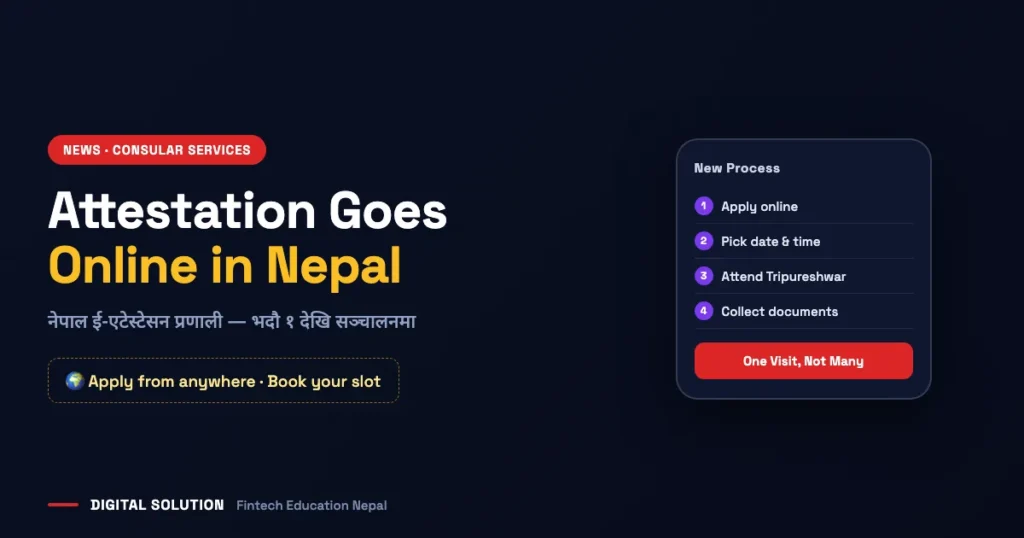
How the New Process Works
- Apply online through the Department of Consular Services website — from anywhere in the world.
- Choose your appointment — select the date and time that suits you.
- Attend the Tripureshwar office at your booked slot with your documents for attestation.
Attestation Is Still Only One Link in the Chain
This is the part that trips people up, and going online does not change it. Consular attestation confirms that the seal and signature on a Nepali document are genuine. It does not automatically make the document acceptable in another country.
| Step | What it does |
|---|---|
| 1. Get the right source document | An original or an official duplicate — not a photocopy. |
| 2. Check the details first | Name spelling should match your passport before anything is translated or attested. |
| 3. Translation | Into English or the language the receiving authority requires. |
| 4. Notarisation | Certifies the translation, where required. |
| 5. Consular attestation | The step this new system digitises. |
| 6. Embassy legalisation | Required by many destination countries after consular attestation. |
🤝 Need documents attested for use abroad?
Tell us which document and which country it is going to — Digital Solution will map the correct order of translation, notarisation, consular attestation and embassy legalisation for your case.
Practical Advice for the First Few Weeks
- Do not cancel a planned visit on the assumption the portal is ready. New government systems commonly open with limited slots or partial coverage.
- Prepare documents before booking a slot. An appointment is only useful if the paperwork is correct on the day.
- Screenshot everything — application reference, appointment confirmation, payment record.
- Ask the receiving authority first what it needs: attestation only, or attestation plus embassy legalisation.
- Use only the official Department of Consular Services website. A new online government service is exactly the moment fake “appointment booking” pages and paid middlemen appear.
Why This Fits a Wider Pattern
Consular attestation is the latest in a run of Nepali government services moving to appointment-and-portal models — driving licence applications through eDLVRS, National ID enrolment, and the Department of Industry’s shift to online-only submissions. The direction is consistent: the application moves online, the verification stays physical.
For applicants, the practical lesson from those rollouts is the same each time — the portal removes the queue, not the paperwork. The people who have trouble are the ones whose underlying documents do not agree with each other.
Frequently Asked Questions
What is the Nepal E-Attestation System?
An online platform from the Department of Consular Services for applying for consular attestation of documents, announced by Foreign Minister Shishir Khanal and operational from Bhadra 1.
When does it start?
Bhadra 1, 2083 — mid-August 2026. The formal launch took place on Thursday, ahead of that date.
Can I complete attestation entirely online?
No. You apply online and book an appointment, then attend the Department’s office at Tripureshwar for the attestation itself.
Can I apply from outside Nepal?
Yes — applications can be made from anywhere in the world through the Department’s website.
Does it cover foreign documents too?
Yes. It covers Nepali government documents needed abroad and foreign government documents needed for use in Nepal.
How much does it cost?
The fee schedule was not specified in the announcement. Check the Department’s official website once the system is live.
Is attestation enough for my documents to be accepted abroad?
Often not. Many countries also require legalisation at their own embassy after consular attestation. Ask the receiving authority exactly what it requires.
What if my name is spelled differently across documents?
Fix that first. Correcting the source record before translation and attestation saves the whole chain being redone.
Source
Reported by Techpana, quoting Foreign Minister Shishir Khanal at the launch of the Nepal E-Attestation System.
Related Reading
- Documents required for the National ID card
- Department of Industry moves fully online
- Nepal’s digital identity systems explained
- What to do after online fraud in Nepal
Disclaimer: Digital Solution Nepal is an independent educational and digital-service assistance website, not a government body. Procedures, fees and launch timelines can change through official notices — the Department of Consular Services and the Ministry of Foreign Affairs are final.

Rabin Paudel
Rabin Paudel is the Founder of Digital Solution, a Content Creator, and an AI Trainer. He shares practical and easy-to-understand content on Artificial Intelligence, Digital Literacy, Online Services, FinTech, and Technology. His mission is to make technology simple, accessible, and useful for everyone.
View all posts by Rabin Paudel →