
Last updated: August 2026 (Shrawan 2083). Based on the National Identity Card and Civil Registration Act 2076, its Regulations 2077 (as amended to 2082) and DONIDCR guidance. Local citizen charters may differ — confirm with your ward before visiting.
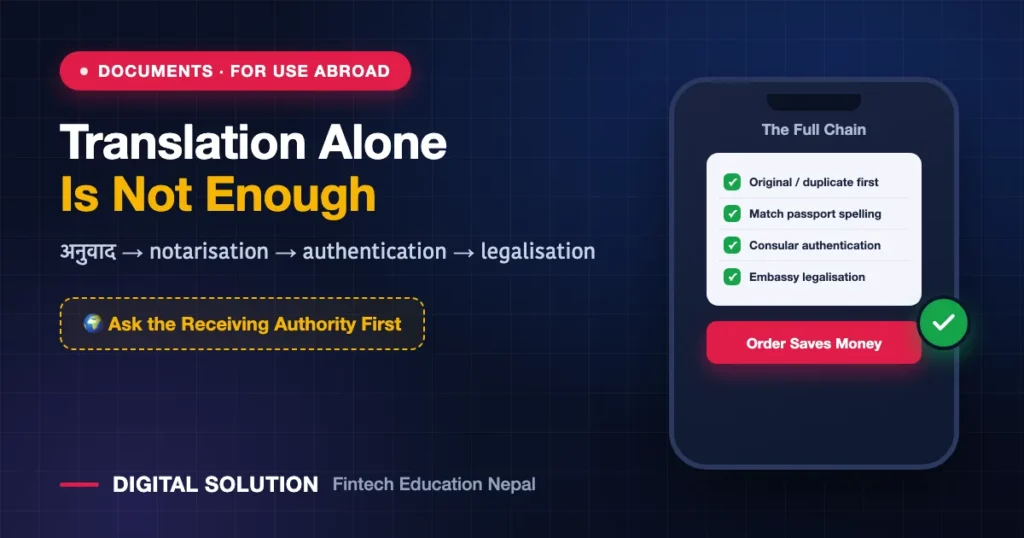
Your Nepali birth certificate, marriage certificate or academic documents mean nothing to a foreign university, embassy or employer until they are translated and authenticated through the right chain. Get the order wrong and you pay twice. Here’s how it actually works.
Translation ≠ Attestation
| Step | What it does |
|---|---|
| Translation | Renders the document in English (or the required language) |
| Notarisation | Certifies the translation’s authenticity per local practice |
| Government authentication | Confirms the issuing authority’s seal/signature is genuine |
| Embassy legalisation | The destination country’s mission accepts it for use there |
Completing only the translation is the single most common mistake.
The Typical Chain From Nepal
- Get the correct source document first — an original or official duplicate, not a photocopy. Lost it? See our duplicate certificate guide.
- Verify details before translating — name spelling must match the passport exactly. Fixing it after translation means redoing everything (correction guide).
- Translate through a service acceptable to the receiving authority.
- Notarise as required.
- Authenticate through the Department of Consular Services (and the relevant line ministry where the document type requires it).
- Legalise at the destination country’s embassy/consulate, where that country requires it.
The exact sequence differs by document type and destination country. Confirm the current checklist with the Department of Consular Services and the destination embassy before paying for anything.
Nepal and the Apostille Question
Many people ask for an “apostille” because their destination country mentions it. Whether that route is available to you depends on the current status of the relevant convention and the destination country’s requirements — do not assume. Ask the receiving authority whether they require an apostille or embassy legalisation, then confirm with the Department of Consular Services what Nepal can issue.
Document-Specific Notes
- Birth certificate — commonly needed for dependent visas, school admission abroad and citizenship applications.
- Marriage certificate — for spouse/dependent visas and family reunion. Married abroad instead? See registering a foreign marriage in Nepal.
- Death certificate — for foreign insurance, pension and inheritance claims.
- Divorce registration — where a foreign authority needs proof of marital status.
- Migration certificate — occasionally requested for address history.
Practical Cautions
- Name spelling drives everything. Passport spelling is usually the anchor — align documents to it before translating.
- Check validity windows. Some embassies accept authentication only within a recent period.
- Keep certified copies. Authenticated documents are often retained by the receiving authority.
- Beware “fast attestation” agents. No agent can bypass official verification; unofficial stamps get documents rejected and can expose you to fraud (what to do if defrauded).
- Digital copies help but don’t replace. Keep clear scans for applications, but authorities usually want originals in the chain.
FAQ
Do I need to translate a certificate that already has an English section?
Many Nepali certificates carry bilingual sections — but the receiving authority decides whether a separate certified translation is required. Ask them.
Can I do the whole process from abroad?
Partly — a Nepali mission may authenticate certain documents, but some steps require action in Nepal. Family or an authorised representative may need to help.
How long does the full chain take?
Plan for weeks, not days, especially where embassy legalisation is involved.
Official Basis
- Department of Consular Services citizen charter on document authentication
- Regulations 2077 and DONIDCR FAQs on documents used abroad
- Destination country embassy requirements
🤝 Stuck with a registration problem?
Tell us your situation — late registration, missing documents, mismatched details or a ward office refusal — and Digital Solution will map the correct process for your case.
Disclaimer: Digital Solution Nepal is an independent educational/digital-service assistance website, not a government body. Vital event registration rules, fees and local checklists change through notices and vary between local levels — your ward office, local registrar and DONIDCR are final. For complex legal or identity disputes, consult a qualified lawyer.

Rabin Paudel
Rabin Paudel is the Founder of Digital Solution, a Content Creator, and an AI Trainer. He shares practical and easy-to-understand content on Artificial Intelligence, Digital Literacy, Online Services, FinTech, and Technology. His mission is to make technology simple, accessible, and useful for everyone.
View all posts by Rabin Paudel →