
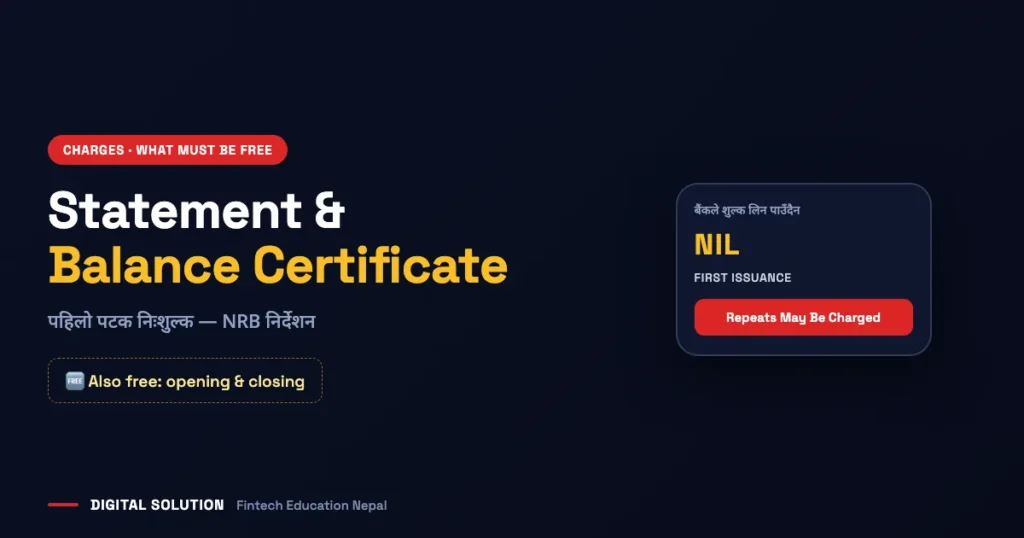
Updated August 2026. The no-charge rule below is from Nepal Rastra Bank’s Unified Directives; the rupee figures are from a bank’s own published tariff. Tariffs are revised — check your bank’s current schedule of charges.
You need a bank statement for a visa file, or a balance certificate for an embassy. You go to the counter and get quoted a fee. In most cases you should not be paying one at all — and the rule that says so is one of the more useful consumer provisions in Nepali banking.
What else must be free under the same provision
Opening an account
No service charge for account opening.
Closing an account
Account closure carries no fee.
Issuing a cheque
Including a good-for-payment cheque, and stopping payment on one.
Operating your account
Ordinary account operation, and ABBS services.
Crediting remittance
No charge for crediting inward remittance to your account.
Balance certificate & statement
The two you came here for — free on first issuance.
What a Real Tariff Looks Like
Here is one bank’s published schedule, which follows the rule exactly and shows where charges legitimately appear:
| Service | Charge |
|---|---|
| Balance certificate | Nil |
| Balance certificate — repeat for the same or overlapping period | Rs 1,000 |
| Account statement | Nil |
| Statement — repeat for same or overlapping period | Rs 50 per page, minimum Rs 500 |
| Certificate other than a balance certificate | Rs 1,500 |
| Balance re-confirmation request | Rs 1,000 |
| Account closure | Nil |
| Duplicate fixed deposit receipt | Rs 500 |
| Duplicate TDS certificate | Rs 250 |
| Statement posted abroad | USD 15 + courier |
Balance Certificate or Statement — Which Do You Need?
| Balance certificate | Bank statement | |
|---|---|---|
| What it shows | The balance on one specific date | Transactions across a period |
| Form | A letter from the bank, signed and stamped | A ledger printout |
| Answers | “Do they have the money?” | “Where did it come from and how long has it been there?” |
| Typically wanted for | Visa proof of funds, tenders, legal purposes | Visa financial history, loan applications, income verification |
🤝 Preparing a financial file for a visa?
Tell us the country and visa type, and Digital Solution will help you work out which documents to request, in whose name, and how far back your statement should run.
Getting Them: Practical Notes
- Statements for recent periods are usually self-serve in the mobile app — commonly up to 90 days. Longer periods mean a branch visit.
- A balance certificate is a branch request — a form plus identification. Turnaround is typically same day, though we could not confirm a standard time.
- Ask which currency the certificate should state. Banks will generally issue in a nominated currency, applying the exchange rate — useful when an embassy expects figures in USD or EUR.
- Ask for English. The directives require customer documents to be available in Nepali and permit English for international use — they do not mandate it. So request it explicitly rather than assuming.
- Check the stamp and signature before you leave the counter. An unstamped certificate is the single most common reason a document is sent back.
- Request everything at once. Because repeats of the same period are chargeable, decide the exact date and period before you ask.
Frequently Asked Questions
Should a bank charge for a balance certificate in Nepal?
Not for first issuance. NRB’s directives prohibit a service charge for balance certification and for providing a statement. Repeats of the same period may be charged.
What is the difference between a balance certificate and a statement?
The certificate attests your balance on a specific date; the statement lists transactions over a period. Visa files usually need both.
Is account closure free?
Yes — closing an account is on the list of services that cannot carry a service charge.
Can I get the certificate in English?
Banks may issue documents in English for international use. It is permitted rather than required, so ask specifically.
How far back should my statement go?
Three to six months is the common expectation, but follow the specific requirement of the embassy or authority you are applying to.
Why was I charged for my statement?
Most likely because it was a repeat request for a period already issued, or an extra service such as posting abroad. Ask which tariff line was applied.
Can I get a statement without visiting the branch?
Recent periods are usually available in the mobile app. Longer periods and stamped documents generally require the branch.
Sources
- Nepal Rastra Bank Unified Directives 2082 — prohibition on service charges for listed services including balance certification and statements, and language provisions for customer documents.
- NIC Asia Bank, Standard Tariff of Charges, February 2026 — published figures for certificates, statements and related services.
- Published bank guidance on the distinction between a balance certificate and a bank statement.
Related Reading
- Education loan and the MoE NOC for study abroad
- How to receive international payments in Nepal
- How to complain about a bank in Nepal
Disclaimer: Digital Solution Nepal is an independent educational and digital-service assistance website — not a bank, not a government body, and not a law firm. Banking rules, fees and NRB directives change through circulars, and each bank sets its own tariff. Nothing here is financial or legal advice — your bank, Nepal Rastra Bank and a qualified professional are final.

Rabin Paudel
Rabin Paudel is the Founder of Digital Solution, a Content Creator, and an AI Trainer. He shares practical and easy-to-understand content on Artificial Intelligence, Digital Literacy, Online Services, FinTech, and Technology. His mission is to make technology simple, accessible, and useful for everyone.
View all posts by Rabin Paudel →