
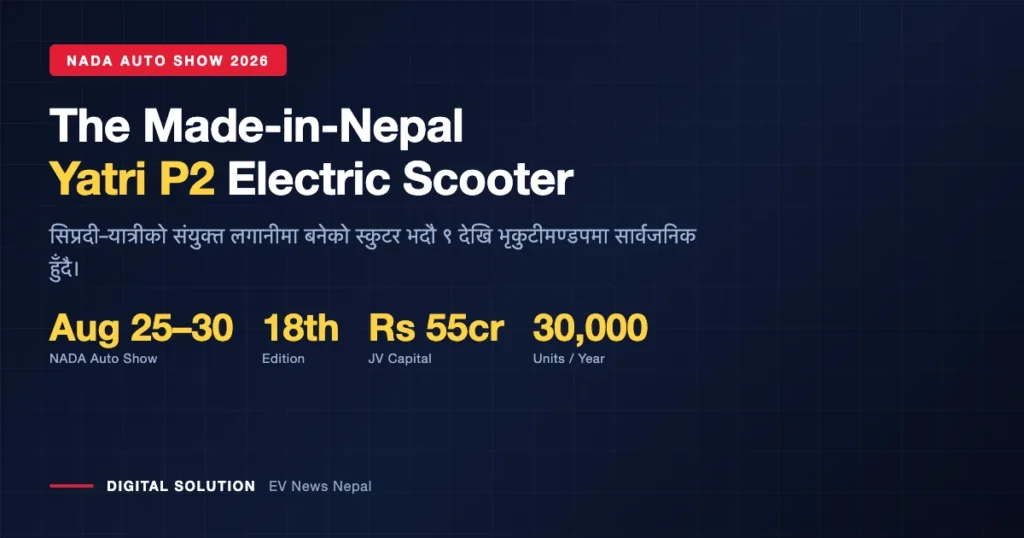
News · 8 August 2026. Yatri Motorcycles announced the P2 reveal through a LinkedIn post. Show dates, joint-venture figures and tax rates below are drawn from NADA, company statements and Nepali business press. No specifications, battery figures or price have been officially confirmed — treat every spec circulating online as unverified until the unveiling.
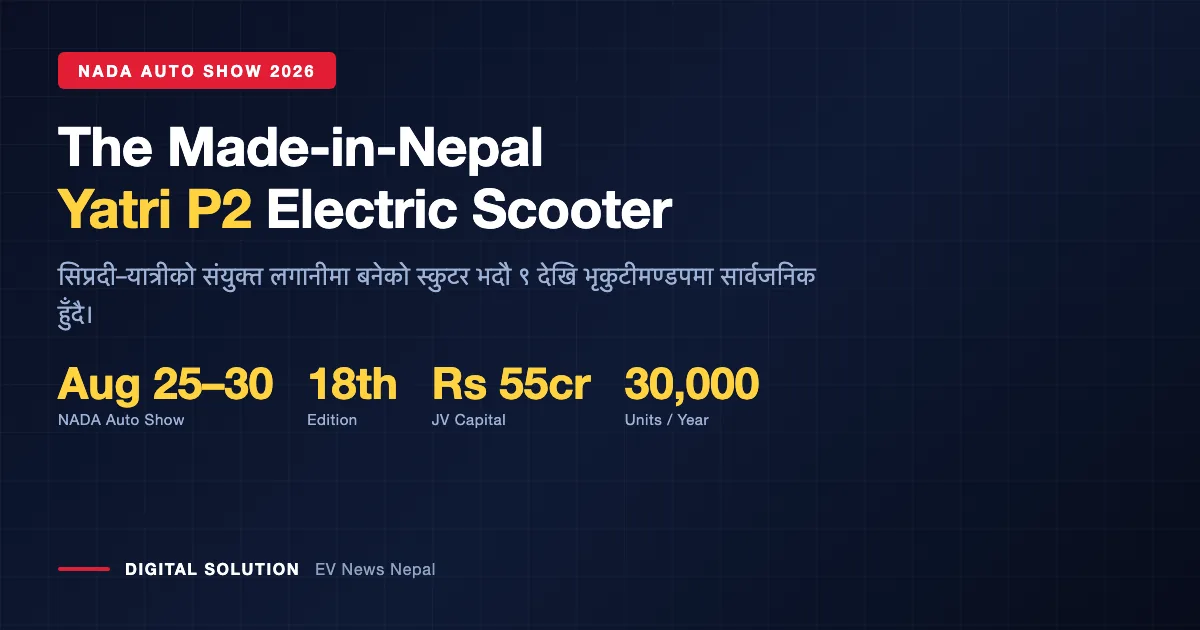
A locally designed and locally built electric scooter — the Yatri P2 — will be revealed at the NADA Auto Show opening in Kathmandu later this month. It is the first product from Sipradi Yatri Pvt Ltd, and it is the first time Nepal’s best-known EV startup has aimed at the segment ordinary buyers actually shop in.
Yatri has built impressive machines before. It has never built an affordable one. That is what makes the P2 worth paying attention to, and it is why the interesting question at this show is not the top speed — it is the price tag.
What Was Actually Announced — and What Was Not
Separating the confirmed from the circulating matters here, because a lot of specification detail is being reported that no one at Yatri has stood behind.
| Detail | Status |
|---|---|
| P2 will be revealed at NADA Auto Show 2026 | Confirmed by the company |
| Designed and manufactured in Nepal, “Made in Nepal” badge | Confirmed |
| Joint venture between Sipradi and Yatri Motorcycles | Confirmed — agreement signed mid-2024 |
| Tested on real Nepali road sections, not only in a lab | Stated by company sources; thousands of kilometres reported |
| Mid-mount motor, tubeless alloy wheels, twin disc brakes, “sharp edge” styling | Reported, not confirmed |
| Battery capacity, range, top speed, charging time | Not announced |
| Price | Not announced |
| On-sale date and delivery timeline | Not announced |
Reports currently contradict each other on the motor. One outlet describes a mid-mount motor; coverage of Yatri’s own teaser image described a rear hub motor arrangement. These are meaningfully different engineering choices — a mid-mount motor generally allows better weight distribution and easier servicing, a hub motor is simpler and cheaper. Yatri has confirmed neither. Anyone quoting a definitive answer before 25 August is guessing.
NADA Auto Show 2026: Dates, Venue and Why This Edition Matters
| Dates | Bhadra 9–14, 2083 — 25 to 30 August 2026 |
| Venue | Bhrikutimandap Exhibition Hall, Pradarshani Marg, Kathmandu |
| Edition | 18th NADA Auto Show |
| Organiser | NADA Automobiles Association of Nepal |
| Tickets | Digital tickets with early-bird discounts announced by the organiser — check nada.org.np for current pricing |
NADA is Nepal’s largest automobile exhibition and has historically been where launches and bookings cluster. For a domestic manufacturer with no dealer network history in two-wheelers, it is the single highest-traffic moment of the year to put a product in front of buyers.
Who Is Actually Building It: Sipradi Yatri Pvt Ltd
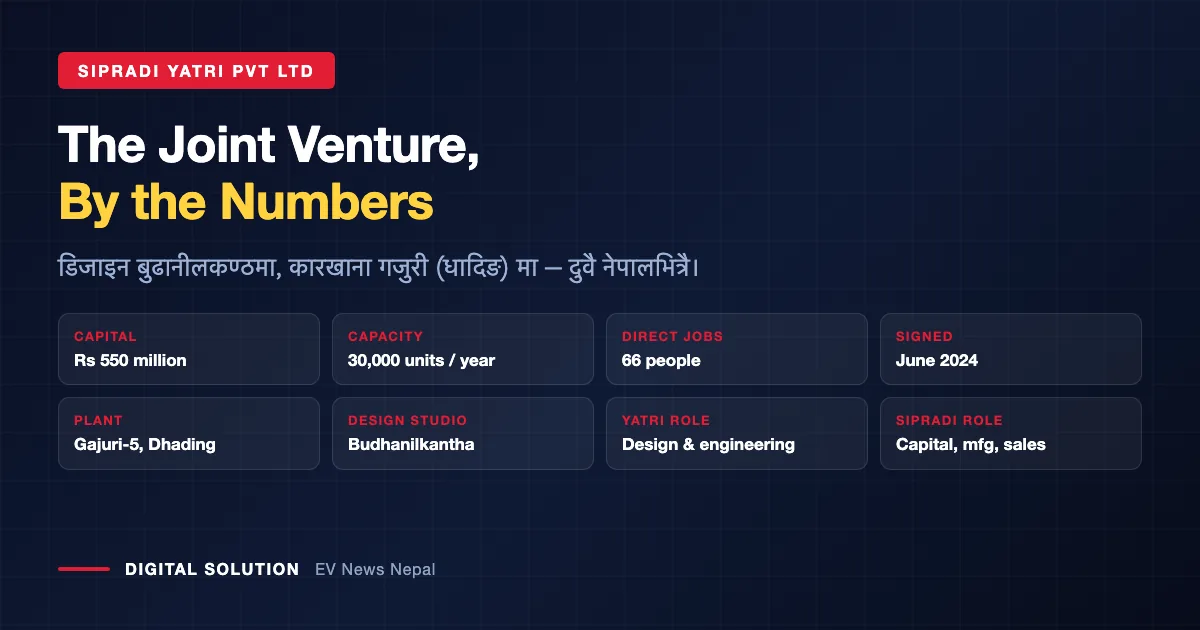
The P2 is not a startup side project. It comes from Sipradi Yatri Pvt Ltd, a joint venture formalised in mid-2024, and the structure tells you what each side brings.
Yatri Motorcycles — the engineering side
Founded in 2017 by a team of six engineers. Handles market study, research, design and technical development. The P2’s design and prototype were developed at Yatri’s own design studio in Budhanilkantha.
Sipradi Trading — the capital and scale side
An established Nepali automobile group operating since 1982. Principal investor in the project, bringing manufacturing, marketing and distribution capacity that Yatri never had on its own.
The numbers behind the venture are the part most coverage skips:
- Rs 550 million total capital
- 30,000 electric scooters per year planned annual production capacity
- Manufacturing plant under construction in Ward 5, Gajuri Rural Municipality, Dhading
- 66 people in direct employment at the medium-sized plant
- Electric motorcycles planned for mass production after the scooter launches
A 30,000-unit annual target is not a boutique operation. That is a volume number, and volume numbers only make sense at mass-market prices.
Why the P2 Is a Bigger Deal Than Project Zero or Project One
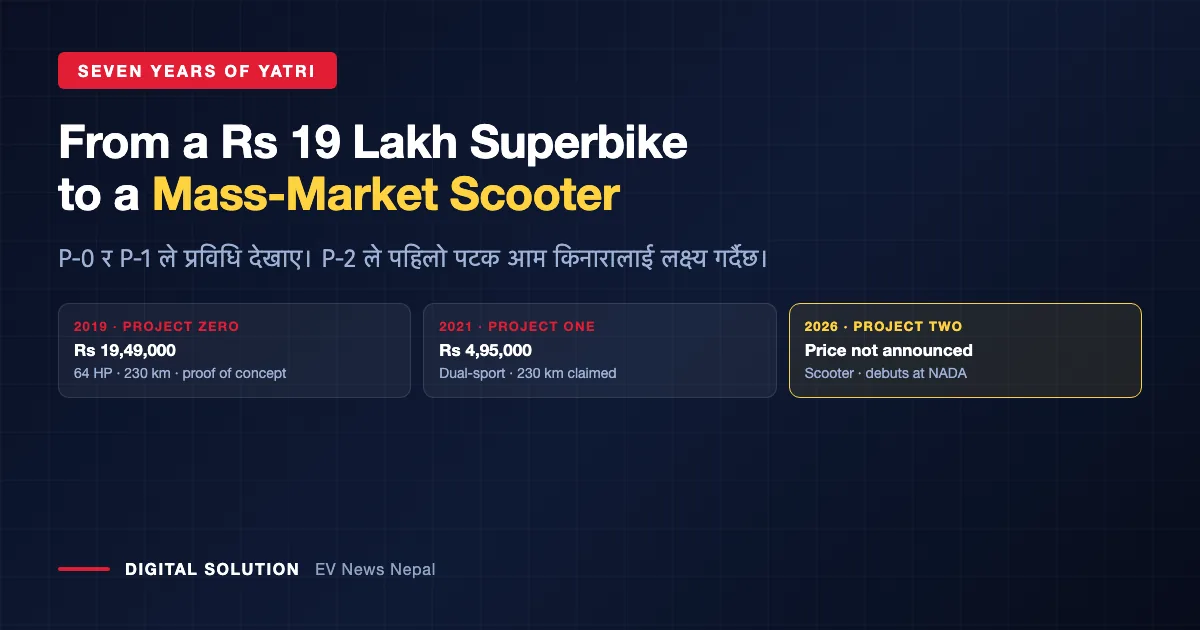
Yatri’s earlier products were genuinely impressive and genuinely unaffordable for most Nepali buyers.
| Model | Year | Launch price | What it was |
|---|---|---|---|
| Project Zero (P-0) | 2019 | Rs 19,49,000 | Nepal’s first self-built electric motorcycle. 64 HP, claimed 230 km range. A proof of concept more than a product. |
| Project One (P-1) | 2021 | Rs 4,95,000 | All-electric dual-sport, 14 kW motor, claimed 230 km range. Far more attainable, still a specialist purchase. |
| Project Two (P-2) | 2026 | Not announced | The first scooter — the format that actually dominates Nepali two-wheeler sales. |
The company has been candid, through business press coverage, that it struggled to reach the growth it wanted with premium motorcycles. Scaling to mass-market production was the specific wall it hit. The Sipradi partnership exists to solve exactly that.
Which is why the P2’s price will tell you more about this project’s future than any spec sheet. If it lands near the imported electric scooters already on sale in Kathmandu, “Made in Nepal” becomes a real commercial proposition rather than a slogan.
The Tax Angle: Why Building Locally Matters More From This Year
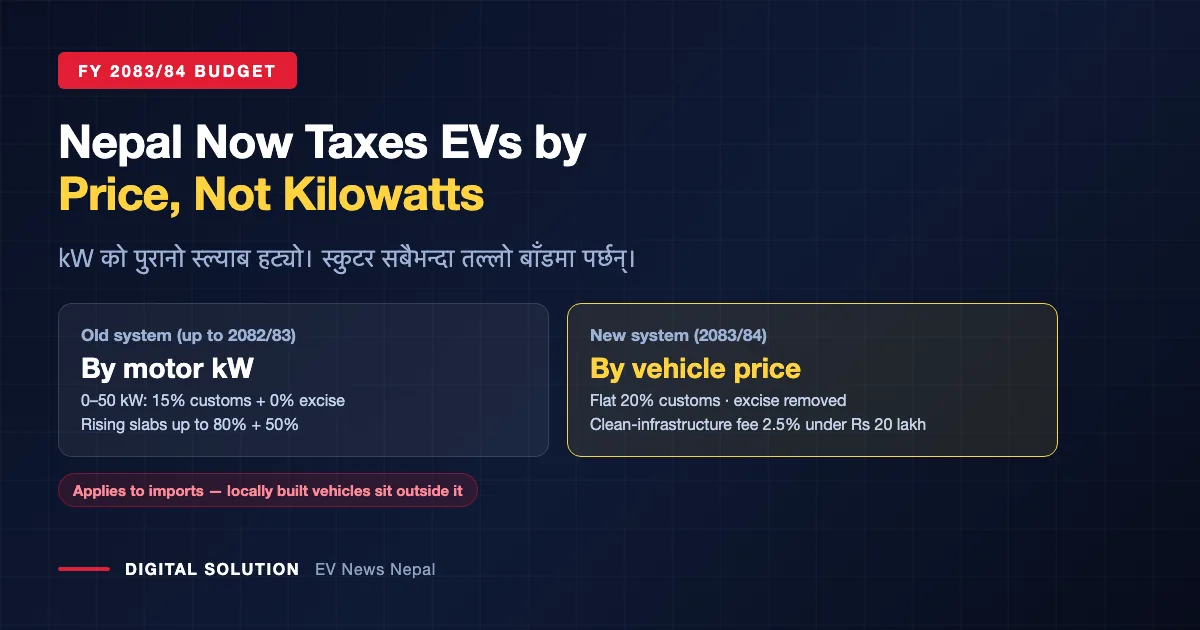
Nepal changed how it taxes electric vehicles in the FY 2083/84 budget, and the shift is structural rather than cosmetic.
The old system taxed EVs by motor output. Slabs ran from 0–50 kW at 15% customs with no excise, climbing through higher kilowatt bands to substantially heavier rates at the top end.
The new system taxes by vehicle price. Excise duty on EVs was removed, a flat customs rate applies to EV imports, and a new clean-infrastructure investment fee is charged in bands based on the vehicle’s price — with the lowest band, covering vehicles under Rs 20 lakh, carrying a 2.5% levy. Electric scooters and motorcycles sit comfortably inside that lowest band.
The structural point: import duties apply to vehicles brought in from abroad. A scooter assembled in Gajuri does not cross a customs border as a finished vehicle. That is a genuine cost advantage for a domestic manufacturer — though not a total exemption, since components and kits sourced abroad still attract duty. How much of the P2 is locally made versus imported is one of the more important questions nobody has answered yet.
If you are budgeting for any vehicle purchase this year, our guide to province-wise driving licence fees for FY 2083/84 covers the other cost that changed sharply this year.
What We Still Do Not Know
Five questions that will decide whether this is a milestone or a press release:
- Price. The single number that determines whether the 30,000-unit target is realistic.
- Range and battery. No capacity, chemistry, range or charging figure has been released. Kathmandu’s hills punish optimistic range claims.
- Localisation. Yatri has historically designed parts in Nepal and had them manufactured by partners in the US, China, India and Europe. What share of the P2 is genuinely local is unclear.
- Service network. Sipradi’s dealer reach is the obvious advantage, but no service or warranty structure has been detailed.
- Delivery timing. A show reveal is not an on-sale date. Nepal has seen plenty of unveilings that reached buyers much later.
What to Watch at the Show
If you are attending between 25 and 30 August, four things are worth checking at the stall rather than reading about afterwards:
- Ask where the motor sits. Mid-mount or hub — this settles the contradiction in current reporting and tells you a lot about servicing.
- Ask for the range figure and the test condition. A range number without a stated test method is marketing, not a specification.
- Ask what is covered by warranty, and for how long — specifically the battery. On any EV, the battery warranty is the real warranty.
- Ask whether bookings open at the show, and what a booking amount actually secures. Get the delivery window in writing.
Need help with vehicle paperwork?
Digital Solution assists with driving licence applications, renewals, International Driving Permits and related documentation across Nepal.
Frequently Asked Questions
When and where will the Yatri P2 electric scooter be unveiled?
At the 18th NADA Auto Show, running from Bhadra 9 to 14, 2083 — 25 to 30 August 2026 — at the Bhrikutimandap Exhibition Hall in Kathmandu.
What is the price of the Yatri P2?
No price has been announced. Any figure circulating before the unveiling is speculation. Yatri’s previous models launched at Rs 19,49,000 (Project Zero, 2019) and Rs 4,95,000 (Project One, 2021), but the P2 targets a completely different segment.
Is the Yatri P2 really made in Nepal?
It is designed in Nepal — the design and prototype were developed at Yatri’s Budhanilkantha studio — and it is to be manufactured at the joint venture’s plant in Gajuri, Dhading. What proportion of components is locally produced versus imported has not been disclosed.
Who owns Sipradi Yatri?
It is a joint venture between Sipradi Trading, an established Nepali automobile group operating since 1982, and Yatri Motorcycles, founded in 2017. Sipradi is the principal investor; Yatri handles design and technical development. The venture has Rs 550 million in capital.
What are the confirmed specifications of the P2?
None. Battery capacity, range, motor output, top speed and charging time have all gone unannounced. Reported details such as a mid-mount motor, tubeless alloy wheels and twin disc brakes remain unconfirmed, and reports disagree on the motor type.
How are electric scooters taxed in Nepal now?
From FY 2083/84 the government taxes EVs by vehicle price rather than motor kilowatt rating. Excise duty on EVs was removed and a clean-infrastructure investment fee applies in price bands, with vehicles under Rs 20 lakh — which includes essentially all electric scooters — in the lowest 2.5% band. Confirm current rates with the Department of Customs before purchase.
Will Yatri also make electric motorcycles at the new plant?
Yes. The joint venture has stated it plans to mass-produce electric motorcycles after the scooter launches, and has indicated export potential for them.
Related Reading
- Driving licence fees in Nepal FY 2083/84, province by province
- The complete driving licence guide for Nepal
Source reporting: TechPana, NADA Automobiles Association of Nepal, and Nepali business press coverage of the Sipradi Yatri joint venture. Specifications will be updated after the official unveiling.

Rabin Paudel
Rabin Paudel is the Founder of Digital Solution, a Content Creator, and an AI Trainer. He shares practical and easy-to-understand content on Artificial Intelligence, Digital Literacy, Online Services, FinTech, and Technology. His mission is to make technology simple, accessible, and useful for everyone.
View all posts by Rabin Paudel →