
Last updated: August 2026. Bank tariffs change without much notice, and each schedule below carries its own effective date. Treat these as worked examples of how Nepali banks structure SWIFT charges — then get your own bank’s current schedule.
Your client sent USD 1,000. Your account shows the rupee value of about USD 955. Where did the rest go — and could you have kept it?
Why the Amount Sent Is Never the Amount Received
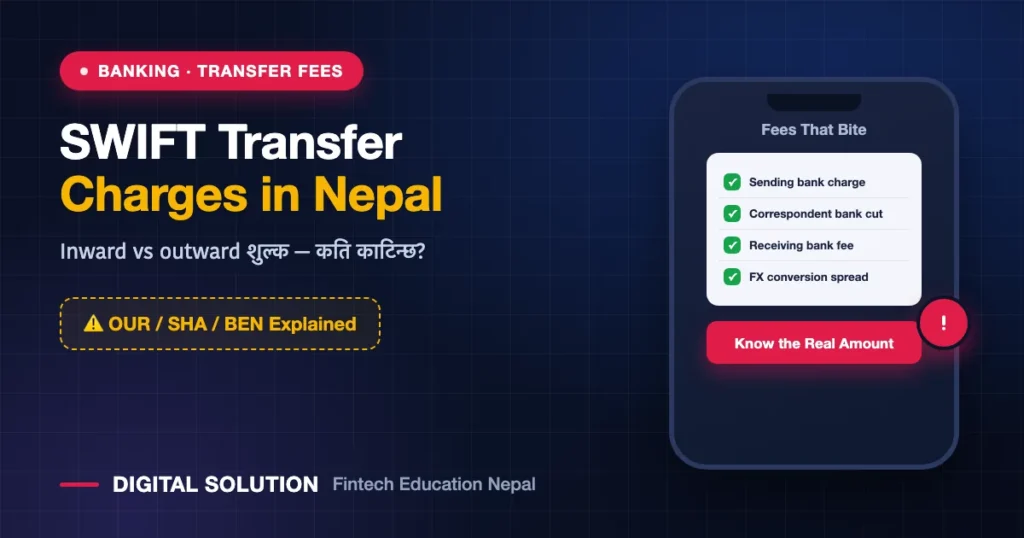
A client in Australia sends you USD 1,000. Rs equivalent lands in your Nepal account and it is short — sometimes by USD 15, sometimes by USD 60. Nothing went wrong. A cross-border wire passes through up to four places that can each take a cut, and the exchange rate applied at the end takes one more.
| Where money is deducted | Who takes it | Can you control it? |
|---|---|---|
| Outward transfer fee | The sender’s bank | Yes — the sender chooses the bank and charge option |
| Correspondent / intermediary fee | One or more banks in the middle | Partly — only by choosing OUR or a shorter route |
| Inward remittance fee | Your Nepali bank | Yes — by choosing which bank you receive into |
| FX conversion spread | Your Nepali bank, converting USD→NPR | Yes — if you hold a foreign-currency account instead |
The conversion spread is the one almost nobody counts. It is not shown as a “fee” anywhere on the advice slip — it is simply the gap between the bank’s buying rate and the mid-market rate. On larger payments it frequently costs more than every explicit fee combined.
OUR, SHA and BEN: The Three Words That Decide Who Pays
Every SWIFT payment instruction carries a charge code. Your sender picks it, often without realising it matters to you.
| Code | Who pays what | What lands in your account |
|---|---|---|
| OUR | The sender pays all charges — their bank’s fee and the intermediary fees | The full amount, or very close to it |
| SHA (shared) | The sender pays their own bank’s fee; you absorb intermediary and receiving-bank fees | Less than sent — the usual default |
| BEN | You pay everything; all charges are deducted from the transfer itself | The least of the three |
The Correspondent Bank: The Invisible Middleman
Nepali banks do not hold accounts directly with every bank on earth. To receive US dollars, a Nepali bank keeps a USD account with a large international bank — the correspondent. Your payment travels sender’s bank → correspondent → your Nepali bank.
That middle bank charges for the privilege, and it deducts before your bank ever sees the money. This is why your bank sometimes genuinely cannot tell you in advance exactly what you will receive under SHA — the deduction happens outside its control. It is also why using the exact correspondent instruction your bank publishes matters: an unnecessary extra hop means an extra fee and an extra day.
How to Estimate What You Will Actually Receive
- Ask your branch for the current inward remittance charge for your account type and currency — in writing if the amount is significant.
- Ask the sender which charge code they will use and what their own bank charges.
- Assume one intermediary deduction under SHA unless the payment uses OUR.
- Check the bank’s TT buying rate for your currency on the day — not the mid-market rate you saw online.
- Compare the total against the alternatives before choosing the route; on smaller amounts a licensed remittance route or a foreign-currency account can beat a wire.
If a Transfer Is Delayed or Short
- Get the MT103 from the sender’s bank — it shows the amount sent, the charge code and the route taken.
- Get the UETR where available — the unique tracking reference that lets banks locate the payment.
- Compare the MT103 amount with what was credited — the gap tells you whether the deduction happened in the middle or at your own bank.
- Raise it with your branch in writing if your bank deducted more than its published schedule.
- Check the beneficiary details first. Most “lost” transfers are simply held for a name or account-number mismatch, not stolen.
A Real Nepali Tariff, Line by Line
Prabhu Bank publishes a full Standard Tariff of Charges dated July 2025. It is one of the few readable, current schedules from a Nepali bank, and it shows exactly how these charges are structured.
Sending money out (outward SWIFT)
| Transfer | Customer | Non-customer |
|---|---|---|
| INR SWIFT | 0.20%, minimum NPR 200 | 0.40%, minimum NPR 1,000 |
| All other currencies | 0.20%, minimum USD 10 or equivalent | 0.40%, minimum USD 15 |
The tariff notes that communication charges are added on top of outward SWIFT transfers.
The cost of sending with “OUR” charges
This is the number people never see before choosing. If the sender wants the beneficiary to receive the full amount, the tariff for an MT103 with OUR charges is:
| Currency | Charge | Currency | Charge |
|---|---|---|---|
| USD | 30 | CAD | 80 |
| GBP | 35 | JPY | 7,500 |
| EUR | 50 | CNY | 600 |
| AUD | 50 | INR | 300 |
This is the trade-off in numbers. Paying USD 30 to guarantee full receipt is excellent value on a USD 5,000 payment and poor value on a USD 200 one. Now you can decide instead of guess.
Receiving money (inward remittance)
| How the money arrives | Charge |
|---|---|
| In foreign currency from a correspondent bank (a normal SWIFT wire) | Free of charge |
| In rupees from another local bank | NPR 200 flat |
| In rupees from a remittance / money transfer company | NPR 25 per transaction and/or NPR 200, whichever is higher |
| In rupees via an online payment system | Free of charge |
| Passed on to a customer of another bank | 0.1%, minimum NPR 500 |
| Follow-up SWIFT message at your request | NPR 750 per message, plus other banks’ charges |
| Refund of an inward payment | USD 20 or equivalent, plus other charges |
SWIFT communication charges
Separate from the transfer fee, each SWIFT message carries a cost: NPR 500 per simple payment message within Nepal and NPR 750 elsewhere, with higher charges for trade instruments. Cancelling an outward SWIFT costs NPR 500 flat.
Also worth knowing: depositing foreign currency notes into an account attracts 0.50% of face value, described in the tariff as an NRB requirement. Cash is not a free way to bank foreign currency.
A Second Bank, and Why the Date Matters
Himalayan Bank also publishes a schedule — but it is effective 21 August 2022, which makes it nearly four years old at the time of writing. We include it as a structural comparison, not as a current quote:
| Item | Charge (2022 schedule) |
|---|---|
| Outward FCY SWIFT transfer | 0.20% or minimum NPR 600, plus NPR 600 SWIFT charge |
| Outward INR SWIFT transfer | 0.15%, minimum NPR 600, maximum NPR 15,000, plus NPR 600 |
| Inward remittance transferred to another bank or against passport | 0.50%, minimum NPR 1,000, maximum USD 100 |
| SWIFT communication charge | NPR 600 flat |
| Refund of inward remittance | USD 50 |
Notice the structural difference. One bank charges nothing to receive a foreign-currency wire into your own account; the other charges a percentage on inward remittance in certain circumstances. This is precisely why “what does a SWIFT transfer cost in Nepal” has no single answer — and why the bank you receive into is a real financial decision, not an administrative detail.
🤝 Need help setting this up with your bank?
Freelancers, IT exporters, students and businesses in Nepal — tell us what you are trying to do and Digital Solution will help you pick the right bank product and assemble the exact document set before you visit the branch.
Five Ways to Keep More of Your Money
- Consolidate payments. Fixed charges and minimums punish small transfers. One monthly invoice usually beats four weekly ones.
- Agree the charge code in advance. Put OUR in the contract, or price SHA into your invoice.
- Choose where you receive. A bank that does not charge on inward foreign-currency credits is worth switching to if you receive regularly.
- Consider a foreign currency account. It removes the automatic conversion at the bank’s buying rate — often the largest single cost. See our guide to dollar accounts in Nepal.
- Use the bank’s exact published route. An unnecessary correspondent hop is an extra fee and an extra day. Start from our SWIFT code list for all Nepali banks.
Frequently Asked Questions
How much does it cost to receive a SWIFT transfer in Nepal?
It depends on the bank. Prabhu’s July 2025 tariff shows foreign-currency credits from correspondent banks as free, while Himalayan’s older schedule shows a percentage charge on inward remittance in certain cases. Confirm with your own bank.
Why did I receive less than what was sent?
Most commonly an intermediary bank deducted under SHA charges, or the exchange rate applied differs from the mid-market rate you saw online. Compare the MT103 amount against what was credited to find out which.
What does OUR mean and should my client use it?
OUR means the sender pays all charges, so you receive the full amount. It costs the sender extra — USD 30 on the Prabhu tariff. Worth it on large payments, poor value on small ones.
What is a SWIFT communication charge?
A per-message fee separate from the transfer fee — NPR 500 within Nepal and NPR 750 elsewhere on the Prabhu tariff.
Can I get a transfer traced?
Yes. Ask for the MT103 and the UETR. Note that a follow-up SWIFT message at your request is itself chargeable — NPR 750 plus other banks’ charges.
Is depositing foreign cash into my account free?
No. Prabhu’s tariff charges 0.50% of face value on foreign currency note deposits, described as an NRB requirement.
Which is cheaper, SWIFT or a remittance company?
For small amounts a licensed remittance company is often cheaper and faster; for large business payments a wire usually wins. See our comparison of all the ways to receive money in Nepal.
Sources
- Prabhu Bank Standard Tariff of Charges, July 2025.
- Himalayan Bank Schedule of Fees and Charges, effective 21 August 2022 — included as a dated structural comparison.
Related Reading
- How to receive international payments in Nepal
- Mobile banking transaction limits and charges in Nepal
- Dollar account in Nepal: who can open one
Disclaimer: Digital Solution Nepal is an independent educational and digital-service assistance website — not a bank, not a financial institution and not a licensed financial adviser. Bank fees, limits, eligibility rules and Nepal Rastra Bank directives change frequently and vary between customer segments. Every figure here is sourced and dated, but the bank’s own current schedule of charges and NRB’s current directives are final. Confirm with your branch before acting on anything in this article.

Rabin Paudel
Rabin Paudel is the Founder of Digital Solution, a Content Creator, and an AI Trainer. He shares practical and easy-to-understand content on Artificial Intelligence, Digital Literacy, Online Services, FinTech, and Technology. His mission is to make technology simple, accessible, and useful for everyone.
View all posts by Rabin Paudel →