Updated 20 October 2026 (4 Kartik 2083). Checked against the Contribution-based Social Security Act 2074 (as amended in 2082), SSF’s Informal and Self-Employed Sector Social Security Scheme Operation Procedure 2079 (with first amendment), the Employer and Worker Registration Procedure 2075, SSF’s citizen charter, the Finance Bill 2083, and the minimum wage notice effective 17 July 2025.
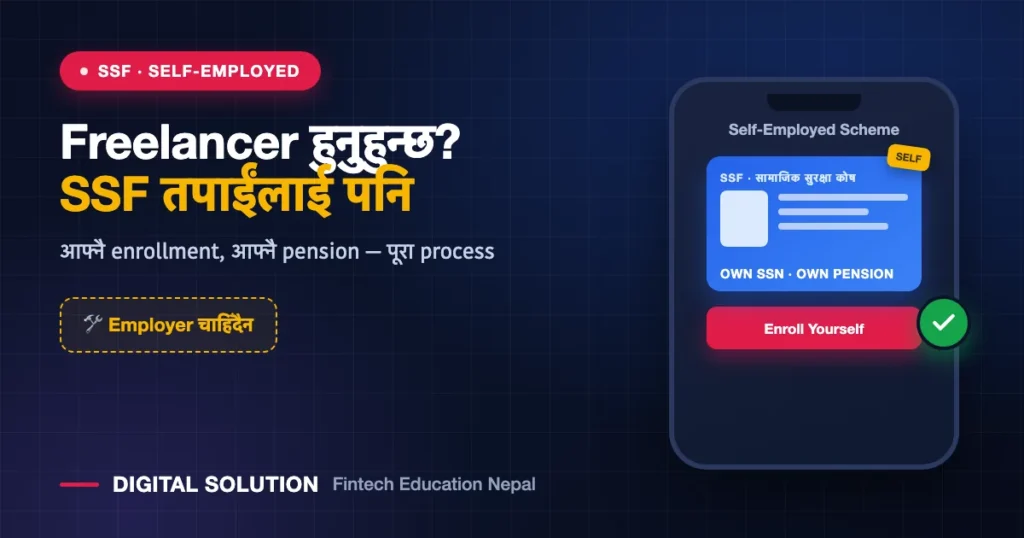
Shopkeepers, freelancers, consultants, drivers and small business owners are not anyone’s employee, so for years they had no social security. Since 2080 Shrawan 31, the Social Security Fund (SSF) has accepted self-employed people (स्वरोजगार) in its own scheme. You pay the whole contribution yourself, choose your contribution base within a range, and get medical, accident, family and old-age protection. Here is how it works.
Who counts as self-employed
The Registration Procedure 2075 defines a self-employed person as someone who runs a profession or business on their own account. In practice that includes:
- Freelancers and independent professionals such as designers, developers, consultants and content creators
- Shop and small business owners
- Drivers and riders who work for themselves
- Farmers and other own-account workers
If you work for someone else without a contract, the informal sector scheme may fit better. If you work abroad, see the foreign employment contribution guide.
How much you pay
Section 5(4) of the Informal and Self-Employed Procedure says a self-employed person must contribute 31% of a base that is at least the minimum basic remuneration and at most three times it. The minimum basic wage in the notice effective 17 July 2025 is Rs 12,170, and we found no newer notice as of 20 October 2026.
| Base you choose | Monthly contribution at 31% (our calculation) |
|---|---|
| Rs 12,170 (minimum) | Rs 3,772.70 |
| Rs 24,340 (2 times) | Rs 7,545.40 |
| Rs 36,510 (3 times, maximum) | Rs 11,318.10 |
There is no employer or government share in the self-employed scheme. You declare your monthly contribution amount when you register.
Where your 31% goes
| Scheme | Share of base | Amount at the minimum base (our calculation) |
|---|---|---|
| Medical, health and maternity | 2.4% | Rs 292.08 |
| Accident and disability | 0.8% | Rs 97.36 |
| Dependent family | 1.8% | Rs 219.06 |
| Old age | 26% (at least 16% goes to the pension account) | Rs 3,164.20 |
Most of your money, 26 of the 31 percentage points, builds your old-age savings. The rest buys insurance-style cover.
What you get
These benefits come from the same procedure. Amounts tied to the minimum basic remuneration rise when it is revised.
| Benefit | What the procedure provides |
|---|---|
| Hospital treatment | Up to Rs 1 lakh a year for you, your spouse and children under 18 when admitted; you pay 20% of each claim |
| Maternity | 60% of the minimum basic remuneration for 98 days, plus one month of minimum basic per newborn for child care |
| Accident treatment | Up to Rs 7 lakh |
| Temporary total disability | 60% of the minimum basic remuneration monthly until you can return to work |
| Permanent disability | A lifelong monthly payment in proportion to the degree of disability |
| Death | For the self-employed, a spouse pension at 40% of your average remuneration; education allowance for up to two children; Rs 25,000 for funeral costs |
| Old age | From 60, pension account plus returns divided by 160, paid monthly for life |
Benefits need a minimum contribution record: 3 months in the last 6 for medical and accident benefits, 9 months in the last 12 for the spouse pension and education allowance, and 1 month in the last 6 for funeral costs.
Discounts the procedure allows
- Paying in advance: if you pay more than six months ahead, the board may give a discount of up to 10%.
- No claims for three years: if you make no medical, accident or dependent-family claim for three straight years, you can apply to move up to 20% of those scheme deposits into your pension account.
The exact amounts are decided by the SSF board, so ask SSF before planning around them.
How to enrol: step by step
- Gather documents. Section 3(3) lists a copy of your Nepali citizenship; your business registration certificate, or if the business is not registered, a recommendation from the ward office where you work; the monthly contribution amount you will pay; a copy of your PAN or tax registration certificate; and your business name, address and contact number. If you do not have a PAN yet, see our PAN and VAT registration guide.
- Apply. Fill the application in the Schedule 2 format at an SSF office, a body SSF designates, or through SSF’s online system (sosys.ssf.gov.np). SSF’s citizen charter says online registration and SSF number issue take up to 3 days.
- Receive your SSF number and ID card. Keep your 11-digit SSN safe.
- Complete KYC and add a nominee. Claims and withdrawals are paid only to the bank account in your verified KYC (KYC and nominee guide).
- Pay every month. Pay through the channels shown in your SSF account, on a fixed date.
- Check your statement. Confirm each payment is posted.
A worked example
Sita runs a small tailoring shop in Pokhara and chooses the minimum base. She pays Rs 3,772.70 a month (our calculation at the Rs 12,170 base). Of that, Rs 3,164.20 goes to her old-age account and the rest buys medical, accident and family cover. After three months of payments in a six-month window, she and her children under 18 can claim hospital treatment up to Rs 1 lakh a year. If her income grows, she can raise her declared base up to Rs 36,510.
The tax angle
The Finance Bill 2083 says the 1% tax on the first income band is not charged on individuals who contribute to SSF. According to Onlinekhabar, the House passed the bill on 28 June 2026. The bill also excludes taxpayers registered as sole proprietorship firms from that 1% band. Ask the Inland Revenue Department or a tax adviser how this applies to your income (FY 2083/84 tax rates).
Is it worth it without an employer?
The formal scheme’s biggest advantage, the employer’s 20%, does not exist here. Compare honestly:
| SSF self-employed scheme | Saving or investing on your own |
|---|---|
| Medical, accident, disability and family cover bundled in | No cover unless you buy insurance separately |
| Lifelong pension from 60 | You manage the risk of outliving your savings |
| Money locked for old age | Full access to your money |
| Returns set by the SSF board each year | Returns depend on your choices |
For many self-employed people with no other safety net, joining at the minimum base and investing separately is a sensible balance.
Need help with SSF registration, KYC or claims?
Digital Solution helps with SSF registration, KYC updates, contribution records and claim documents, online and step by step. SSF सम्बन्धी काममा सहयोग चाहिए सम्पर्क गर्नुहोस्।
Frequently asked questions
Can freelancers join SSF in Nepal?
Yes. Freelancers count as self-employed and can register with a citizenship copy, a business registration certificate or ward recommendation, and a PAN, then contribute 31% of a base they choose.
How much does a self-employed person pay each month?
Between Rs 3,772.70 and Rs 11,318.10 a month at the current minimum basic of Rs 12,170, depending on the base you choose (31% of one to three times the minimum basic).
Do self-employed contributors get a pension?
Yes. At least 16% of the base goes to the pension account. From 60, the balance plus returns is divided by 160 and paid monthly for life.
I freelance now but may take a job later. What happens?
Your SSN is permanent. Section 34 of the procedure lets SSF convert your participation into the formal scheme when you are appointed in the formal sector, so your record continues.
Can my family’s medical costs be covered?
Yes. Hospital treatment for you, your spouse and children under 18 is covered up to Rs 1 lakh a year with a 20% co-payment, once you have 3 months of contributions in the last 6.
Conclusion
SSF’s self-employed scheme gives business owners and freelancers a pension and basic protection they would otherwise have to build alone. Choose a base you can sustain, register with your citizenship and PAN, complete KYC, and pay every month. Check the current minimum basic on ssf.gov.np before you fix your amount.
Sources
- Social Security Fund, Informal and Self-Employed Sector Social Security Scheme Operation Procedure 2079 with first amendment: https://ssf.gov.np/list/act_regulation/informal-and-self-employed-sector-social-security-scheme-operation-procedure-with-first-amendment-2079
- Social Security Fund, Contribution-based Social Security Act 2074 (as amended in 2082): https://ssf.gov.np/list/act_regulation/contribution-based-social-security-act-2074
- Social Security Fund, Employer and Worker Registration Procedure 2075: https://ssf.gov.np/list/act_regulation/rajagarathata-ra-sharamakaka-sacakaranae-samabnathha-karayavathha
- Social Security Fund, Citizen charter (2026): https://ssf.gov.np/pages/citizen-charter
- Social Security Fund, Press release on Social Security Day 2082 (27 November 2025): https://ssf.gov.np/list/press_release/press-release
- Pradhan & Associates, Minimum Remuneration Notice 2082 (24 July 2025): https://pradhanlaw.com/publications/minimum-remuneration-notice-2082-2025-ad
- Ministry of Finance, Finance Bill 2083: https://mof.gov.np/content/1742/economic-bill–2083/
- Onlinekhabar, HoR passes Finance Bill 2083 (28 June 2026): https://english.onlinekhabar.com/hor-passes-finance-bill-2083.html
Digital Solution Pvt. Ltd. is an independent publisher and is not affiliated with the Social Security Fund; confirm the current contribution range and benefits with SSF (ssf.gov.np, hotline 1116) before enrolling.

Rabin Paudel
Rabin Paudel is the Founder of Digital Solution, a Content Creator, and an AI Trainer. He shares practical and easy-to-understand content on Artificial Intelligence, Digital Literacy, Online Services, FinTech, and Technology. His mission is to make technology simple, accessible, and useful for everyone.
View all posts by Rabin Paudel →