
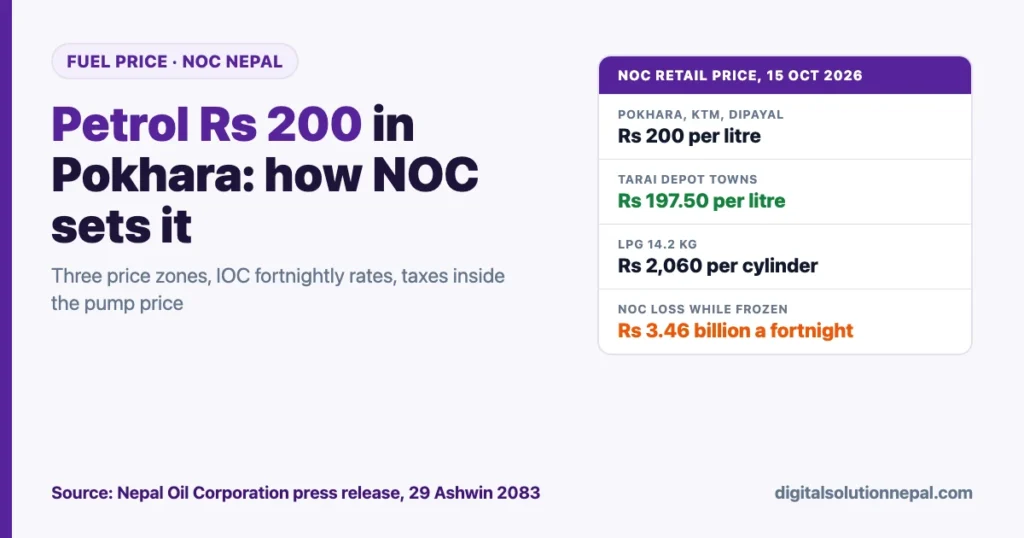
As of 30 October 2026 (13 Kartik 2083). Prices and the depot rule are from Nepal Oil Corporation (noc.org.np) and its press release of 29 Ashwin 2083 (15 October 2026); the tax table is from NOC’s release of 26 Chaitra 2082 (9 April 2026). The 1 October decision is reported from ShareSansar and Peoples’ Review with attribution because that notice is not on the NOC site. nea.org.np timed out when we checked the electricity tariff, so EV figures use the ERC 2078 tariff as reported by secondary sources and are marked as our calculation.
The petrol price in Nepal is not set at the pump or by the dealer. It is fixed by Nepal Oil Corporation (NOC), the state monopoly importer, each time Indian Oil Corporation (IOC) sends a new purchase price. A rider in Pokhara pays Rs 200 a litre today; a rider in Biratnagar pays Rs 197.50 for the same fuel. This post explains why, what sits inside that Rs 200, and why the price has not moved since August even though NOC says its own cost has risen twice since then.
Quick answers
| Question | Answer (as of 30 October 2026) |
|---|---|
| Petrol in Pokhara and Kathmandu | Rs 200 per litre (Category 3) |
| Diesel and kerosene, Pokhara and Kathmandu | Rs 200 per litre |
| Petrol in Biratnagar, Birgunj, Bhalwari | Rs 197.50 per litre (Category 1) |
| Petrol in Surkhet and Dang | Rs 199 per litre (Category 2) |
| LPG, 14.2 kg cylinder | Rs 2,060 |
| Last change | 3 August 2026 (petrol up Rs 3, diesel up Rs 5) |
| Who decides | NOC board, under the automatic pricing mechanism |
| IOC revision cycle | Fortnightly for petrol, diesel, kerosene; monthly for ATF and LPG |
| NOC’s stated loss while holding prices | About Rs 3.46 billion per fortnight (15 October 2026 release) |
Current petrol, diesel and LPG price in Nepal by zone
NOC’s press release of 29 Ashwin 2083 (15 October 2026) confirms the prices below. They apply within 15 km of an NOC depot or office for petrol, diesel and kerosene, and within 50 km of the bottling plant for LPG. Beyond that radius dealers may add approved transport cost, which is why a hill pump can show a rupee or two more.
| Product | Category 1 | Category 2 | Category 3 |
|---|---|---|---|
| Petrol (per litre) | Rs 197.50 | Rs 199.00 | Rs 200.00 |
| Diesel and kerosene (per litre) | Rs 197.50 | Rs 199.00 | Rs 200.00 |
| Aviation fuel, domestic (per litre) | Rs 249 | Rs 249 | Rs 249 |
| Aviation fuel, international (per kilolitre) | USD 1,697 Kathmandu; USD 1,395 Bhairahawa; USD 1,410 Pokhara | ||
| LPG (14.2 kg cylinder) | Rs 2,060 | Rs 2,060 | Rs 2,060 |
Category 1 covers Charali, Biratnagar, Janakpur, Amlekhgunj, Bhalwari, Nepalgunj, Dhangadhi and Birgunj. Category 2 covers Surkhet and Dang. Category 3 covers Kathmandu, Pokhara and Dipayal.
Diesel now costs the same as petrol. For years it was Rs 15 to Rs 20 cheaper, but during the April 2026 spike NOC raised diesel faster because its diesel import cost rose faster (ShareSansar, 10 April 2026). Our reading is that this has removed the running-cost edge that diesel SUVs and pickups used to enjoy.
The three price zones: why Pokhara pays more than Birgunj
NOC publishes no formula for the zones, but the pattern is clear in every notice. Category 1 towns have an NOC depot near the Indian border, where fuel arrives by tanker or, at Amlekhgunj, by the Motihari to Amlekhgunj pipeline. Category 2 towns are inland. Category 3 towns (Kathmandu, Pokhara, Dipayal) are farthest from the supply points and need the longest tanker haul.
So the Rs 1.50 and then Rs 1 steps between zones are, in our reading, NOC’s approved transport cost. Pokhara’s fuel mostly comes through the Bhalwari (Bhairahawa) depot and up the Siddhartha Highway, so the Rs 2.50 gap between Bhalwari and Pokhara is what a Pokhara rider pays for the haul on every litre.
The 15 km rule matters in Kaski. Pumps in Pokhara city sit inside the radius of NOC’s Pokhara office, so they must sell at Rs 200. A pump 40 km out towards Baglung can legally add transport cost, which is why highway prices are sometimes Rs 201 or Rs 202. If a city pump asks more than the notice price, you can complain to NOC through the grievance link on noc.org.np or to the District Administration Office.
How NOC sets the petrol price in Nepal: the automatic pricing mechanism
Nepal buys all of its petrol, diesel, kerosene, jet fuel and LPG from IOC under a long-term supply agreement. IOC sends a fresh purchase price for petrol, diesel and kerosene every fortnight and for aviation fuel and LPG every month (The Kathmandu Post, 17 July 2023). The two IOC letters behind this post arrived on 14 Ashwin (30 September) and 29 Ashwin (15 October) 2083.
The automatic pricing mechanism (स्वचालित मूल्य प्रणाली) is NOC’s rule for turning that IOC price into a pump price. It was first introduced on 29 September 2014, dropped within months when the government began cross-subsidising, and revived on 17 July 2023 after NOC cleared Rs 31 billion of dues to IOC (Onlinekhabar and The Kathmandu Post, July 2023). Under the revived version NOC keeps a fixed margin, reported as Rs 3.63 a litre on petrol and Rs 2.79 on diesel by The Kathmandu Post (2.5 and 2 percent in Onlinekhabar’s report), and passes the rest of any cost change through to the consumer.
In practice the process runs like this.
- IOC sends the fortnightly purchase price in Indian rupees per kilolitre, converted at the fixed INR to NPR rate of 1.60.
- NOC adds the government levies: customs duty, infrastructure development tax, road maintenance fee, pollution control fee, green tax, the price stabilisation fund levy and 13 percent VAT.
- NOC adds its own costs: transport from the border, depot handling, insurance, transit losses, its fixed margin and the dealer commission.
- The result is compared with the current retail price. If the mechanism gives a higher number, the board approves an increase; if lower, a decrease.
- The new price takes effect at 00:01 the next morning and is published as a press release on noc.org.np in the three-category table.
Step 4 is where politics enters. The board can decide not to follow the mechanism, which is exactly what happened on 1 October and again on 15 October 2026.
The October 2026 freeze: higher cost, same pump price
On 14 Ashwin 2083 (30 September 2026) IOC’s new rates raised NOC’s purchase cost by Rs 20.44 per litre on petrol, Rs 20.21 on diesel, Rs 15.96 on kerosene, Rs 18.66 on aviation fuel and Rs 81.32 per LPG cylinder (ShareSansar, 1 October 2026, citing NOC’s statement). The mechanism would have pushed Pokhara petrol above Rs 220. Instead the board kept the retail price unchanged from 00:01 on 1 October, citing the Dashain and Tihar season, the Bhotekoshi floods and landslides, and volatility from the Middle East conflict. NOC put the cost of that decision at about Rs 3.20 billion per fortnight.
Two weeks later the next IOC letter arrived. NOC’s own release of 29 Ashwin (15 October 2026) says the board again held prices as before (साबिककै खुद्रा बिक्री मूल्यलाई नै यथावत) and that the fortnightly loss at current rates is Rs 3 arab 45 crore 81 lakh, which is Rs 3.458 billion (our conversion).
Our reading: a freeze is not a cut. NOC is still buying at the higher IOC price, so each fortnight adds roughly Rs 3.4 billion to its losses, to be covered by the price stabilisation fund, government loans, or a later increase after the festivals. If IOC’s rate falls, the freeze unwinds with no visible change at the pump. If it does not, a post-Tihar rise is the likely outcome, though NOC has announced nothing as of our check date.
What is inside Rs 200: taxes and fees in a litre of petrol
NOC’s release of 26 Chaitra 2082 (9 April 2026) is the only recent official document that lists every levy per litre. It was issued to explain the Cabinet’s 50 percent cut in customs duty and infrastructure tax from 24 Chaitra 2082 (7 April 2026).
| Levy (per litre) | Petrol, before 7 April 2026 | Petrol, after cut | Diesel, before | Diesel, after cut |
|---|---|---|---|---|
| Customs duty and declaration fee | Rs 25.23 | Rs 12.63 | Rs 12.03 | Rs 6.03 |
| Road maintenance fee | Rs 4.00 | Rs 4.00 | Rs 2.00 | Rs 2.00 |
| Pollution control fee | Rs 1.50 | Rs 1.50 | Rs 1.50 | Rs 1.50 |
| Infrastructure development tax | Rs 10.00 | Rs 5.00 | Rs 10.00 | Rs 5.00 |
| Green tax | Rs 1.00 | Rs 1.00 | Rs 1.00 | Rs 1.00 |
| VAT (13 percent, on the Rs 202 or Rs 182 price of that day) | Rs 23.24 | Rs 23.24 | Rs 20.94 | Rs 20.94 |
| Price stabilisation fund levy (1 percent) | Rs 2.02 | Rs 2.02 | Rs 1.82 | Rs 1.82 |
| Total government revenue | Rs 66.98 | Rs 49.38 | Rs 49.28 | Rs 38.28 |
We found no later official notice restoring the full rates, so we treat the halved rates as still in force but unverified. On today’s Rs 200 petrol, VAT alone is Rs 23.01 (200 multiplied by 13 and divided by 113, our calculation). With the other levies at the halved rates, roughly Rs 49 of every Rs 200 litre is tax, about one quarter; at full rates it would be about Rs 67, one third. Either way the government earns far more on a litre than NOC, whose margin is under Rs 4.
The same release shows how far below cost the pump price can fall. On 9 April NOC’s landed cost of petrol was Rs 236.36 a litre against a retail price of Rs 202, and diesel cost Rs 302.54 against Rs 182. The total loss that fortnight was Rs 11.72 billion, which is why prices were raised sharply over the following three weeks.
2026 price timeline (Category 3: Kathmandu, Pokhara, Dipayal)
From the price history on noc.org.np and NOC press releases.
| Effective date | Petrol | Diesel | Note |
|---|---|---|---|
| 1 January 2026 | Rs 159 | Rs 137 | |
| 16 January 2026 | Rs 156 | Rs 136 | Petrol down Rs 3, diesel down Rs 1 |
| 16 February 2026 | Rs 157 | Rs 142 | |
| 16 March 2026 | Rs 172 | Rs 152 | Middle East conflict begins to bite |
| 26 March 2026 | Rs 187 | Rs 167 | Up Rs 15 |
| 3 April 2026 | Rs 202 | Rs 182 | Up Rs 15 |
| 10 April 2026 | Rs 219 | Rs 207 | Petrol up Rs 17, diesel up Rs 25 |
| 16 April 2026 | Rs 219 | Rs 237 | Diesel up Rs 30, now above petrol |
| 30 April 2026 | Rs 217 | Rs 225 | First cut |
| 1 July 2026 | Rs 197 | Rs 195 | Petrol down Rs 20, diesel down Rs 30 |
| 3 August 2026 | Rs 200 | Rs 200 | Unchanged since |
Petrol in Pokhara went from Rs 156 in mid-January to Rs 219 in mid-April, a rise of 40 percent in three months (our calculation), before easing to Rs 200.
What Rs 200 petrol means for your monthly bill: bike, car and EV
This table is our calculation at the Category 3 price of Rs 200 with stated assumptions. Electricity is taken at Rs 11 per unit plus 13 percent VAT, the top household block of the ERC 2078 tariff as reported by secondary sources, because nea.org.np was unreachable at our check time.
| Vehicle | Assumed efficiency | Monthly distance | Energy used | Monthly cost |
|---|---|---|---|---|
| 125 to 160 cc petrol bike | 40 km per litre | 600 km | 15 litres | Rs 3,000 |
| 110 cc scooter | 45 km per litre | 600 km | 13.3 litres | Rs 2,667 |
| Petrol car or small SUV | 13 km per litre | 1,000 km | 76.9 litres | Rs 15,385 |
| Diesel SUV or pickup | 13 km per litre | 1,000 km | 76.9 litres | Rs 15,385 |
| Electric scooter | 25 km per unit | 600 km | 24 units | Rs 298 |
| Electric car, home charging | 6.5 km per unit | 1,000 km | 154 units | Rs 1,912 |
| Electric car, public charger (Rs 12.36 per unit ceiling, normal hours) | 6.5 km per unit | 1,000 km | 154 units | Rs 1,901 |
The EV rows leave out the higher purchase price, battery risk and charging time, which we cover in our guide to electric car prices in Nepal. Still, at Rs 200 a litre an electric car saves about Rs 13,000 a month on 1,000 km, and a petrol bike ridden 600 km a month burns around Rs 36,000 a year in fuel. Factor that in when you compare models in our bike price list for Nepal.
How to check the real petrol price and avoid overpaying
- Open noc.org.np. The home page price block shows the rate for each category and the note that it applies within 15 km of the depot.
- Find your category: Pokhara, Kathmandu and Dipayal are Category 3; Surkhet and Dang are Category 2; the Tarai depot towns are Category 1.
- If your pump is more than 15 km from a depot or NOC office, expect a small transport addition, but ask for the approved rate if the gap is more than a few rupees.
- Check the date on the latest press release under Media Center. A viral post about a “hike from tonight” can be verified in a minute.
- Keep the receipt. Written complaints with receipts go to the Department of Commerce, Supplies and Consumer Protection or the District Administration Office.
- Watch the 1st and 16th of each month. New IOC rates usually arrive then, so that is when NOC’s decisions are announced.
Need help with vehicle paperwork or an EV switch?
Digital Solution in Pokhara prepares and scans documents, fills forms on official portals (licence, bluebook renewal, company registration) and runs AI and digital skills training for small businesses. Ask us before your next trip to the Transport Office. हामी पोखरामा छौं, सम्पर्क गर्नुहोस्।
Frequently asked questions
What is the petrol price in Nepal today?
As of 30 October 2026, petrol is Rs 200 per litre in Kathmandu, Pokhara and Dipayal, Rs 199 in Surkhet and Dang, and Rs 197.50 in Charali, Biratnagar, Janakpur, Amlekhgunj, Bhalwari, Nepalgunj, Dhangadhi and Birgunj. Diesel and kerosene match petrol in each zone. The rates have not changed since 3 August 2026.
Why is petrol dearer in Pokhara than in Bhairahawa?
NOC groups towns into three categories by distance from its supply depots. Pokhara is in Category 3, the farthest group, so its price carries about Rs 2.50 more than Bhalwari (Bhairahawa), a Category 1 depot town. This is our reading of NOC’s zone table; NOC does not publish the transport formula.
How often does NOC change fuel prices?
IOC sends new purchase prices for petrol, diesel and kerosene every fortnight, usually around the 1st and 16th, and NOC’s board decides whether to pass them on. In 2026 prices changed eleven times between 1 January and 3 August and were then frozen on 1 and 15 October.
How much tax is in one litre of petrol?
On NOC’s April 2026 table the government took Rs 66.98 per litre at full rates and Rs 49.38 after the Cabinet halved customs duty and infrastructure tax. On today’s Rs 200 price VAT alone is about Rs 23. We could not confirm whether the halved rates still apply in October 2026.
Is NOC losing money at Rs 200?
Yes, by its own statement. The 15 October 2026 release puts the loss at Rs 3.458 billion per fortnight while prices are held. Whether this is recovered through a later rise or absorbed by the price stabilisation fund has not been announced.
Conclusion
The petrol price in Nepal is a chain: IOC’s fortnightly rate, government levies of roughly Rs 49 to Rs 67 a litre, NOC’s transport and margin, and a board decision that can override the formula. Right now the formula says the price should be higher, and the board has chosen to freeze it for the festival season at a cost of about Rs 3.4 billion a fortnight. Pokhara pays Rs 200 because it sits in the farthest price zone, Rs 2.50 above the Tarai depot towns. Watch noc.org.np on the 1st and 16th of each month; that is when the next decision will appear.
Sources
- Nepal Oil Corporation, home page price block and retail price history (checked 30 October 2026): https://noc.org.np/
- Nepal Oil Corporation, Press Release 29 Ashwin 2083 / 15 October 2026 (prices held, Rs 3.4581 billion fortnightly loss): https://beta.noc.org.np/storage/articles/documents/fCsKKddhmiYgh5itl0zYzHHLQcRerUqxdQ3DeCMi.pdf
- Nepal Oil Corporation, Press Release 26 Chaitra 2082 / 9 April 2026 (tax table, cost versus retail): https://beta.noc.org.np/storage/articles/documents/m2QIEUDeUh2PeSIuokpnpa86Cbi3XjCFrSJsIsMc.pdf
- Nepal Oil Corporation, Press Release 1 Magh 2082 / 15 January 2026 (zone list, 15 km rule): https://beta.noc.org.np/storage/articles/documents/2FDDiKuf9XzkoTawNUpd39xhlMewmMjWveGAkCiE.pdf
- ShareSansar, Nepal Oil Corporation Keeps Fuel Prices Unchanged Despite Higher Import Costs (1 October 2026): https://www.sharesansar.com/newsdetail/nepal-oil-corporation-keeps-fuel-prices-unchanged-despite-higher-import-costs-2026-10-01
- ShareSansar, Nepal Oil Corporation Raises Fuel Prices; Petrol Hits Rs 200 Per Liter in Kathmandu (3 August 2026): https://www.sharesansar.com/newsdetail/nepal-oil-corporation-raises-fuel-prices-petrol-hits-rs-200-per-liter-in-kathmandu-2026-08-03
- Peoples’ Review, NOC not to increase retail price until upcoming festival (1 October 2026): https://peoplesreview.com.np/2026/10/01/heavy-petroleum-price-increment-yet-noc-not-to-increase-retail-price-until-upcoming-festival/
- Nepalnews, Fuel prices remain unchanged as NOC faces fortnightly loss (15 October 2026): https://english.nepalnews.com/s/business/fuel-prices-remain-unchanged-as-noc-faces-fortnightly-loss/
- The Kathmandu Post, Nepal Oil revives auto pricing of fuel (17 July 2023): https://kathmandupost.com/money/2023/07/17/nepal-oil-revives-auto-pricing-of-fuel
- Onlinekhabar, Government revives automatic pricing system for petroleum products (17 July 2023): https://english.onlinekhabar.com/automatic-pricing-system-petroleum-products.html
- Spotlight Nepal, Government reduces fuel customs duty and infrastructure development tax by half (8 April 2026): https://www.spotlightnepal.com/2026/04/08/nepal-governemnt-rduces-fuel-customs-duty-and-infrastructure-development-tax-half/
- EV News Nepal, EV charging cost in Nepal (ERC 2078 tariff as reported; checked 30 October 2026): https://evnewsnepal.com/ev-charging-cost-in-nepal
Prices change at short notice; confirm the current rate on noc.org.np before relying on any figure here. Monthly cost figures are illustrative calculations, not quotes.

Rabin Paudel
Rabin Paudel is the Founder of Digital Solution, a Content Creator, and an AI Trainer. He shares practical and easy-to-understand content on Artificial Intelligence, Digital Literacy, Online Services, FinTech, and Technology. His mission is to make technology simple, accessible, and useful for everyone.
View all posts by Rabin Paudel →