
Updated 13 August 2026. Every figure below is taken directly from the Ministry of Finance procedure — सहुलियतपूर्ण कर्जाका लागि ब्याज अनुदानसम्बन्धी कार्यविधि, २०८२ — and its First Amendment, 2083, published by Nepal Rastra Bank. This is the governing document, not a summary of one.
Most Nepalis who could use a Nepal subsidy loan never apply, for one reason: they assume they need land to pledge.
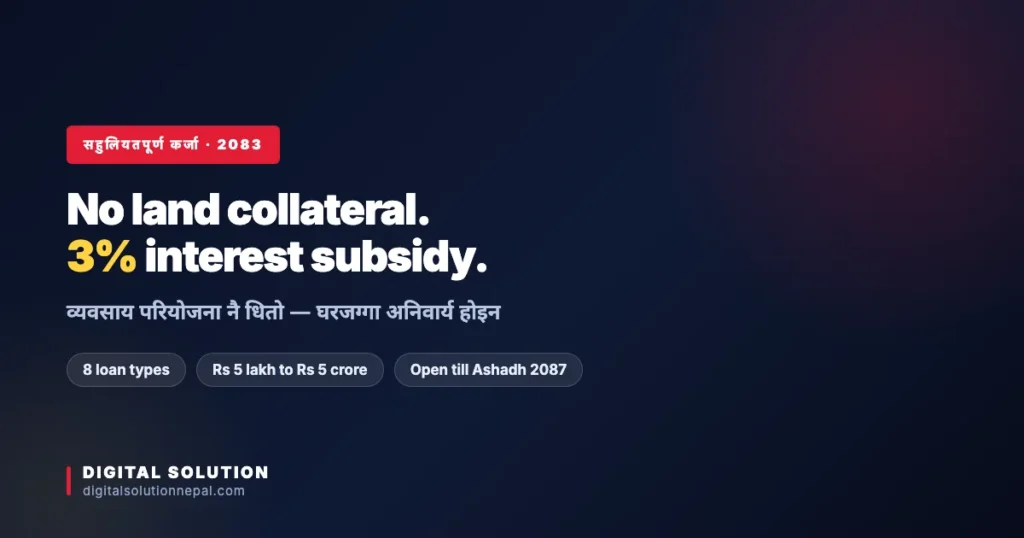
They do not. The procedure says the opposite in plain terms — the business project itself is the collateral, and the bank must treat project feasibility as the main basis for its decision.
That single rule is what makes this scheme different from every other loan in Nepal. This guide covers all eight loan types, the exact limits, the subsidy you actually receive, who qualifies, and the deadlines that now apply after the First Amendment.
What the subsidy actually is
The scheme is officially सहुलियतपूर्ण कर्जा — subsidized loan — and the subsidy is on the interest, not the principal.
Two numbers define it:
| Interest you are charged | Bank’s base rate + maximum 1.5% |
| Subsidy the government pays | 3 percentage points of that interest rate |
So the government does not lend you money. Your bank lends at a capped rate, and the Government of Nepal reimburses 3 percentage points of the interest through a dedicated account at Nepal Rastra Bank.
Your bank’s base rate therefore decides your real cost. We explain how base rate works, and why it changes monthly, in our guide to bank interest rates in Nepal.
One condition people miss: the subsidy is paid after you have paid your interest, protection fee and insurance premium — not before. You pay, then the government reimburses the bank. Falling behind means losing it.
The eight loan types and their limits
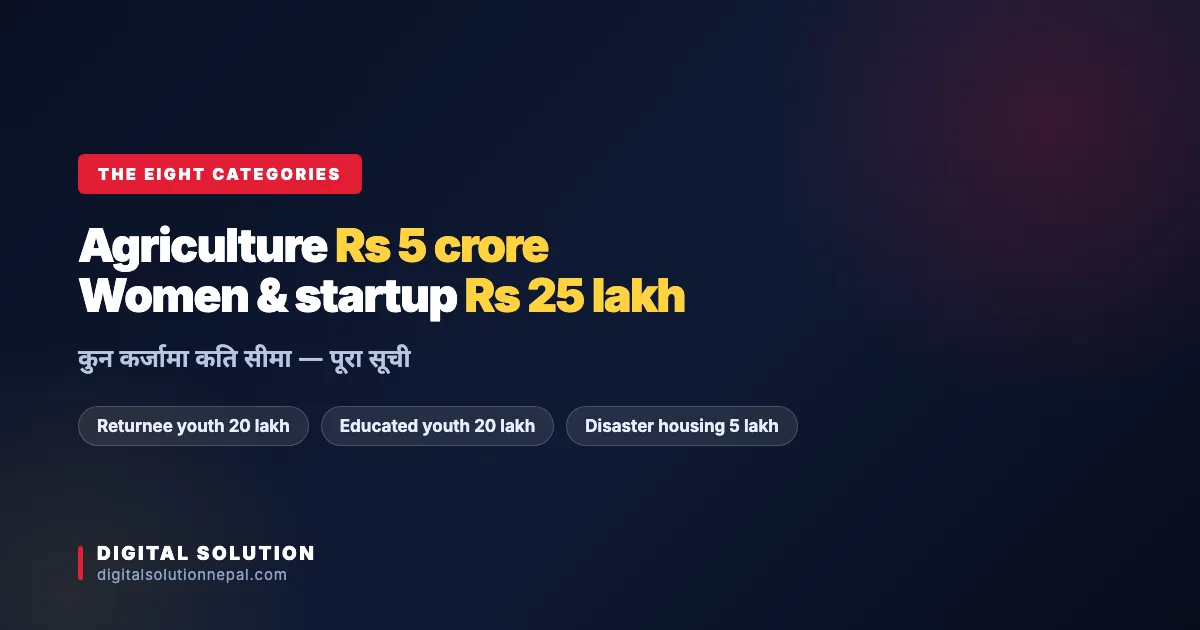
The procedure sets one limit per category. These are ceilings, not entitlements — what you get depends on your project.
| Loan type | Maximum |
|---|---|
| Agriculture and livestock (कृषि तथा पशुपन्छी) | Rs 5 crore |
| Women entrepreneur (महिला उद्यमशील) | Rs 25 lakh |
| Startup enterprise (स्टार्ट अप उद्यम) | Rs 25 lakh |
| Foreign-employment returnee youth self-employment | Rs 20 lakh |
| Educated youth project (शिक्षित युवा परियोजना) | Rs 20 lakh |
| Dalit community enterprise development | Rs 20 lakh |
| Boiler replacement in industry | Rs 50 lakh |
| Private housing for natural disaster victims | Rs 5 lakh |
Three rules apply across all of them:
- The loan is instalment-based (आवधिक), not an overdraft
- Once approved, the limit cannot be increased again
- Only one member per household (एकाघर परिवार) may take a subsidy loan
The collateral rule that changes everything
This is section 10, and it is the part worth reading twice.
When a bank lends under this scheme, it must lend against the personal or group guarantee of a household member, with the business project pledged as security. And when deciding, the feasibility of the project must be the main basis.
In practice this means a well-prepared project proposal matters more than owning land. If a bank tells you a subsidy loan requires property collateral, it is not following the procedure — ask them to show you where it says so.
For group loans, if one member cannot continue for reasons beyond their control, they must clear their share of principal and interest themselves, or the remaining members must give the bank a written commitment to cover it. Get that in writing at the start, not when someone leaves.
Who qualifies
The basic conditions apply to everyone:
- 18 years or older
- Nepali citizen
- Not blacklisted by the Credit Information Centre
- Holds a PAN certificate
- Business or institution registered — except for the disaster housing loan
- For an institution: 100% Nepali citizen ownership
Then the category-specific ones:
Women entrepreneur loan — the business must be 100% women-owned. Not majority. All of it.
Foreign-employment returnee — you must have gone abroad on a labour permit (श्रम स्वीकृति), worked at least six months in any country, and returned. But if you hold permanent residency of any country, you are not eligible. That rules out many people who assume returning from abroad is enough.
Educated youth project — at least a Bachelor’s degree, and the project must relate to your own knowledge, experience, interest or skill.
Group loans — at least five members, each 18 or older, and they must be from different families.
Startup enterprise — this one has its own test. Annual turnover must not exceed Rs 15 crore in any fiscal year since establishment; it must be a genuinely new enterprise, not one created by merging or splitting an existing business; and it must be a novel, creative idea with potential for rapid growth.
You are not a startup — explicitly — if you are not registered as an industry, if you import goods or services from abroad to resell, if you are blacklisted, or if you are registered as a holding or investment company.
What you need to apply
Attach these to your bank’s loan application form:
- Business registration, PAN certificate and tax clearance certificate — copies
- Citizenship or National ID — copy
- A short proposal on running the enterprise and using the loan
- Guarantee documents, where a guarantee applies
- For loans above Rs 10 lakh — a recommendation from the local-level ward or branch dealing with that business
- A self-declaration that you have taken no other subsidy loan and hold no country’s permanent residency
Disaster housing loans are treated differently. You do not need business registration, PAN or tax clearance. Instead you need a copy of the document from the federal, provincial, local or designated body listing you as disaster-affected.
The bank has a deadline too
People rarely know this, and it is worth quoting at your branch.
| Bank must decide on your application | Within 15 working days |
| If rejected, bank must tell you in writing | Within 3 working days, with the basis and reasons |
A refusal without written reasons is not a proper refusal under this procedure.
There is also a limit on charges. Beyond interest, the credit information fee and the insurance premium you have to bear, the bank may not levy any other charge. On loans above Rs 15 lakh, the insurance premium is the borrower’s own cost.
How long the subsidy lasts — and the new deadline
Two time limits matter, and the First Amendment changed one of them.
Interest subsidy runs for a maximum of five years on any loan.
The scheme itself closes. Subsidy loans under this procedure will be issued only until the end of Ashadh 2087. That is the window.
What the First Amendment added (section 2क): for loans issued under the earlier Unified Procedure, 2075, if the loan is renewed, the subsidy remains available for five years from the date the subsidy started — not from the renewal. If you took a subsidy loan under the old scheme, this is the clause that decides how much runway you have left.
Your bank sets the grace period, instalment size and repayment period based on the loan type, amount, purpose, nature of the business, the time it takes to generate returns, and risk.
Misuse has a specific consequence
The procedure is blunt about this. If the subsidized loan is found to have been misused:
- The interest subsidy stops for the remaining period, and
- Any subsidy already received is recovered from the borrower — with interest
Monitoring whether the loan was used properly is the bank’s responsibility, not a government inspector’s. In practice that means your bank will ask for evidence that the money went into the business you described — purchase receipts, supplier invoices, photographs of equipment or construction, and site visits.
This is worth planning for rather than fearing. Keep every receipt from the day the money lands, and keep the loan in a separate account from your personal spending. Mixing subsidised loan money with household expenses is the most common way honest borrowers end up unable to prove proper use.
Note also that misuse is not the only route to losing the benefit. Because the subsidy is reimbursed only after you have paid your interest, protection fee and insurance premium, falling behind on payments interrupts the subsidy in practice even where no misuse is alleged.
The practical reading
If you are considering this, three things decide whether it works for you:
Your project proposal is the application. Since feasibility is the legal basis for the decision, the proposal is not paperwork — it is the thing being assessed. Costs, expected revenue, repayment capacity, and why you specifically can run it.
Get your registration and PAN done first. Except for disaster housing, the procedure requires business registration, PAN and tax clearance before you apply. That is a few days of work that people leave until the bank asks.
Check the household rule. One subsidy loan per household. If a family member already has one, you cannot take another under this scheme.
Frequently asked questions
What is the interest rate on a Nepal subsidy loan?
Your bank charges its base rate plus a maximum of 1.5%. The Government of Nepal then provides a subsidy equal to 3 percentage points of that interest rate, reimbursed to the bank after you have paid.
Do I need land or property as collateral?
No. The procedure requires the bank to lend against the personal or group guarantee of a household member with the business project itself as security, and to treat project feasibility as the main basis for the decision.
How much can I borrow?
It depends on the category: up to Rs 5 crore for agriculture and livestock, Rs 25 lakh for women entrepreneurs and startups, Rs 20 lakh for returnee youth, educated youth and Dalit enterprise development, Rs 50 lakh for boiler replacement, and Rs 5 lakh for disaster housing.
I worked abroad. Can I get this loan?
If you went on a labour permit, worked at least six months abroad and have returned, yes. But not if you hold permanent residency of any country — that disqualifies you.
How long does the bank take to decide?
Fifteen working days. If your application is rejected, the bank must give you written reasons within three working days.
How long does the subsidy last?
Up to five years. For loans originally issued under the 2075 unified procedure and later renewed, the First Amendment allows subsidy for five years from the date the subsidy first started.
When does the scheme end?
Subsidy loans under this procedure are to be issued only until the end of Ashadh 2087.
Can two people in my family each take one?
No. The procedure allows only one member per household (एकाघर परिवार).
What happens if I use the money for something else?
The subsidy stops for the remaining period and everything already paid is recovered from you, with interest. Your bank is responsible for monitoring proper use.
Getting your paperwork right before you apply
The gap between people who get these loans and people who do not is rarely the idea. It is registration, PAN, tax clearance and a proposal that a credit officer can actually assess.
Digital Solution helps businesses across Nepal with exactly that groundwork — registration, documentation, and getting a business properly set up on paper — from our office in Pokhara and remotely.
WhatsApp us on +977 9766597181 with what you want to start and where you are in the process.
Related reading: how bank base rates work in Nepal, SSF loans for contributors, and education loans and the MoE NOC.
Source: सहुलियतपूर्ण कर्जाका लागि ब्याज अनुदानसम्बन्धी कार्यविधि, २०८२ (decision date 2082/04/26) as amended by the पहिलो संशोधन कार्यविधि, २०८३ (amendment date 2083/3/18), issued by the Ministry of Finance under section 65(4) of the Financial Procedure and Fiscal Responsibility Act, 2076, and published by Nepal Rastra Bank. Read 13 August 2026. Banks apply their own credit assessment on top of these rules — confirm details with your branch before applying.

Rabin Paudel
Rabin Paudel is the Founder of Digital Solution, a Content Creator, and an AI Trainer. He shares practical and easy-to-understand content on Artificial Intelligence, Digital Literacy, Online Services, FinTech, and Technology. His mission is to make technology simple, accessible, and useful for everyone.
View all posts by Rabin Paudel →