
Last updated: August 2026 (Shrawan 2083). Document requirements can vary by office and change through government notices — confirm with your District/Area Administration Office before travelling. This is the document-focused companion to our complete National ID guide.
The most common reason people are turned away at a National ID enrollment counter isn’t eligibility — it’s documents. Either they brought photocopies instead of originals, or their citizenship certificate doesn’t match their current name, address or date of birth, and they didn’t bring the paper that bridges the gap.
So: what documents do you need for the National ID Card (राष्ट्रिय परिचयपत्र)? The short answer is one mandatory document plus whatever your personal situation requires. Here’s the complete breakdown, scenario by scenario.
The Short Answer
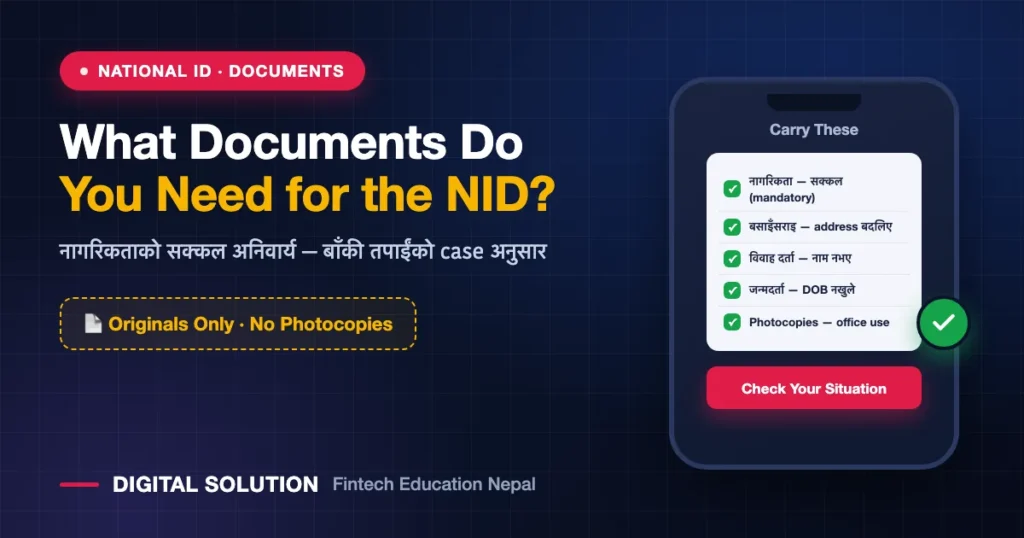
- ✅ Original Nepali citizenship certificate — mandatory for everyone
- ✅ Migration certificate (बसाइँसराइ) — if your permanent address has changed
- ✅ Marriage registration or relationship verification certificate — for married applicants whose spouse’s name is not on the citizenship certificate
- ✅ Birth registration, academic certificate or passport — if your citizenship certificate doesn’t show a complete date of birth
The citizenship certificate original is compulsory. The other documents are needed only if your records require them — which is exactly what the table below sorts out.
Find Your Situation: What to Carry
| Your situation | Bring (in addition to original citizenship) |
|---|---|
| Straightforward case — details all match | Nothing extra |
| Permanent address changed / moved district | Original migration certificate (बसाइँसराइ प्रमाणपत्र) or another accepted address proof |
| Married, spouse’s name already on citizenship | Nothing extra — the citizenship covers it |
| Married, spouse’s name not on citizenship | Marriage registration certificate, marriage verification, or relationship verification certificate |
| Citizenship shows age, not a full date of birth | Birth registration certificate, academic certificate, passport, or pension document |
| Name spelled differently across documents | Official document establishing the correct name — and often, correct the source record first |
| Applying from a district other than the issuing district | Address/migration proof; confirm the office’s requirement in advance |
| Cannot give fingerprints (disability, injury) | Nothing extra — the operator records the condition in the system |
1. Original Citizenship Certificate — Non-Negotiable
This is the foundation of the entire registration. Nepal’s National ID system is currently built on the citizenship certificate, so it must be the original, in readable condition, carried in person.
What tends to cause problems at the counter:
- A certificate that is torn, faded, laminated badly or water-damaged to the point details can’t be read
- Any self-correction — hand-written fixes, overwriting, whitener on a date or name
- Photocopies presented in place of the original
DONIDCR is explicit that unclear, damaged, self-corrected, altered or photocopied documents may not be accepted as the basis for registration. If your certificate is in poor shape, sort a proper replacement through your District Administration Office before attempting National ID enrollment.
2. Migration Certificate — When Your Address Has Changed
If the permanent address on your citizenship certificate is no longer where you live permanently — you moved district, or your family relocated — you’ll need the original migration certificate (बसाइँसराइ प्रमाणपत्र) or another officially accepted document confirming the current permanent address.
This is one of the most common gaps, especially for people who moved to Kathmandu, Pokhara or Chitwan for work but hold citizenship from their home district. Get this certificate from the relevant local level (ward/municipality) before your enrollment visit.
3. Marriage or Relationship Documents — For Married Applicants
The rule is simple:
- Spouse’s name already appears on your citizenship? The citizenship certificate is enough.
- Spouse’s name is not there? Bring a marriage registration certificate, marriage verification document, or relationship verification certificate.
An important limitation for married women: you generally cannot add a spouse’s surname to your National ID if that surname isn’t legally established in your citizenship record. In that case the citizenship certificate has to be amended first, and the National ID is then prepared or corrected on that basis. Trying to register a name that doesn’t exist in the source record creates verification problems later — with passports, banks and every service that checks identity.
4. Date of Birth Proof — When Citizenship Is Incomplete
Many older citizenship certificates record the person’s age at the time of issue rather than a full date of birth. If that’s your certificate, bring the strongest official evidence you have:
- Birth registration certificate (जन्मदर्ता)
- Academic certificate (SEE/SLC marksheet or character certificate)
- Passport
- Pension document
Whatever date ends up in the system will follow you across passports, banking and government records for life — so verify the final date on screen carefully before the operator finalizes your enrollment.
Originals vs Photocopies: The Rule
Carry originals for verification and photocopies for office use. The operator checks your details against the original; the office may keep copies. Going with photocopies alone is a wasted trip.
What Gets Applications Rejected or Delayed
- Only photocopies brought — the single most common wasted visit.
- Damaged or unreadable citizenship — fix the source document first.
- Any self-correction on a document — corrections must come from the issuing authority, never your pen.
- Missing bridge document — married name, changed address or incomplete DOB with nothing to prove it.
- Mismatched details across documents — different spellings between citizenship, academic certificates and passport. Correct the source records first; this is the fix that saves years of trouble.
- Not checking the screen — errors approved at enrollment are far harder to fix afterwards than to catch in the moment.
Before You Leave Home: Final Checklist
- ☑️ Original citizenship certificate (readable, undamaged)
- ☑️ Online pre-enrollment receipt / Application ID or QR code, where required
- ☑️ Migration certificate — if address changed
- ☑️ Marriage or relationship certificate — if applicable
- ☑️ Date-of-birth proof — if citizenship is incomplete
- ☑️ Any other original that explains a difference in your records
- ☑️ An active mobile number (your NIN and card SMS go here)
- ☑️ Photocopies of the above for office use
One more thing before biometrics: avoid caps, hats, face coverings, heavy makeup or jewellery that blocks a clear facial photograph — the operator will ask you to remove them anyway.
Frequently Asked Questions
Can I register with a photocopy of my citizenship certificate?
No. The original is required for verification. Bring photocopies as well for office use, but the original is what makes registration possible.
My citizenship is from another district — can I still register where I live now?
Generally yes, at designated registration stations, but you may need address/migration proof and additional verification. Confirm with the specific office before travelling.
I’m married and my citizenship doesn’t have my spouse’s name. What do I bring?
A marriage registration certificate, marriage verification document, or relationship verification certificate. If you also want your married surname on the National ID, the citizenship certificate must be amended first.
My citizenship shows only my age, not my date of birth. What now?
Bring official proof — birth registration, academic certificate, passport or pension document — and check the final recorded date carefully before approving.
Is any fee charged for these documents or the first National ID?
Initial registration has generally been provided without a card fee; costs arise for obtaining supporting certificates or for a replacement card (NPR 500). Never pay agents for appointments or “faster” processing — no agent can accelerate government processing.
What if I can’t provide fingerprints?
Registration still proceeds — the operator records the relevant condition (disability, missing fingers, visual impairment) in the system and completes enrollment with the available information.
What Happens After Enrollment
Once your documents pass verification and biometrics are captured, you receive an application/request number — keep it. Your NIN arrives afterwards (often by SMS), and the physical card is printed later as a separate stage. Full walkthrough of both: how to check your National ID status, and how to download your eNID while the card is pending.
For everything else — eligibility, the enrollment process, corrections, passport rules and where the NID is now required — see our complete National ID Card guide.
🤝 Not sure which documents your situation needs?
Tell us your case — address changed, married name, missing date of birth, mismatched spelling — and Digital Solution will tell you exactly what to carry before you make the trip.
Disclaimer: Digital Solution Nepal is an independent educational/digital-service assistance website, not a government body. Document requirements can vary between offices and change through government notices — DONIDCR and your District/Area Administration Office are final.

Rabin Paudel
Rabin Paudel is the Founder of Digital Solution, a Content Creator, and an AI Trainer. He shares practical and easy-to-understand content on Artificial Intelligence, Digital Literacy, Online Services, FinTech, and Technology. His mission is to make technology simple, accessible, and useful for everyone.
View all posts by Rabin Paudel →