
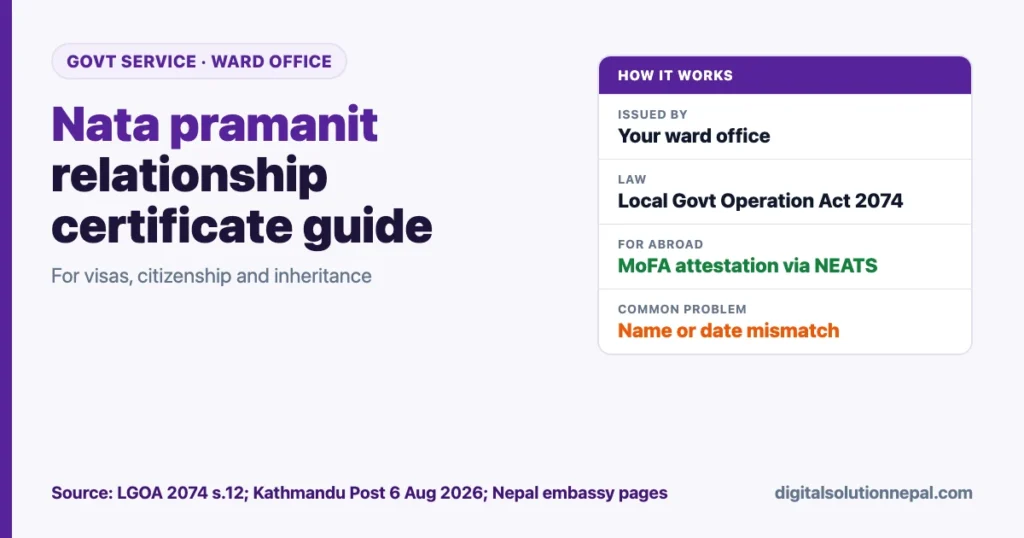
As of 2 November 2026 (16 Kartik 2083). Checked the ward functions list in the Local Government Operation Act, 2074 (section 12, read in an unofficial English translation; the Nepali text on lawcommission.gov.np did not download), the citizen charter of the Area Administration Office, Mehelkuna (Surkhet), Nepal embassy pages in the UK, UAE and Bahrain, and Kathmandu Post and Himalayan Times reports on consular attestation. Ward fees are set by each municipality and were not published on the municipal sites we could reach, so no fee is given here.
A nata pramanit (नाता प्रमाणित, relationship certificate) is a letter from your ward office that certifies how two or more people are related: parent and child, husband and wife, brothers and sisters, or a living person and someone who has died. You need it when your existing documents do not show the relationship clearly enough, for example for a dependant visa, a citizenship application through a relative, a land transfer after a death, or a claim abroad.
This guide explains who issues it, what documents to bring, how witnesses are used, how to get an English version attested for use abroad, and why applications get stuck.
Quick answers
| Question | Short answer |
|---|---|
| Who issues it? | Your ward office (वडा कार्यालय), under the Local Government Operation Act, 2074 |
| Legal basis | Ward “recommendation and certification” duties: certifying kinship, kinship with the living and kinship with the dead |
| Who can apply? | A family member named in the relationship, usually from the ward where the family is registered |
| Main documents | Citizenship of everyone in the relationship, birth/marriage/death registration as relevant, photos, application |
| English version | Wards can certify in English; for abroad it must then be attested by the Department of Consular Services (MoFA) |
| Online attestation | Nepal e-Attestation System (NEATS), running from 17 August 2026 |
| Fee | Set by each municipality’s local finance law; ask your ward |
| If the relationship is disputed | The ward cannot settle a dispute; a District Court case may be needed |
What the law says
The Local Government Operation Act, 2074 lists the functions of the ward committee. Under the heading “recommendation and certification”, the unofficial English translation of the Act includes:
- certifying kinship (नाता प्रमाणित);
- certifying kinship with the living;
- recommending kinship with the dead;
- certifying the right holder or heir;
- recommending that a person with different names, caste or date of birth in documents is the same person;
- recommendation and certification in English.
Our reading: this is why the nata pramanit comes from the ward and not from the District Administration Office (DAO). The ward knows the family through local records and can ask neighbours if needed. The DAO and other offices then use the ward letter as supporting evidence.
When you need a nata pramanit
| Purpose | Who usually asks for it | What it proves |
|---|---|---|
| Citizenship by descent | District Administration Office | Link to a relative within three generations when a parent cannot identify you |
| Minor identity card | District or Area Administration Office | Child’s link to parents (the Mehelkuna charter lists a three-generation nata pramanit) |
| National ID | Administration office handling NID enrolment | Spouse’s link when the citizenship does not show the husband or wife’s name |
| Dependant or family visa | Foreign embassy or immigration | Spouse, child or parent relationship |
| Work visa for relatives (UAE) | Nepal embassy in Abu Dhabi | Blood relationship to the sponsor, attested by the Department of Consular Services |
| Inheritance and land transfer | Land Revenue Office, banks, insurers | Heir’s link to the deceased |
| Pension, insurance or compensation claims | Employer, insurer, MoFA for workers abroad | Legal heir’s relationship to the deceased |
The Mehelkuna Area Administration Office citizen charter, for example, asks for a nata pramanit covering three generations for a minor identity card, and accepts a relationship certificate as one way to prove the spouse’s name for a national ID when the citizenship certificate does not show it. For citizenship by descent, if a parent cannot identify the applicant, it asks for a ward recommendation with a nata pramanit of a relative within three generations.
Who can apply
Usually one of the people named in the relationship, such as the son applying to prove his relationship with his father, or the wife with her husband. Apply at the ward where the family’s permanent address and records are, because that ward holds the household and vital registration records.
If you live abroad, a family member in Nepal can usually prepare and submit the papers, but many wards want the applicant or a close relative present to sign. Ask the ward whether they accept a power of attorney or a signed application sent from abroad.
Nata pramanit documents to bring
Requirements vary between municipalities, and the ward lists we tried to download were not reachable, so treat this as a working list and confirm it with your ward:
- Application (निवेदन) addressed to the ward chairperson, stating who is related to whom and why you need the letter.
- Citizenship certificates of every living person in the relationship (original and photocopies).
- Birth registration certificates of children, especially minors.
- Marriage registration certificate for husband and wife relationships.
- Death registration certificate of the deceased, for relationship with the dead or inheritance.
- Passport-size photos of the people named, as the ward may attach them to the certificate.
- Previous documents with different spellings or dates, plus any name-correction letter, so the ward can link them.
- Anything else the ward lists, such as proof of local residence or local tax receipts. Ask before you go.
Make a simple family chart showing each person, their citizenship number and how they connect. It speeds up checking and helps you spot a missing link before you reach the counter.
Step-by-step process
- Check what the receiving office wants. Ask the embassy, DAO or Land Revenue Office exactly which relationships must be shown, and whether they want Nepali, English or both.
- Collect and compare documents. Check that names, parents’ names, dates and addresses match across citizenship, birth and marriage records.
- Fix mismatches first. If a name or date differs, correct it or ask the ward for a “same person” recommendation, which the Act lists as a separate ward service.
- Submit at the ward office. Hand in the application and copies; pay the ward fee set by your municipality and keep the receipt.
- Ward verification. The ward secretary checks the records and may ask for local witnesses or a field inquiry (सर्जमिन) if records are thin.
- Signature and issue. The certificate is signed by the ward chairperson or authorised official. Ask for an English version too if you need it abroad.
- Municipal verification for attestation. For use abroad, have the signature verified at the municipal office as required for consular attestation (see below).
- MoFA attestation. Apply through NEATS and complete the final step at the Department of Consular Services.
Witnesses and field inquiry
Where records are incomplete, for example an older relative without birth registration, the ward may ask two or more local people who know the family to sign as witnesses, or send staff to confirm with neighbours. Administration offices use a similar local inquiry (सर्जमिन मुचुल्का) for citizenship cases when needed, as the Mehelkuna charter shows.
Our reading: witnesses support the record; they do not replace it. If two relatives disagree, or another heir objects, the ward will usually stop. A law firm guide by Alpine Law Associates notes that disputed lineage goes to the District Court, which can weigh evidence and, in some cases, order DNA testing.
English version and attestation for visas
Foreign embassies want an English document they can trust. The usual chain is:
| Step | Office | Note |
|---|---|---|
| 1 | Ward office | Issue the nata pramanit, ideally with an English version on letterhead |
| 2 | Municipality (Chief Administrative Officer or registration chief) | Verify the signature for consular attestation |
| 3 | Department of Consular Services, MoFA | Attest the document; apply online through NEATS |
| 4 | Embassy of the destination country | Further legalisation if that country requires it |
| 5 | Nepali embassy abroad (if you are already abroad) | Some missions re-verify MoFA-attested certificates |
Two points matter here. First, The Himalayan Times reported in December 2020 that the Ministry of Federal Affairs told all local levels that documents for consular attestation must be verified by the Chief Administrative Officer or the chief of the registration section, after hundreds of applicants were turned away because only the ward chair or mayor had signed. Second, The Kathmandu Post reported that MoFA launched the Nepal e-Attestation System (NEATS) on 6 August 2026, with service from 17 August, allowing online applications, tracking and fee payment, with a visit only for the final step.
Examples from Nepal’s missions abroad:
- United Kingdom: the Nepal embassy in London lists relationship certificates among documents it attests, with a fee of £40, and requires a Nepali document’s English translation to be attested by the Department of Consular Services first.
- Bahrain: the embassy’s “Attestation of Relationship Verification Certificate” needs the original certificate attested by MoFA Nepal, plus passport, citizenship and visa copies.
- UAE: for individual demand letter attestation involving blood relations, the embassy asks for a relationship certificate attested by the Department of Consular Services, covering parents, siblings, spouse or children.
For more on translation and the attestation chain, see our guide to translating and attesting Nepali certificates for use abroad.
Common reasons for rejection or delay
| Problem | Example | Fix |
|---|---|---|
| Name mismatch | “Ram Bahadur Thapa” in citizenship, “Ram B. Thapa” in passport | Same-person recommendation or name correction first |
| Different date of birth | Citizenship and school certificate differ | Correct the record before the nata pramanit |
| Wife’s surname changed | Citizenship before marriage shows father’s surname | Attach marriage registration |
| Missing birth or death registration | Older relatives never registered | Late registration at the ward, then apply |
| Wrong ward | Family moved and records are elsewhere | Apply where the household records are |
| Signature not verified for attestation | Only the ward chair signed | Get CAO or registration chief verification |
| Disputed relationship | Another heir objects | Legal advice; District Court route |
Our guide on correcting names and dates in Nepali documents explains how to fix mismatches before you apply.
Preparing a nata pramanit for a visa?
Digital Solution, Pokhara, can help you check your documents for name and date mismatches, prepare the ward application and English translation, and scan and upload papers for MoFA attestation on NEATS. We cannot promise any visa or approval. कागजात मिलाउन हामी सहयोग गर्छौं।
Frequently asked questions
What is a nata pramanit in English?
It is a relationship certificate or relationship verification certificate issued by the ward office. Embassies may call it a “relationship certificate”, “kinship certificate” or “family relationship letter”.
How long does it take?
Alpine Law Associates describes the uncontested ward route as taking about one to two days. Field inquiries, missing records and MoFA attestation add time, and a court case can take weeks to months.
Can I get a nata pramanit with a deceased person?
Yes. The Local Government Operation Act lists recommending kinship with the dead and certifying heirs as ward duties. Bring the death registration certificate and the citizenship of the heirs.
Is a nata pramanit enough for inheritance?
It supports the claim, but the Land Revenue Office or bank may also want death registration, heirs’ citizenship and agreement among heirs. Disputed inheritance needs court proceedings.
Do I need MoFA attestation for a visa?
Most embassies require documents from Nepal to be attested by the Department of Consular Services. Check the visa checklist of your destination country, and apply through NEATS.
Conclusion
A nata pramanit is a simple ward letter, but it only works when the documents behind it match. Fix name and date differences first, bring every relevant citizenship and registration certificate, ask for an English version, and get the signature verified before MoFA attestation. If anyone disputes the relationship, take legal advice rather than relying on the ward alone.
Sources
- Nepal Law Commission, Local Government Operation Act, 2074 (official text; section 12 ward functions read in an unofficial English translation): https://lawcommission.gov.np/content/12760/12760-local-government-regulation-ac/
- Area Administration Office Mehelkuna, Surkhet, citizen charter: https://aaomehelkuna.moha.gov.np/upload/53bdd3520b5c587e21d17d0ef13f8a04/files/नागरिक_वडापत्र.pdf
- The Kathmandu Post, “Nepal launches online consular attestation system, service to begin from August 17” (6 August 2026): https://kathmandupost.com/national/2026/08/06/nepal-launches-online-consular-attestation-system-service-to-begin-from-august-17
- The Himalayan Times, “Document verification must for DoCS attestation” (4 December 2020): https://thehimalayantimes.com/nepal/document-verification-must-for-docs-attestation
- Embassy of Nepal, London, document legalisation: https://uk.nepalembassy.gov.np/pages/document-legalization/
- Embassy of Nepal, Manama, paper validation and attestation: https://bh.nepalembassy.gov.np/pages/paper-validation-3/
- Embassy of Nepal, Abu Dhabi, citizen charter: https://ae.nepalembassy.gov.np/pages/citizen-charter-12/
- Alpine Law Associates, Nata Kayam in Nepal 2026 (relationship certificate guide): https://lawalpine.com/blog/nata-kayam-certification-nepal
This article is general information; requirements and fees differ by ward and by embassy, so confirm with the office that will receive your document.

Rabin Paudel
Rabin Paudel is the Founder of Digital Solution, a Content Creator, and an AI Trainer. He shares practical and easy-to-understand content on Artificial Intelligence, Digital Literacy, Online Services, FinTech, and Technology. His mission is to make technology simple, accessible, and useful for everyone.
View all posts by Rabin Paudel →