As of 29 October 2026 (12 Kartik 2083). Limits, prices and terms were read on each company’s own pages from Pokhara: Gemini Apps Help and gemini.google/subscriptions, canva.com/pricing, bing.com/images/create and Microsoft’s Copilot terms, ideogram.ai/pricing and its Terms of Service, adobe.com Firefly plans, and OpenAI’s Free Tier FAQ (updated 27 October 2026). Canva’s help centre and AI product terms, Adobe’s credit FAQ and OpenAI’s image article returned 403 or 404 to us, so where a figure comes from a sales page rather than a help page we say so. We did not run paid tests; the prompts at the end are ours.
A free AI image generator is now good enough for a Tihar greeting card, a Laxmi Puja offer poster or a Facebook ad for a Pokhara shop, as long as you know three things before you start: how many images the free tier really gives you, whether the output carries a watermark or a usage restriction, and whether the tool can write Nepali text without mangling the matras.
This guide compares six free tiers on those three points, using each company’s published terms rather than blog hearsay. It then gives a short testing routine for Devanagari text and a set of prompts for the festival week (Laxmi Puja is Sunday 8 November, Bhai Tika Wednesday 11 November, Chhath Sunday 15 November 2026).
Quick answers
| Question | Answer |
|---|---|
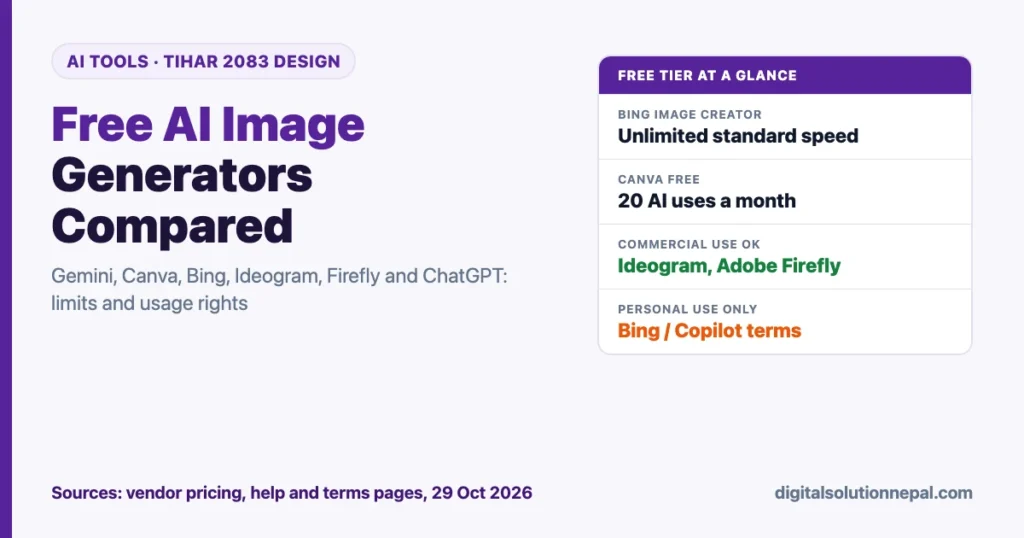
| Most generous free tier for plain images | Bing Image Creator: unlimited standard-speed creations, 10 fast creations a day on the live page |
| Best free tier for text on images | Gemini (Nano Banana 2), which Google says renders text “for all supported languages”; 1K download on free |
| Free tier with explicit commercial rights | Ideogram (terms allow commercial use of outputs) and Adobe Firefly (outputs “safe for commercial use”) |
| Free tier with a personal-use clause | Bing Image Creator and Copilot: Microsoft’s terms say “for your own personal use” |
| Canva Free AI allowance | Up to 20 uses a month of Standard or Premium AI tools, no Ultra tools |
| Ideogram free credits | Weekly credits for eligible accounts signed in with Google, Apple or Microsoft; “amount may vary” |
| ChatGPT Free | Image creation included, with a separate, unpublished rate limit |
| Invisible watermark | Google uses SynthID; Microsoft attaches content credentials and forbids removing them |
The six free tiers side by side
| Tool | What free gives you | Watermark or marker | Commercial use (published position) |
|---|---|---|---|
| Gemini app (Nano Banana 2) | Image generation and editing; daily quota not stated; downloads at 1K (2K with a Google AI plan) | SynthID invisible watermark across Google’s generative products | Google’s help page only says to use discretion before publishing; no restriction stated |
| Canva Free | Shared AI allowance, up to 20 uses a month of Standard or Premium tools; no Ultra tools; 1.6 million+ templates | None stated on the pricing page | Not verified; Canva’s AI product terms were unreachable from Nepal when checked |
| Bing Image Creator | 10 fast creations a day on the live page (Microsoft’s feature page says 15), unlimited standard-speed creations; MAI-Image-2.5-Flash option | Content credentials; terms forbid hiding or removing them | Copilot terms: “You can only use Copilot for your own personal use” |
| Ideogram | Weekly credits for eligible accounts; slow queue; images public unless on a paid plan; one generation at a time | Terms forbid removing watermarks placed on outputs | Yes: “free to use them for any purpose, including commercial use” |
| Adobe Firefly | “Free daily generations” that refresh every day; exact number not published | Content Credentials attached automatically | Yes: outputs from Firefly models are “safe for commercial use” |
| ChatGPT Free | Create images in ChatGPT, separate usage limit, number not published | Not stated on the FAQ | Not stated on the FAQ |
Three reading notes. First, Google’s limits are compute-based and refresh every five hours with a weekly cap, according to its subscriptions page, so a free account that spends its budget on long chats has less left for images. Second, Ideogram quietly replaced the Free column on its pricing page with a pay-as-you-go option at one US cent per credit in mid-October 2026, which is why the free allowance now reads “may vary”; a Medium render on its 4.5 model costs 6 credits. Third, Microsoft’s “personal use” line sits in the Copilot terms that the Image Creator page links to; our reading is that a shop ad made there is outside the letter of those terms, even if nobody enforces it.
What each tool is actually good for
Gemini (Nano Banana 2). The strongest free option for images with words on them. Google’s own feature list promises better text rendering for all supported languages and the ability to keep a character consistent across images, which matters if you want the same cartoon diyo or the same shop mascot on five posters. Free downloads top out at 1K resolution, which is fine for Facebook and WhatsApp but soft for an A3 print. Nano Banana Pro, the higher-detail model, is paid only, and once your daily Nano Banana 2 quota is used you cannot redo images with Pro either.
Canva Free. Not really a generator; it is the layout tool you paste generated images into. Twenty AI uses a month is enough for a handful of backgrounds, and the free template library covers Tihar greeting formats in the right sizes. Standard AI tools on paid plans do not count against the allowance, but on Free they do. Pricing shown to us in Nepal was US$55 a year for Pro and US$95 for Business, with the Free AI allowance also applying during a trial.
Bing Image Creator. The fastest way to get a dozen variations of “oil lamps on a marigold rangoli” without an account limit biting. The catch is the terms. Microsoft does not claim your creations, but it tells you to use Copilot only for personal use and not to remove the content credentials that mark the image as AI-made. For a family greeting it is ideal; for a paid ad campaign, choose a tool with explicit commercial rights.
Ideogram. Built around typography, so it is the one to try for a poster headline. Two warnings: free generations are public in the explore feed unless you pay for private generation, so never put a customer’s name or an unreleased offer in a free prompt; and the free allowance has shrunk to a weekly grant whose size Ideogram no longer states.
Adobe Firefly. The safest choice when a client asks “can I use this in an advert”. Adobe states that outputs from its own Firefly models are safe for commercial use and attaches Content Credentials automatically. The free plan gives daily generations that refresh, but Adobe does not publish the number, and its plan page quoted us prices in UAE dirhams rather than rupees or dollars, which hints that Nepal is not a priority market.
ChatGPT Free. OpenAI’s Free Tier FAQ, updated two days before we checked, lists “Create images in ChatGPT” as a free capability with a separate usage limit and says the app will tell you when you hit it. The number is not published and changes with demand, so treat it as a backup rather than your main tool.
How to test Nepali text before you trust a tool
No vendor publishes a Devanagari accuracy score, and we have not seen an independent benchmark for Nepali in image generators (the published Devanagari studies cover OCR, which is reading text, not drawing it). Run this five-minute test yourself on each free tier before the festival rush.
- Prompt for a short phrase first: “शुभ दीपावली” on a plain red card. Check the matras: the ि in “दी” and the ा in “वा” are the first things to break.
- Add a conjunct: “शुभ तिहार तथा छठ पर्वको हार्दिक मंगलमय शुभकामना”. Look at “र्द” and “ष्ठ”; most models either drop the reph or glue the wrong halves together.
- Ask for a number in Devanagari: “२०८३”. Models trained mostly on Latin digits often render ३ as a mirrored 3.
- Put the text at the bottom third, not the centre, and ask for “large, clear, no other text”. Stray fake letters appear in busy backgrounds.
- If the text still breaks, generate the image without text and add the Nepali line in Canva with a Devanagari font such as Mukta or Kalimati. That is the workflow we use for client posters, and it also keeps the text editable.
Our reading from reading each vendor’s feature claims: Gemini and ChatGPT describe multilingual text rendering explicitly, Ideogram describes typography but does not name Devanagari, and Bing and Firefly do not promise non-Latin text at all. Test anyway.
Prompts for the festival week
Copy these as written, then change the shop name, offer and colours. Keep text in quotation marks so the model knows which words to draw.
Tihar greeting card (family or page post) “A warm greeting card, 1080 by 1080, a row of clay diyo lamps on a marigold and sayapatri garland, soft bokeh, deep red and gold palette, the text ‘शुभ तिहार २०८३’ large at the bottom in clean Devanagari, no other text, no people.”
Laxmi Puja offer poster (shop) “Vertical poster 1080 by 1350 for a mobile shop in Pokhara, Laxmi Puja theme, oil lamps and rangoli border, clean centre space for a product photo, headline ‘तिहार अफर’ at the top in bold Devanagari, small line ‘Digital Solution’ style footer area left empty, modern flat design.”
Bhai Tika social post “Illustration of a saptarangi (seven-colour) tika tray with makhamali and gobhe flowers, walnut and sel roti, flat lay from above, pastel background, space on the right for text, no text in the image.”
Chhath morning scene (community page) “Riverbank at sunrise, women in red and yellow saris offering arghya to the sun, bamboo soop baskets with fruit and thekua, warm light, respectful and realistic, no text.”
Deusi Bhailo program announcement “Night street scene in a Nepali hill town with children singing Deusi, string lights on brick houses, one lit diyo in the foreground, cinematic, leave the top third dark for a title.”
For the posters, generate without the Nepali text if your test in the previous section failed, then add the words in Canva. For ads that will run as paid Facebook campaigns, use Firefly or Ideogram output, or a tool you pay for, so the commercial-use question is settled before the invoice.
A Nepal-specific checklist before you publish
- Faces: do not generate a recognisable real person, including politicians or celebrities, for an ad. Every tool’s terms ban it, and our guide to deepfake scams in Nepal shows why audiences now react badly to it.
- Religious imagery: keep deities out of discount posters. A diyo, a rangoli or a marigold garland says Tihar without putting Laxmi next to a 20% off sticker.
- Disclosure: Microsoft forbids removing content credentials, and Google’s SynthID survives normal cropping. Assume a reader can check, and say “AI-generated” in the caption where it matters.
- Resolution: free tiers mostly cap at 1K. For a printed banner, upscale in Canva or regenerate on a paid plan.
- Privacy: Ideogram free generations are public. Do not type a customer list, a phone number or an unreleased price into a free prompt. The same logic applies to any browser tool; our post on free online tools that work without uploading explains the habit.
If you make festival content every year, our round-up of AI tools for content creators in Nepal covers the paid tiers and the video side.
Want festival posters and ads made for your shop?
Digital Solution in Pokhara designs Tihar greeting cards, offer posters and Facebook ad creatives, and runs hands-on AI and digital skills training so your team can do it in-house next year. तिहार अफरको पोस्टर र विज्ञापनका लागि हामीलाई सम्पर्क गर्नुहोस्।
Frequently asked questions
Which free AI image generator has no daily limit?
Bing Image Creator offers unlimited creations at standard speed; only the fast creations are capped (10 a day on the live page we saw, 15 on Microsoft’s feature page). Ideogram’s paid plans advertise unlimited slow credits, but its free tier is a weekly grant.
Can I use a free AI image in a paid Facebook ad?
Ideogram’s terms and Adobe’s Firefly FAQ say yes for their own model outputs. Microsoft’s Copilot terms say personal use only. Google and OpenAI do not state a position on their help pages we read, and Canva’s AI terms were unreachable from Nepal, so check before you spend ad money.
Does the free Gemini tier watermark images?
Google embeds SynthID, an invisible watermark, across its generative products, and offers a public SynthID Detector portal. There is no visible logo on the image.
Why does Nepali text come out wrong?
Devanagari matras and conjuncts need glyph shaping that image models learn poorly from mostly Latin training data. Short phrases work better than sentences, and adding the text in Canva afterwards is the reliable fix.
Is Canva’s AI free in Nepal?
Yes, Canva Free includes a shared monthly allowance of up to 20 uses of Standard or Premium AI tools. Ultra tools need a paid plan. Canva’s pricing page has a separate FAQ on country availability, so check it if a feature is missing.
Conclusion
A free AI image generator will carry a small business through Tihar if you match the tool to the job. Use Gemini for cards with Nepali text, Bing for unlimited personal variations, Canva to lay everything out, and Ideogram or Firefly when the image will go into an advert and the commercial-use question has to be answered. Test the Devanagari first, keep real faces and deities out of offers, and read the one line in each company’s terms that decides whether your poster is personal or commercial.
Sources
- Google, Gemini Apps Help, “Generate and edit images with Gemini Apps” (read 29 October 2026): https://support.google.com/gemini/answer/14286560
- Google, Gemini plans and pricing (Google AI Plus US$4.99, AI Pro US$19.99; usage limits): https://gemini.google/subscriptions/
- Google DeepMind, SynthID: https://deepmind.google/technologies/synthid/
- Canva, Pricing page and FAQ “How does AI usage work across Canva plans?” (read 29 October 2026): https://www.canva.com/pricing/
- Microsoft, Bing Image Creator (live page, free creations and model options): https://www.bing.com/images/create
- Microsoft, Bing Image Creator feature page (15 fast creations a day, Rewards): https://www.microsoft.com/en-us/bing/features/bing-image-creator
- Microsoft, Copilot Terms of Use (personal use, content credentials, ownership): https://www.bing.com/new/termsofuse
- Ideogram, Pricing and FAQ (read 29 October 2026): https://ideogram.ai/pricing
- Ideogram, Terms of Service (User Output, commercial use, watermarks): https://about.ideogram.ai/legal/tos
- Adobe, Firefly plans and FAQ (free daily generations, commercial-safe outputs, Content Credentials): https://www.adobe.com/products/firefly/plans.html
- OpenAI, “ChatGPT Free Tier FAQ” (updated 27 October 2026): https://help.openai.com/en/articles/9275245-chatgpt-free-tier-faq
- Nepal Rastra Bank, bank holiday list 2083 (Tihar and Chhath dates): https://www.nrb.org.np/
Free-tier limits and terms change often; the figures above are as published on the dates stated and are not legal advice.

Rabin Paudel
Rabin Paudel is the Founder of Digital Solution, a Content Creator, and an AI Trainer. He shares practical and easy-to-understand content on Artificial Intelligence, Digital Literacy, Online Services, FinTech, and Technology. His mission is to make technology simple, accessible, and useful for everyone.
View all posts by Rabin Paudel →