
As of 24 October 2026 (7 Kartik 2083). We read the Nepal Police Cyber Bureau’s website (fraud types, reporting page and contact details) and reports in The Kathmandu Post, Ratopati and Technology Khabar on that date. We list only cases those sources reported.
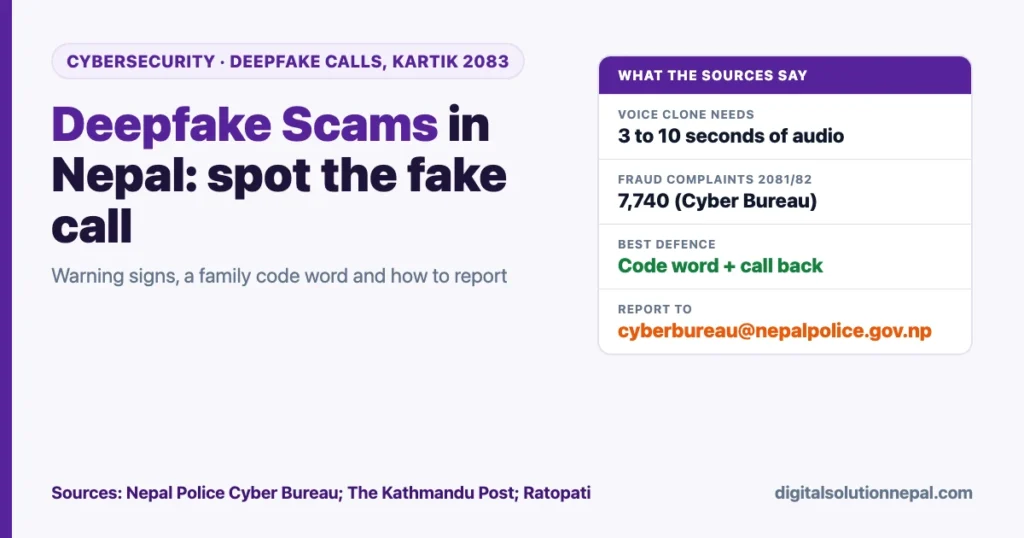
A deepfake scam in Nepal is a fraud or blackmail attempt that uses AI-made or AI-edited voice, video or images to make you believe something false: that your son is calling, that a leader said something, or that a nude video of you exists. The tools are cheap and fast. An AI expert quoted by The Kathmandu Post in October 2026 said a voice can be imitated from 3 to 10 seconds of clear audio.
The good news is that the defence is mostly habit, not technology. This guide covers what has actually been reported in Nepal, the warning signs on a call, a family code word checklist, and how to report.
Quick answers
| Question | Answer |
|---|---|
| What is a deepfake? | AI-generated or AI-altered voice, video or image of a real person |
| How much audio is needed to copy a voice? | 3 to 10 seconds of clear audio for basic cloning, per an expert in The Kathmandu Post (Oct 2026) |
| Is Nepali voice cloning convincing? | Not yet as smooth as English, the same expert said; it can sound unnatural or carry a Hindi-like accent |
| Best single defence | A family code word, plus calling back on a number you already have |
| First call if money is leaving your account | Your bank or wallet, to block it |
| Where to report | Nearest police office, or the Cyber Bureau, Bhotahiti, or cyberbureau@nepalpolice.gov.np |
| Cyber Bureau phone | 01-5319044; duty line 9851286770 (as listed on its website) |
| Police emergency | 100 |
What has been reported in Nepal so far
We looked for reported cases before writing. Here is what reliable sources show, with attribution.
| Date reported | What happened | Source |
|---|---|---|
| 3 Sep 2025 | RSP leader Swarnim Wagle filed a complaint at the Cyber Bureau, Bhotahiti, about a deepfake video made using his voice. Cyber Bureau SP Deepak Raj Awasthi said it would be investigated. | Ratopati |
| 4 Mar 2026 (20 Falgun 2082) | Police arrested a man in Bharatpur on the charge of posting an AI-generated deepfake video of the Indian Prime Minister to spread hatred around the election, with the Cyber Bureau’s technical help. | Technology Khabar |
| Mid-2026 (data to end of Jestha 2083) | Police told Ratopati that a trend of WhatsApp video calls, in which men are asked to undress and are then blackmailed with the recording, is increasing. | Ratopati, reporting police and Cyber Bureau data |
| 15 Oct 2026 | The Kathmandu Post reported disputed audio clips involving public figures, where people on both sides claim “AI”, and explained how forensic checks work. | The Kathmandu Post |
The Cyber Bureau’s own “fraud types” page also describes a WhatsApp video call scam: a friend request from a woman you have never met, a call where you are encouraged to undress or appear on camera, and then a threat to send a picture of your face with a nude body to your friends and family unless you pay. The Bureau says plainly that there is often no woman at all.
Our reading: as of 24 October 2026 we did not find a news or police report in Nepal of money stolen with a cloned voice of a family member. That kind of case has been reported abroad. Ratopati, in August 2026, summarised one from the United States, where a mother heard what sounded like her teenage son crying on the phone and was asked for USD 7,500. It was an AI voice. Nepal has every ingredient for the same scam: family members abroad, voice notes on social media, and quick wallet transfers. So it is worth preparing now.
The scale of online fraud in Nepal
Deepfakes are one tool inside a much larger fraud problem. Cyber Bureau figures reported by Ratopati:
| Fiscal year | Online fraud complaints to the Cyber Bureau |
|---|---|
| 2080/81 | 4,154 |
| 2081/82 | 7,740 |
| 2082/83, first 11 months | 7,799 |
The same report said wallet hacking and OTP phishing links drew the most complaints, and that police recovered about Rs 17 crore in fraud cases that year. Our guide to OTP, PIN and password safety covers that side.
How a deepfake scam in Nepal usually works
These are the three patterns to watch for. The first is reported by the Cyber Bureau; the other two are, in our reading, the most likely local forms based on cases abroad and the reports above.
1. Video call blackmail (sextortion). A stranger, often with a woman’s photo, chats, then moves to a video call. They record you, or they take your face from the call or your profile and paste it onto explicit images. Then they demand money.
2. “Family emergency” voice or video call. A call or voice message that sounds like a son, daughter or spouse abroad: an accident, an arrest, a hospital bill, a lost passport. Someone else may take over the call as a “police officer” or “agent”. They ask for money now, by wallet, bank transfer or QR.
3. Fake boss or fake public figure. A voice note or short video that seems to come from your office head, a known businessperson or a leader, asking for a quick payment, a gift card, an investment or a share. It may arrive from a hacked account of someone you know.
Warning signs on a call or voice message
You may not be able to hear the fake. AI expert Rojesh Shikhrakar told The Kathmandu Post that short clips are the hardest to judge, and that online detection tools give estimates, not proof. So judge the situation, not only the sound.
Red flags:
- Urgency and secrecy. “Don’t tell anyone”, “send it in the next ten minutes”, “don’t call Mummy.”
- A new or unknown number, or a familiar account behaving oddly.
- Payment to someone else’s account, wallet or QR, or requests for gift cards or crypto.
- The caller avoids your questions or keeps saying the line is bad.
- Very short clips, voice notes instead of a live call, or a video call that drops whenever you ask them to move.
- Flat emotion or odd rhythm, repeated words said the same way each time. The Post’s expert listed these as clues, but not proof.
- A video call where the face looks smooth, blurs at the edges or lags behind the voice.
One simple test on a video call: ask the person to turn their head fully sideways, or pass a hand slowly across their face. Our reading is that many live face filters still struggle with this. It is not proof either way, so still verify by calling back.
Family code word checklist
Ratopati’s August 2026 report noted experts recommending a secret family code word, and the point that people under panic often forget to use it. That makes practice as important as the word.
Set it up this week:
- Sit together, in person or on a call you started yourself, and choose one word or short phrase.
- Pick something nobody could guess from Facebook or TikTok. Not a pet’s name, birthday, village or school.
- Do not write it in any chat app, group or note on your phone.
- Agree on the rule: no money, OTP or document is sent on any “emergency” call until the caller says the word.
- Add a second step: hang up and call back on the number you already saved, even if the word is right.
- Include grandparents and anyone who handles money at home. They are often the ones called.
- Tell family members abroad, so they know you will ask for it.
- Have a fallback question only the real person can answer, in case they forget the word.
- Practise it once. Ask it on a normal call, so it feels natural.
- Change the word if you think anyone outside the family has heard it.
What to do if you get a suspicious call
- Do not send money, OTPs or photos, and do not agree to anything on the call.
- Ask for the code word. If there is none or it is wrong, hang up.
- Call the person back on their saved number, or call someone who is with them.
- If you already paid, call your bank or wallet at once and ask them to block and flag the transaction.
- Take screenshots of the profile, number, chat, call log and payment message. Save the link to the profile. Do not delete anything.
- Report to the police, as below.
- Warn your family group and friends, especially if your own account was used.
If you are being blackmailed with a video or a fake image, do not pay. Our reading, from how these cases are described, is that paying usually leads to more demands. Stop replying, keep the evidence, report it, and ask the platform to remove the content. If your Facebook account was taken over to send these messages, see our guide to recovering a hacked Facebook account.
How to report a deepfake scam in Nepal
The Cyber Bureau’s reporting page, read on 24 October 2026, says:
| Step | What the Cyber Bureau says |
|---|---|
| Where to submit | Nearest district, area or ward police office, police circle, or the Cyber Bureau at Bhotahiti, Kathmandu, in person |
| If you cannot go in person | Email full details to cyberbureau@nepalpolice.gov.np |
| Compulsory attachments | A copy of your citizenship, national ID, passport or driving licence (birth registration for a child), and the links (URLs) and clear screenshots |
| Language | English, Nepali or both; typed or handwritten in the same format |
| Contact | 01-5319044; duty line 9851286770 |
The Bureau has separate forms for online financial fraud, fake or hacked IDs, and obscene audio, video or photos posted on social media. Our step-by-step guide to the Cyber Bureau complaint process walks through each form and what to fill in.
Train your family or team to spot AI scams
Digital Solution runs practical AI training that shows how deepfake voice and video scams work and how to check before you pay. आफ्नो परिवारलाई आजै सचेत बनाउनुहोस्।
Frequently asked questions
Has anyone in Nepal lost money to a deepfake voice call?
We did not find a publicly reported case as of 24 October 2026. Reported Nepali cases so far involve deepfake videos of public figures and video call blackmail.
Can AI really copy a Nepali voice?
Yes, roughly. An expert quoted by The Kathmandu Post said basic tools need 3 to 10 seconds of audio, but Nepali output can still sound unnatural.
What is a family code word?
A secret word your family agrees on and asks for before acting on any emergency call. Pair it with a call back to a saved number.
Should I pay if someone threatens to share a fake nude image?
No. Stop replying, save the evidence and report it to the police or the Cyber Bureau.
Where do I report a deepfake scam in Nepal?
At any police office, at the Cyber Bureau in Bhotahiti, or by email to cyberbureau@nepalpolice.gov.np with your ID copy and screenshots.
Conclusion
A deepfake scam in Nepal works on panic, not on perfect technology. The fake does not need to sound exactly like your son if you are frightened and the caller says “right now”. Agree a code word, always call back on a saved number, never pay or share an OTP on an emergency call, and report anything suspicious with screenshots. Ten minutes with your family this week is the cheapest protection you can buy.
Sources
- Nepal Police Cyber Bureau, Fraud types (ठगीका स्वरूपहरू) (read 24 October 2026): https://cyberbureau.nepalpolice.gov.np/public-services/general-police-services/23
- Nepal Police Cyber Bureau, Report cyber crime (read 24 October 2026): https://cyberbureau.nepalpolice.gov.np/report-cyber-crime/
- Nepal Police Cyber Bureau, home page and contact details (read 24 October 2026): https://cyberbureau.nepalpolice.gov.np/
- The Kathmandu Post, Sajana Baral, “Can AI fake a Nepali voice convincingly? Here’s what the experts say” (15 October 2026): https://kathmandupost.com/science-technology/2026/10/15/can-ai-fake-a-nepali-voice-convincingly-here-s-what-the-experts-say
- Ratopati, “Swarnim Wagle files complaint with Cyber Bureau against making deepfake videos” (3 September 2025): https://www.ratopati.com/story/510966/swarnim-wagle-files-complaint-with-cyber-bureau-against-making-deepfake-videos
- Technology Khabar, arrests for spreading rumours and posting a deepfake video of the Indian Prime Minister (4 March 2026): https://www.technologykhabar.com/2026/03/04/232481/
- Ratopati, “Online Scams Increase in Nepal: Police Report 767 Victims in One Year” (Cyber Bureau data to end of Jestha 2083): https://www.ratopati.com/lang-url/575770/en
- Ratopati, “What can be done to prevent voice scams caused by AI?” (9 August 2026): https://www.ratopati.com/story/583407/what-can-be-done-to-prevent-voice-scams-caused-by-ai
This guide is general safety information from Digital Solution Pvt. Ltd., not legal advice; for any loss or threat, contact your bank and Nepal Police directly.

Rabin Paudel
Rabin Paudel is the Founder of Digital Solution, a Content Creator, and an AI Trainer. He shares practical and easy-to-understand content on Artificial Intelligence, Digital Literacy, Online Services, FinTech, and Technology. His mission is to make technology simple, accessible, and useful for everyone.
View all posts by Rabin Paudel →