
As of 2 November 2026 (16 Kartik 2083). Checked Cyber Bureau contact details on cyberbureau.nepalpolice.gov.np, and reports on police warnings in The Kathmandu Post, The Himalayan Times (RSS), Ratopati and Hamro Patro (ICT Samachar). Indian advisories on “digital arrest” are cited from news reports because pib.gov.in returned an error (403) when we checked.
A fake police email Nepal users receive usually looks frightening: a Nepal Police or CIB logo, a senior officer’s name, an “Official Court Order” subject line and a 24-hour deadline. The Cyber Bureau of Nepal Police has warned about these messages several times since January 2025, and the Central Investigation Bureau (CIB) issued its own warning in July 2026. This guide shows what these emails and the related “digital arrest” video calls look like, how to check whether a notice is real, and what to do if you or a relative abroad has been targeted.
Quick answers
| Question | Short answer |
|---|---|
| Does Nepal Police send legal threats by email? | Police say real investigations follow the Criminal Procedure Code, not threatening emails |
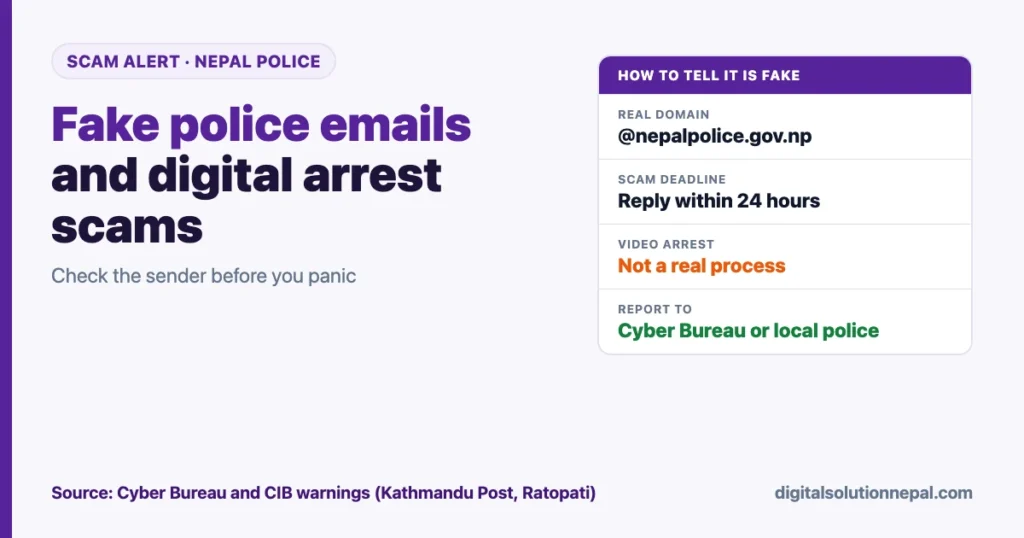
| Official email domain | Addresses end in @nepalpolice.gov.np (for example cyberbureau@nepalpolice.gov.np) |
| What the fake emails claim | Illegal websites viewed, a “court order” on your internet traffic, or a CIB case |
| Usual deadline | Reply within 24 hours “to avoid legal action” |
| Do they ask for money first? | Usually not. The first email only aims to get a reply |
| Can police arrest you over a video call? | No. Treat any “digital arrest” call as a scam |
| Where to report | Nearest police office, or the Cyber Bureau, Bhotahiti, Kathmandu |
What the police have warned about so far
The warnings have come in several waves. Here is a short timeline from published reports.
| When | Who warned | What the fake message said |
|---|---|---|
| 16 to 19 January 2025 | Cyber Bureau (spokesperson SP Deepak Raj Awasthi) | Emails in Nepali and English using senior officers’ names, an “Official Court Order Warning” subject, claims of illegal internet use, a 24-hour reply demand |
| 17 January 2025 | Cyber Bureau, via RSS | Do not answer calls from unknown numbers or trust mails from new email IDs using police officers’ names |
| 2 July 2026 | Central Investigation Bureau (CIB) | Emails claiming to come from CIB or its chief: “reply immediately” or CIB will file a court case |
| Date not given in the report | Cyber Bureau, reported by ICT Samachar | Phishing emails with the Nepal Police name and logo accusing people of viewing obscene or illegal websites |
The Kathmandu Post reported that one January 2025 email was signed in the name of a real senior officer but with the wrong rank. The bureau pointed out that the officer was an Additional Inspector General (AIGP), not a Deputy Inspector General as the email claimed. The same report said three formal complaints had reached the bureau within days, while monitoring suggested the emails had gone to many more people.
The CIB’s July 2026 statement, as reported by Ratopati, said neither the CIB nor its chief sends such messages, and that the Cyber Bureau was investigating the senders.
How a fake police email Nepal scam works, step by step
The first email is bait. Police told The Kathmandu Post that these emails do not ask for money at first. The money demand comes later, once the person is scared and talking. Our reading of the pattern, based on the police warnings and similar cases in the region:
- The threat. You get an email accusing you of a serious crime, often viewing child sexual abuse material or “illegal websites”, with a fake court order and a police logo.
- The deadline. You are told to reply within 24 hours or a case will be filed.
- The reply. If you answer, a “police officer” or “lawyer” writes back, sometimes moving you to WhatsApp, Telegram or a phone call.
- The “settlement”. You are offered a way to close the case quietly: a fine, a “verification deposit” or a fee paid to a personal account, wallet or crypto address.
- The escalation. If you pay, new demands follow. Some versions add a video call with a person in uniform: this is the “digital arrest” stage.
What a “digital arrest” is
“Digital arrest” is the name used in India for scams where criminals pose as police, CBI, customs or other officers on a video call and tell the victim they are under arrest. The victim is told to stay on camera, not to speak to family, and to transfer money to “clear” their name.
The Tribune reported that India’s Indian Cyber Crime Coordination Centre (I4C) issued an advisory in October 2024 saying the CBI, police, customs, ED and judges do not arrest people through video calls. The Kathmandu Post noted the same scam pattern in its January 2025 report on fake Nepal Police emails, saying police were concerned about cases in the region where people were kept confined at home for days.
Our reading: no police force in Nepal or India arrests anyone over a video call. If a caller says you are under “digital arrest”, the call is a scam.
Fake police email Nepal red flags
Use this checklist. One red flag is enough to stop and verify.
- Wrong sender address. Nepal Police email uses the nepalpolice.gov.np domain. Gmail, Outlook, Yahoo or look-alike domains (extra letters, “.com” instead of “.gov.np”) are fake.
- Wrong rank or title. Real officers’ names may be used, but titles are often wrong, as in the January 2025 case.
- Awkward Nepali or English. The bureau said official correspondence is in clear Nepali, while the scam emails used poorly translated text, possibly machine-made.
- A 24-hour deadline and threats. Real legal processes give formal notice and do not demand an email reply to avoid “arrest”.
- Shame-based accusations. Pornography and “illegal sites” are chosen because victims are less likely to ask anyone for help.
- Mixed agencies. One email claimed to represent the CIB, the “Commissioner of Police Department” and a “National Cyber Security Centre” at once.
- Links or attachments. Hover over links before clicking. A PDF “court order” can carry malware.
- Any request for money, OTPs or ID scans. Police do not collect fines through personal wallets or crypto.
How to check whether a police notice is real
- Do not reply and do not click. Keep the email; do not delete it, because it is evidence.
- Check the sender address. Open the full header or tap the sender name to see the real address.
- Look up contact details yourself. Go to cyberbureau.nepalpolice.gov.np by typing the address, not from the email. Use the numbers and email listed there.
- Call or visit your local police office. Ask whether any case or summons exists in your name. Our reading: a genuine case will be traceable through a police office or court, not only through an email.
- Compare with published warnings. Search the Cyber Bureau’s news page and Nepal Police’s Facebook page for notices about the same email. Our guide to verifying a fake notice explains how to check letterheads, reference numbers and dates.
How big is the problem?
The Himalayan Times reported in August 2026 that Nepal Police received 20,526 cybercrime complaints in FY 2082/83, up from 18,926 the year before. In that year police filed 161 cases and arrested 155 people.
| Channel (FY 2082/83) | Complaints |
|---|---|
| Facebook and Messenger | 7,123 |
| TikTok | 6,776 |
| 3,105 | |
| Telegram | 1,031 |
| 114 |
Our reading: email is a small share of complaints, but email threats are often the first contact that moves a victim to WhatsApp or a phone call, where the loss is recorded. The low arrest numbers also mean prevention matters more than recovery.
If a relative abroad is targeted
Nepalis abroad are exposed to two versions: fake Nepal Police emails, and the local “digital arrest” calls common in the country where they live or work, especially India.
- Tell them to end the call. No real officer will object if they hang up and call back through an official number.
- Call them yourself on a known number. Scammers often tell victims not to contact family. A call from you breaks that isolation.
- Report locally first. In India, I4C points people to the 1930 helpline and cybercrime.gov.in, according to news reports of its advisory. In other countries, use the local police.
- Report to Nepal as well if Nepal Police names were used. Email the evidence to cyberbureau@nepalpolice.gov.np and inform the nearest Nepali embassy if money or documents were taken.
- Freeze the money trail. If money was sent from Nepal through a bank or wallet, call the bank immediately. Our post on deepfake scams in Nepal covers fake video and voice calls in more detail.
What to do if you replied or paid
- Stop all contact. Do not send more money, documents or OTPs.
- Secure your accounts. Change your email password and turn on two-step verification. If you shared an OTP, call your bank or wallet right away.
- Collect evidence. Save the email with full header, screenshots of chats, call logs, payment receipts and account numbers.
- File a complaint. Visit the nearest police office or the Cyber Bureau in Bhotahiti, Kathmandu. Our step-by-step guide to filing a Cyber Bureau complaint lists the documents to bring.
- Do not feel ashamed. These emails are designed to cause shame. Police said the January 2025 messages reached many people at once, so you are not alone.
Got a scary police email? Get it checked first
Bring the email or screenshots to Digital Solution, Pokhara, and we will help you secure your email and wallet accounts and prepare your documents for a police or Cyber Bureau complaint. डराएर जवाफ नदिनुहोस्, पहिले जाँच गराउनुहोस्।
Frequently asked questions
Does Nepal Police send summons or warnings by email?
Police have said real investigations follow the Criminal Procedure Code and that threatening emails are not how they work. If you are unsure, contact your local police office using details you find yourself.
What is the official email of the Cyber Bureau?
The bureau’s notices list cyberbureau@nepalpolice.gov.np and the website cyberbureau.nepalpolice.gov.np. Any police email should end in nepalpolice.gov.np.
I received a fake police email but did not reply. Should I report it?
Yes, if you can. Forward it with the full header to the Cyber Bureau or report it at a police office. Then block the sender and delete nothing until you have saved a copy.
Can someone be arrested over a video call?
No. A “digital arrest” over video call is a scam pattern. India’s I4C has said agencies do not arrest people through video calls, and no such process exists in Nepal either.
What if the email uses a real police officer’s name?
Scammers copy real names and photos from news and websites. In January 2025 the bureau pointed out a wrong rank attached to a real officer’s name. A real name does not make the email real.
Conclusion
A fake police email Nepal residents receive is designed to make you panic and reply within hours. Check the sender domain, look for wrong ranks and broken language, and verify through the Cyber Bureau’s own website or your local police office. Never pay to “settle” a case by email or video call, and report the message so police can warn others.
Sources
- The Kathmandu Post, “Fake police emails being used to dupe, intimidate people” (19 January 2025): https://kathmandupost.com/national/2025/01/19/fake-police-emails-being-used-to-dupe-intimidate-people
- The Himalayan Times (RSS), “Cyber Bureau cautions all not to answer calls from unknown numbers” (17 January 2025): https://thehimalayantimes.com/nepal/cyber-bureau-cautions-all-not-to-answer-calls-from-unknown-numbers
- Ratopati English, “Central Investigation Bureau Warns of Fraudulent Emails Using Its Name” (2 July 2026): https://english.ratopati.com/story/68834/be-careful-did-you-receive-an-email-from-the-cib-threatening-legal-action
- Hamro Patro (ICT Samachar), Cyber Bureau warning on phishing emails in Nepal Police’s name: https://www.hamropatro.com/news/detail/653129580564215
- The Himalayan Times, “Cybercrime complaints top 20,000 in Nepal but only 155 arrests made” (14 August 2026): https://thehimalayantimes.com/nepal/cybercrime-complaints-top-20000-in-nepal-but-only-155-arrests-made
- The Tribune, “CBI, ED don’t nab via video calls: advisory to curb digital arrest” (October 2024): https://www.tribuneindia.com/news/india/cbi-ed-dont-nab-via-video-calls-advisory-to-curb-digital-arrest/
- Cyber Bureau, Nepal Police (contact details): https://cyberbureau.nepalpolice.gov.np/
This article is general safety information, not legal advice; contact Nepal Police directly for any case involving you.

Rabin Paudel
Rabin Paudel is the Founder of Digital Solution, a Content Creator, and an AI Trainer. He shares practical and easy-to-understand content on Artificial Intelligence, Digital Literacy, Online Services, FinTech, and Technology. His mission is to make technology simple, accessible, and useful for everyone.
View all posts by Rabin Paudel →