
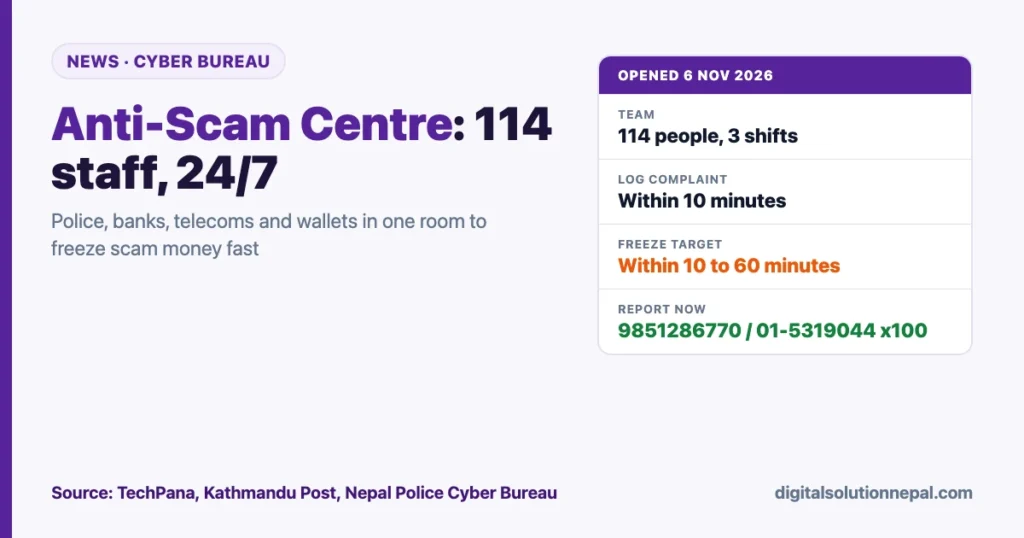
As of 6 November 2026 (20 Kartik 2083). Based on TechPana’s report of 6 November, the Kathmandu Post (6 November) and OnlineKhabar English, which all describe the Home Ministry’s 2026 guideline for the centre. Cyber Bureau contact numbers were checked on the Bureau’s own contact page on 6 November. We have not seen the guideline document itself.
Nepal’s anti-cyber scam centre has started work inside the Nepal Police Cyber Bureau. Its name is the Integrated Anti-Cyber Scam Response Centre (एकीकृत साइबर स्क्याम प्रतिकार्य केन्द्र, IACSC). It brings police, Nepal Rastra Bank, commercial banks, Nepal Telecom, Ncell, internet providers, eSewa and Khalti into one room, 24 hours a day.
The goal is simple: when someone is scammed, stop the money before it leaves the financial system. Under the guideline, the centre should freeze the receiving account or wallet within 10 to 60 minutes of a complaint.
The centre at a glance
| Item | Detail |
|---|---|
| Full name | Integrated Anti-Cyber Scam Response Centre (IACSC) |
| Legal basis | Home Ministry guideline, approved 23 Asoj 2083 (9 October 2026), under section 45 of the Good Governance (Management and Operation) Act 2064 |
| Location | New Cyber Bureau building, Samakhusi, Kathmandu |
| Started | Friday 6 November 2026 (orientation held the same day) |
| Hours | 24/7, in three shifts |
| Total staff | 114 |
| Day-to-day head | A Superintendent of Police (SP) |
| Target | Log a complaint in 10 minutes, trace the money in 30, freeze it within 60 |
Who sits in the 114-member team
TechPana and the Kathmandu Post give the same breakdown from the guideline.
| Institution | Staff | Notes |
|---|---|---|
| Nepal Police | 33 | Nine per shift, plus six for daily operations |
| Class A commercial banks | 60 | 20 per shift |
| Nepal Telecom and Ncell | 6 | Combined |
| Payment service providers (eSewa and Khalti) | 6 | Combined |
| Nepal Rastra Bank | 3 | |
| Internet service providers | 3 | Through the ISP association |
| Development banks | 3 | Through the development bankers’ association |
| Total | 114 |
Other development banks, finance companies, payment service providers (PSPs) and payment system operators (PSOs) do not sit in the centre. Instead, Nepal Rastra Bank’s Payment Systems Department told them to name a liaison officer reachable 24 hours a day, with a phone number and an official email.
Why this matters: in a scam, the money usually moves from the victim’s bank to a “mule” account, then onward to wallets or other banks within minutes. When a bank officer sits next to a police officer, a freeze request can go across the desk instead of by letter.
How a complaint is handled: the 60-minute plan
The guideline sets a clock for every complaint. Here is the sequence as reported.
- Within 10 minutes: the complaint is entered in a case management system, gets a case ID, and is classified and prioritised by scam type.
- 10 to 30 minutes: bank, PSP and PSO officers find the final beneficiary account or wallet, the transaction time and the money trail.
- 10 to 60 minutes: a debit freeze is placed on the accounts and wallets used. If the money has already moved, officers follow it and request a freeze at each new stop.
- Within 60 minutes: telecoms deactivate the scam phone numbers and SIM cards; ISPs block phishing domains and IP addresses.
- After that: evidence is collected, police open an investigation, and money is returned to the victim through the legal process, which the reports say involves a court order.
Our reading: the freeze is the fast part. Getting the money back still takes a legal process, so the centre speeds up recovery but does not make it instant.
Scammed? Get Your Complaint Ready Fast
Digital Solution, Pokhara helps you write the Cyber Bureau complaint, organise screenshots and transaction proof, and secure your accounts. WhatsApp +977 9766597181 or use our Order Portal.
Scams the centre will handle
The guideline and news reports list a broad range of electronic fraud:
- Fake investment and trading schemes, including Telegram “tasks”
- Online job scams and romance scams
- QR code and digital wallet fraud
- “Digital arrest” and blackmail calls from fake police
- Phishing (fake links), smishing (fake SMS) and vishing (fake calls asking for OTP or KYC)
- SIM swap fraud
- Cryptocurrency fraud and illegal remittance (hundi)
- Fake lottery and gift parcel schemes
- Online buying and selling fraud and online betting fraud
Why Nepal needed this
According to the Cyber Bureau’s spokesperson, Deputy Superintendent of Police Deepak Raj Awasthi, letters between police and banks could take months, and some victims followed their cases for up to a year (Kathmandu Post). By then, the money was long gone.
The scale is large. Republica reported on 29 October that complaints to the Cyber Bureau over the past three fiscal years involve more than Rs 4 billion in alleged losses. It also reported 2,379 complaints from people who lost money after fake “bank KYC update” calls or after sharing an OTP.
Home Ministry spokesperson Ananda Kafle told the Kathmandu Post that coordination delays let money disappear in digital fraud. Sajan Sharma, former president of Fintech Alliance Nepal, called the centre a positive first step, while warning that cyber fraud will not end overnight.
How to report a scam right now
The guideline says complaints can come through a hotline, the Nagarik App, the Nepal Police App, an online portal and police units. As of 6 November, the centre’s own hotline number had not been published (OnlineKhabar said it was not finalised). Until it is, use the Cyber Bureau’s existing channels, which feed the same building.
| Channel | Contact (Cyber Bureau contact page, checked 6 November 2026) |
|---|---|
| Duty officer, 24×7 | +977 9851286770 |
| Hotline | 01-5319044, extension 100 |
| cyberbureau@nepalpolice.gov.np | |
| Police emergency | 100 |
Do these in order, and fast. Every minute counts against the 60-minute freeze window.
- Call your own bank or wallet on the official number printed on your card or app, and ask them to block your account and flag the transaction.
- Call the Cyber Bureau duty officer and give the transaction ID, the amount, the time and the receiving account or wallet number.
- Save the evidence: screenshots of chats, the scammer’s number, links, the QR code and your bank SMS. Do not delete the chat.
- File the written complaint by email or at the nearest police office, with a copy of your citizenship, national ID, passport or licence.
- Do not pay “recovery agents”. Anyone who promises to get your money back for a fee is usually a second scam.
Our bank fraud first-hour guide lists 24/7 numbers for major banks and wallets. Our Cyber Bureau complaint guide shows how to fill the application form.
What is still unclear
- The hotline number: not yet announced. We will update this page when it is.
- The online portal and app: a software system for alerts, call recording and a central database (called AFRS in the Kathmandu Post) was still under development.
- Refund timelines: the guideline sets times for the freeze, not for the refund.
- Outside Kathmandu: reports do not say how district police will hand complaints to the centre in real time.
Frequently asked questions
What is the Integrated Anti-Cyber Scam Response Centre?
A 24/7 unit inside Nepal Police’s Cyber Bureau, set up under a Home Ministry guideline of October 2026. Police, NRB, banks, telecoms, ISPs and wallets work together in it to trace and freeze scam money quickly.
How many people work in Nepal’s anti-cyber scam centre?
114: 33 police, 60 from Class A banks, 6 from Nepal Telecom and Ncell, 6 from eSewa and Khalti, and 3 each from NRB, ISPs and development banks.
How fast can scam money be frozen?
The guideline targets a freeze within 10 to 60 minutes of a complaint, after the money trail is traced within 10 to 30 minutes.
What is the anti-scam centre’s hotline number?
It had not been published as of 6 November 2026. Use the Cyber Bureau duty line +977 9851286770 or 01-5319044 extension 100 until it is.
Will I get my money back?
Not automatically. A quick freeze gives you the best chance, but the money is returned through investigation and the legal process.
Conclusion
The anti-cyber scam centre Nepal has waited years for is now running in Samakhusi: 114 people, three shifts, and a target of freezing scam money within an hour. Its success depends on one thing victims control, which is how fast they report. Save the Cyber Bureau numbers in your phone today, and share them with parents and relatives who use mobile banking.
Need help writing a cyber complaint, collecting evidence or securing your accounts after a scam? Digital Solution can help you prepare the documents.
Sources
- TechPana: 114-member team with police, banks, telecoms, ISPs, PSPs and PSOs to stop scams (6 November 2026)
- Kathmandu Post: Nepal sets up round-the-clock centre to combat online financial scams (6 November 2026)
- OnlineKhabar English: Integrated Anti-Cyber Scam Centre to begin operations on Friday
- Republica: Online scams drain over Rs 4 billion in three years as Nepal plans anti-scam center (29 October 2026)
- Nepal Police Cyber Bureau: contact page (checked 6 November 2026)
Details may change as the centre’s hotline and portal launch. Check the Cyber Bureau’s official channels before relying on a number.

Rabin Paudel
Rabin Paudel is the Founder of Digital Solution, a Content Creator, and an AI Trainer. He shares practical and easy-to-understand content on Artificial Intelligence, Digital Literacy, Online Services, FinTech, and Technology. His mission is to make technology simple, accessible, and useful for everyone.
View all posts by Rabin Paudel →