
Last updated: July 2026 (Shrawan 2083). Formula per current SSF procedures — verify your own account figures on the SSF portal (ssf.gov.np).
“SSF बाट pension कति आउँछ?” is the single most-asked question among contributors — and the answer is a formula you can run yourself in two minutes. This guide explains the SSF pension calculation: the ÷160 formula, who qualifies, worked examples at real salary levels, and what happens to the other part of your money (the 8.33% retirement benefit).
Who Qualifies for the SSF Pension
- Age 60 reached, AND
- At least 180 months (15 years) of contribution.
Meet both → you receive a lifelong monthly pension. Contributed less than 180 months by 60? Your options revolve around refunds/lump-sum settlement per SSF’s rules — the fund’s provisions for short contributors have their own procedure.
The Formula
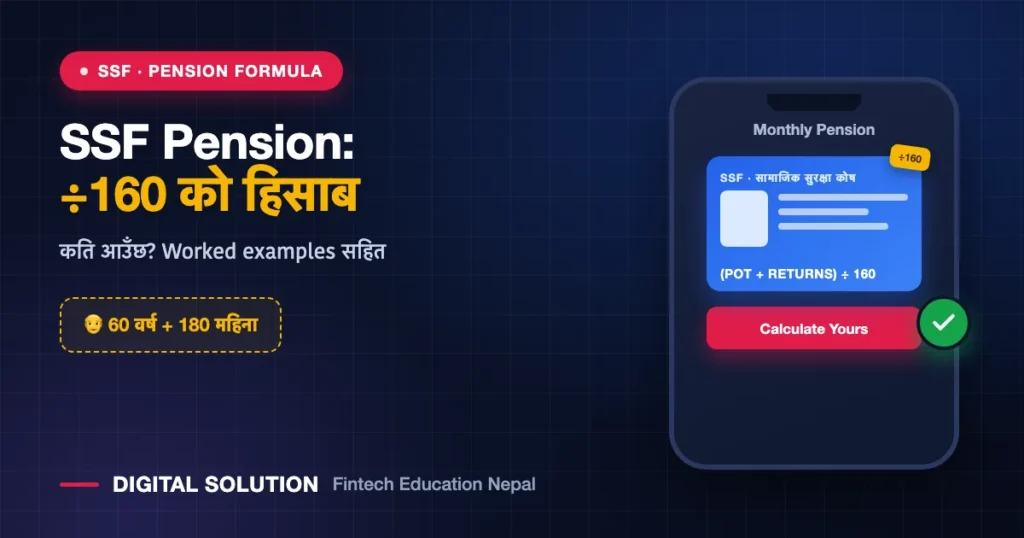
Monthly Pension = (Total in your Pension Account + Investment Returns) ÷ 160
Remember from our 31% breakdown guide: 20% of your basic salary flows into the pension account every month. That accumulated pot — plus the returns SSF earns investing it — divided by 160 is your monthly pension for life.
Worked Examples
| Basic Salary | Monthly Pension Deposit (20%) | 15 Years’ Deposits* | Monthly Pension (approx.)* |
|---|---|---|---|
| Rs 20,000 | Rs 4,000 | Rs 7.2 lakh + returns | Rs 4,500–6,000 |
| Rs 30,000 | Rs 6,000 | Rs 10.8 lakh + returns | Rs 6,750–9,000 |
| Rs 50,000 | Rs 10,000 | Rs 18 lakh + returns | Rs 11,250–15,000 |
*Illustrative: assumes flat salary and a modest return range; real figures depend on salary growth, contribution years beyond 15, and SSF’s actual interest (recently revised — see our interest-rate post in this series). Longer contribution = dramatically higher pension.
The key insight from the ÷160 design: contribute for 20–30 years instead of 15, and the account (plus compounding) grows far beyond these examples — the formula rewards staying in.
Don’t Forget the Other Pot: 8.33% Retirement Benefit
Your old-age money is actually TWO accounts:
| Account | Rate | When You Get It |
|---|---|---|
| Pension Scheme | 20% | Monthly pension after 60 (÷160 formula) |
| Retirement Benefit Scheme | 8.33% | Lump sum at employment end or retirement |
So at retirement you typically receive a lump sum (the 8.33% pot) plus the lifelong monthly pension (from the 20% pot). What happens to these when you change or leave jobs mid-career? That’s tomorrow’s guide in this series.
Plan It Properly (Free Tools)
- 💰 SSF Financial Planner — project your pension by salary and years
- 🧮 SIP Calculator — compare with market investing
- Full pension & retirement guide on SSF School
FAQ
How is the SSF pension calculated?
(Total pension-account amount + investment returns) ÷ 160 = your monthly pension for life, payable once you’re 60 with 180+ months of contribution.
Why divide by 160?
It’s the annuity divisor SSF’s scheme design uses to convert your accumulated pot into a lifetime monthly payment. You keep receiving it for life — even after the notional pot is “used up.”
What if I contributed 10 years only by age 60?
Below 180 months the lifelong-pension condition isn’t met; settlement follows SSF’s refund/lump-sum provisions. If you’re close to 180, continuing contributions (including via new employment) is usually the far better deal.
Is the SSF pension taxable?
Tax treatment follows current income-tax law and thresholds — confirm the year’s rules with a tax professional or our tax guide.
🤝 आफ्नो pension projection निकाल्न सहयोग चाहियो?
SSF School को Financial Planner free छ — अथवा team सँग सिधै कुरा गर्नुहोस्।
Disclaimer: Digital Solution Nepal is an independent educational/digital-service assistance website, not a government body. Formulas and examples are illustrative — your SSF statement and ssf.gov.np are final.

Rabin Paudel
Rabin Paudel is the Founder of Digital Solution, a Content Creator, and an AI Trainer. He shares practical and easy-to-understand content on Artificial Intelligence, Digital Literacy, Online Services, FinTech, and Technology. His mission is to make technology simple, accessible, and useful for everyone.
View all posts by Rabin Paudel →