
Last updated: July 2026 (Shrawan 2083), per the 5th Amendment allocation effective Baisakh 1, 2082. Rates change by notice — verify on ssf.gov.np.
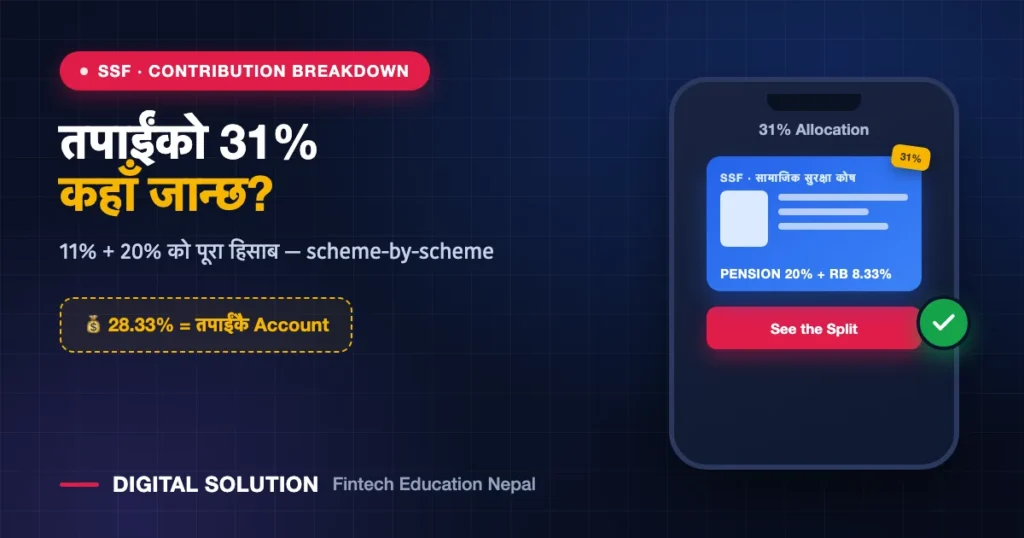
Every month, 31% of your basic salary goes into the Social Security Fund (SSF) — but ask most contributors where that money actually goes, and the answer is a shrug. This guide breaks the SSF contribution rate down to the last paisa: who pays what, which scheme gets which share, and why most of it is actually your own savings, not a tax.
The Big Split: 11% You + 20% Employer
| Who Pays | Component | Rate |
|---|---|---|
| Employee (11%) — deducted from salary | Provident Fund | 10% |
| Social Security Tax | 1% | |
| Employer (20%) — added on top | Provident Fund | 10% |
| Gratuity | 8.33% | |
| Other | 1.67% |
Important: the 31% applies to your basic salary only — allowances, bonus and overtime are not subject to contribution. So if your basic is Rs 20,000, the SSF deposit is Rs 6,200/month (Rs 2,200 from you + Rs 4,000 from your employer).
Where the 31% Goes: The Four Schemes
Under the 5th Amendment (effective Baisakh 1, 2082), the 31% is allocated like this:
| Scheme | Share | What It Covers |
|---|---|---|
| Medical & Maternity | 1.20% | Treatment costs, maternity protection |
| Accident & Disability | 0.80% | Workplace and other accident protection |
| Dependent Family | 0.67% | Family protection if the contributor dies |
| Old Age (your account) | 28.33% | Pension 20% + Retirement Benefit 8.33% |
Read that last row again: 28.33 of the 31 percentage points go into your own old-age account. Only 2.67 points fund the shared protection schemes. SSF is primarily a forced-savings + pension system with insurance attached — not money that disappears.
See Your Own Numbers
Instead of doing the math by hand, use the free calculators on our dedicated SSF portal:
- 🧮 Employee–Employer Contribution Calculator — your exact monthly split
- 🧮 31% Contribution Breakdown tool — scheme-by-scheme allocation of your salary
- 📊 SSF Assessment — 10 questions, 1 minute: “how much do you need SSF?”
Common Confusions, Cleared
- “मेरो तलबबाट 31% काटिन्छ?” No — only 11% comes from your salary. The other 20% is the employer’s cost, on top of your pay.
- “Basic कम, allowance धेरै भए?” Contribution follows basic salary. That’s also why some employers structure pay with a low basic — it reduces their 20% burden (and your savings).
- “Social Security Tax फिर्ता आउँछ?” The 1% SST is a tax component; the PF/gratuity/pension parts are what accumulate for you.
- “Job छोडे पैसा के हुन्छ?” The 8.33% retirement benefit can come as a lump sum; the 20% pension share waits for age 60 — full breakdown in our upcoming job-leaving guide in this series.
FAQ
What is the SSF contribution rate in Nepal?
31% of basic salary — 11% deducted from the employee (PF 10% + SST 1%) and 20% added by the employer (PF 10% + gratuity 8.33% + other 1.67%).
Is SSF calculated on gross or basic salary?
Basic salary only. Allowances, bonuses and overtime are excluded from contribution.
How much of my SSF contribution is my own savings?
28.33 percentage points of the 31% go into your personal old-age account (pension 20% + retirement benefit 8.33%). The remaining 2.67 points fund medical/maternity, accident/disability and dependent-family protection.
Did the allocation rates change recently?
Yes — the 5th Amendment allocation (medical 1.20%, accident 0.80%, dependent 0.67%, old-age 28.33%) applies from Baisakh 1, 2082. Always check ssf.gov.np for the current schedule.
🤝 SSF बुझ्न वा KYC/contribution को काम गर्न help चाहियो?
हाम्रो SSF School मा calculators र guides free छन् — अथवा सिधै team सँग कुरा गर्नुहोस्।
Disclaimer: Digital Solution Nepal is an independent educational/digital-service assistance website, not a government body. Rates and rules follow SSF notices and can change — ssf.gov.np is final.

Rabin Paudel
Rabin Paudel is the Founder of Digital Solution, a Content Creator, and an AI Trainer. He shares practical and easy-to-understand content on Artificial Intelligence, Digital Literacy, Online Services, FinTech, and Technology. His mission is to make technology simple, accessible, and useful for everyone.
View all posts by Rabin Paudel →