
Last updated: July 2026 (Saun 2083). Fees and deadlines below are based on the official press briefing by the Transport Management Office, Kaski. Always confirm final figures with the office before applying.
Ride sharing in Pokhara has officially moved from a legal grey zone to a fully regulated industry. On Saun 8, 2083 (July 24, 2026), the Transport Management Office (Vehicle), Kaski announced that applications are now open for companies that want to operate ride-sharing services in Gandaki Province — making Gandaki the first province in Nepal to actually implement ride-sharing registration on the ground.
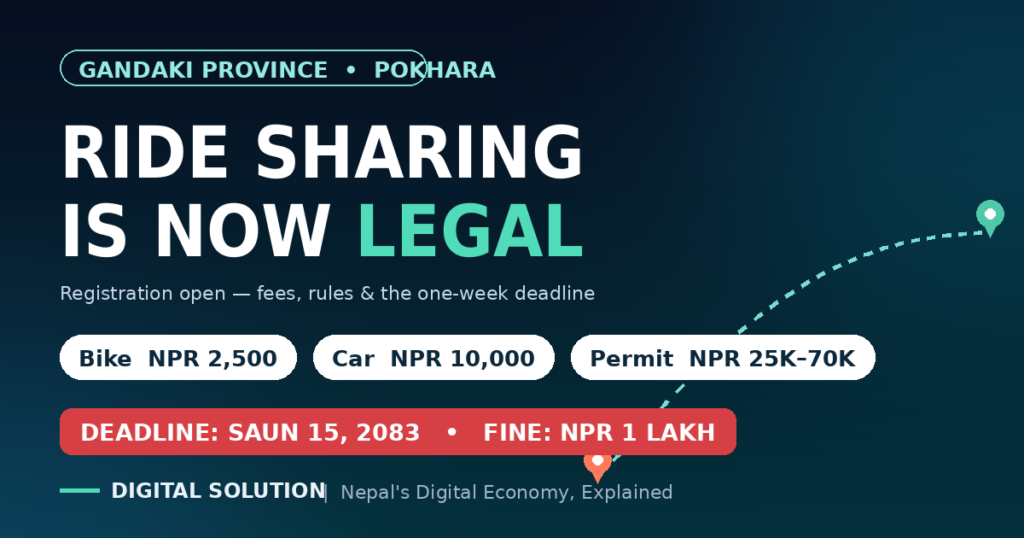
This is a big deal. For years, apps like Pathao and InDrive operated across Nepal without a clear provincial legal framework. Now, Gandaki has set concrete permit fees, vehicle registration charges, a hard deadline (Saun 15, 2083), and a NPR 1,00,000 fine for anyone operating without a license.
Whether you are a rider who uses these apps daily, a bike or car owner thinking of earning through ride sharing, or an entrepreneur considering launching a platform, here is everything you need to know — fees, process, deadlines, and what happens next.
The Quick Answer: What Was Announced
Office Chief Dhaka Prasad Sharma of the Transport Management Office (Vehicle), Kaski held a press conference on Friday and confirmed the following:
- Applications are open for companies wanting to run ride-sharing services in Gandaki Province.
- The legal basis is three laws working together: the Province Vehicle and Transport Management Act, 2076, the Gandaki Province Ride Sharing (Regulation and Management) Rules, 2082, and the Gandaki Province Economic Act, 2083.
- Five companies have already registered, and one — Sawari Sewa Nepal Pvt. Ltd. (Kathmandu) — has received official operating permission.
- Anyone currently operating ride-sharing services without a license must obtain one by Saun 15, 2083 (around July 31, 2026).
- Operating without a license after that means a fine of NPR 1,00,000 — and double for repeat violations.
If you only remember one thing from this article: the unregulated era of ride sharing in Gandaki is over, and the compliance window is roughly one week from the announcement.
Ride Sharing Registration Fees in Gandaki Province (Full Table)
The fee structure has two layers: a company permit fee (paid by the platform operator) and a per-vehicle registration fee (for each vehicle joining the service).
Company Permit Fees
| Permit Type | Fee (NPR) |
|---|---|
| Two-wheeler ride sharing only | 25,000 |
| Four-wheeler ride sharing only | 50,000 |
| Both two-wheeler and four-wheeler | 70,000 |
Vehicle Registration Fees
| Vehicle Type | Registration Fee (NPR) |
|---|---|
| Two-wheeler (bike/scooter) | 2,500 |
| Four-wheeler (car) | 10,000 |
| Existing registered taxis | 50% discount on the registration fee |
The 50% taxi discount is a smart policy move — it gives traditional taxi drivers, who protested heavily against ride sharing in 2025, a financial incentive to join the new system instead of fighting it.
Which Companies Are Registered for Ride Sharing in Gandaki?
As of the announcement, five companies have registered with the Transport Management Office, Kaski:
- Sajilo Nepal Pvt. Ltd.
- Sawari Sewa Nepal Pvt. Ltd. (Kathmandu) — the only one with official operating permission so far
- Ecomo Nepal Pvt. Ltd.
- James Green Electro Mobility Service Pvt. Ltd.
- Move In Nepal Pvt. Ltd.
Notably absent from the registered list at announcement time: the biggest national players. If Pathao, InDrive, or inDrive-style platforms want to keep operating legally in Pokhara and the rest of Gandaki, they fall under the same Saun 15 deadline as everyone else. Expect movement on this within days — no major platform will risk a NPR 1 lakh fine per violation in one of Nepal’s most lucrative city markets.
How Companies Apply: The Registration Process
According to the office, a company that wants to operate ride sharing in Gandaki Province must:
- Prepare an IT-based system (the app/platform) that meets the technical standards defined in the Ride Sharing Rules, 2082 — this includes digital booking, fare display, and trip records.
- Compile the required documents — company registration, PAN/VAT, system details, and other paperwork specified in the regulation.
- Submit an application to the Transport Management Office (Vehicle), Kaski.
- Pay the permit fee based on vehicle category (NPR 25,000 / 50,000 / 70,000 as per the table above).
- Register each vehicle joining the platform (NPR 2,500 per bike, NPR 10,000 per car).
The regulation is explicitly technology-first: services must operate exclusively through digital platforms, with government-approved online registration. Cash-based, unregistered “informal” ride arrangements do not qualify.
Can You Use Your Private (Red Plate) Bike or Car for Ride Sharing?
This is the question most individual earners in Pokhara are asking — and the answer is what made this regulation historic (and controversial).
Under the Gandaki Ride Sharing Rules 2082, private red-plate vehicles are permitted to do commercial ride sharing for the first time, subject to reported conditions:
| Requirement | Two-Wheeler | Four-Wheeler |
|---|---|---|
| Minimum engine/motor capacity | 95cc / 1.5kW (electric) | 790cc / 20kW (electric) |
| Maximum vehicle age | Under 10 years | Under 15 years |
| Registration route | Through a licensed ride-sharing company | Through a licensed ride-sharing company |
These technical criteria come from published reporting on the regulation — verify the exact current thresholds with the Transport Management Office or the licensed company you join, as amendments have adjusted details over time.
Practically, this means a Pokhara resident with a 2019 scooter can register through a licensed platform, pay the NPR 2,500 vehicle fee, and legally earn as a ride-sharing partner. That is a meaningful new income stream in a city with heavy tourist and student mobility demand.
The Deadline and the Fine: Saun 15, 2083
The enforcement teeth of this announcement:
- Deadline: Any organization, company, or individual currently operating ride-sharing services without a license must obtain one by Saun 15, 2083 (approximately July 31, 2026).
- First violation: NPR 1,00,000 fine.
- Repeat violation: Double the fine (NPR 2,00,000).
This gives existing operators roughly one week from the announcement. The short window signals that the provincial government considers the transition period — which effectively ran through the protests and suspension of 2025 and the amended rules of 2026 — to be over.
The Backstory: Why This Took More Than a Year
To understand why this announcement matters, you need the timeline. Gandaki’s ride-sharing regulation triggered one of Nepal’s biggest transport conflicts in recent memory.
May 2025 — The regulation drops. Gandaki publishes the Ride Sharing (Regulation and Management) Rules 2082 in the provincial gazette, legalizing private red-plate vehicles for commercial ride sharing for the first time in Nepal.
Late May–June 2025 — Nationwide protests. Traditional transport operators, led by transport entrepreneur federations, see red-plate legalization as an existential threat. Taxis, buses, and freight services shut down across the province — over 16,000 public vehicles parked in protest — and the strike escalates nationwide, paralyzing Kathmandu, Pokhara, and Bhairahawa.
June 2025 — Federal intervention and suspension. After a six-point agreement between the federal government and transport entrepreneurs, the Office of the Prime Minister asks Gandaki to pause. The province suspends the regulation for one month to allow dialogue.
April–May 2026 — The second amendment. Gandaki’s cabinet approves a second amendment to the rules, which takes effect after gazette publication in May 2026. The amended version reportedly adds a cap of 300 four-wheelers per company (to prevent market dominance), mandatory fare discounts of at least 10% below government-fixed rates (15% for electric vehicles), and a 30-day licensing window for existing operators.
July 2026 (Saun 2083) — Implementation begins. The Kaski transport office opens applications, publishes the fee schedule, confirms five registered companies, and sets the Saun 15 compliance deadline — the announcement covered in this article.
Gandaki is now the first of Nepal’s seven provinces to move from paper regulation to actual enforcement. Koshi Province has drafted similar rules but has not enforced them, and the federal government is reportedly preparing a nationwide framework. What happens in Pokhara over the next few months will likely shape ride-sharing law for the whole country.
What This Means for Riders in Pokhara
For everyday users, regulated ride sharing should bring concrete benefits:
- Cheaper fares than taxis, guaranteed by law. Under the amended rules, ride-sharing platforms reportedly must charge at least 10% below government-fixed fare rates — and 15% below for electric vehicles. That EV incentive also nudges the market toward companies like Ecomo and James Green Electro Mobility, both of which appear positioned around electric fleets.
- More supply. With red-plate bikes and cars legally allowed to join, the number of available rides in Pokhara should increase significantly — especially valuable during tourist season and for Lakeside–airport–bus park routes.
- Accountability. Registered vehicles, digital trip records, and a licensing authority mean passengers finally have somewhere to complain if something goes wrong.
- Fewer app shutdowns. The on-again, off-again enforcement raids against unlicensed platforms should end for compliant operators, meaning more reliable service.
What This Means for Earners and Entrepreneurs
If you own a bike or car in Gandaki: Once major platforms complete licensing, joining as a partner becomes a legal, low-barrier side income. Budget NPR 2,500 (bike) or NPR 10,000 (car) for vehicle registration, and check that your vehicle meets the age and engine-capacity thresholds before applying.
If you drive a taxi: The 50% registration discount is your entry ticket. Rather than competing against app platforms with an empty back seat, registering your taxi on a licensed platform lets you capture app-based demand while keeping your existing business.
If you are building a platform: The NPR 70,000 combined permit is remarkably low as a market-entry cost for a province that includes Pokhara — Nepal’s tourism capital. The real barrier is the IT-system requirement and the reported 300-car cap per company, which is actually an opportunity: the cap prevents any single player from monopolizing four-wheeler supply, leaving room for local Pokhara-built platforms to compete with Kathmandu giants. First-mover advantage in Gandaki compliance is available right now.
Frequently Asked Questions (FAQ)
Is ride sharing legal in Pokhara now?
Yes. As of Saun 2083 (July 2026), ride sharing is fully legal in Pokhara and across Gandaki Province — but only through companies licensed by the Transport Management Office (Vehicle), Kaski. Operating without a license after Saun 15, 2083 carries a NPR 1,00,000 fine.
How much does a ride sharing license cost in Gandaki Province?
Company permits cost NPR 25,000 (two-wheelers only), NPR 50,000 (four-wheelers only), or NPR 70,000 (both). Individual vehicle registration costs NPR 2,500 for bikes and NPR 10,000 for cars, with a 50% discount for existing registered taxis.
Can I use my private bike for ride sharing in Pokhara?
Yes — this regulation legalized red-plate private vehicles for commercial ride sharing. Reported requirements include a minimum 95cc engine (or 1.5kW for electric) and vehicle age under 10 years for two-wheelers. You must register through a licensed ride-sharing company, not independently.
Which ride sharing companies are registered in Gandaki Province?
Five companies have registered: Sajilo Nepal, Sawari Sewa Nepal, Ecomo Nepal, James Green Electro Mobility Service, and Move In Nepal. As of the announcement, only Sawari Sewa Nepal Pvt. Ltd. has received official operating permission.
Is Pathao or InDrive legal in Pokhara?
Any platform — including Pathao and InDrive — must obtain a Gandaki Province license by Saun 15, 2083 to operate legally. Check the Transport Management Office, Kaski for the latest list of licensed operators before assuming an app is compliant.
What is the fine for unlicensed ride sharing in Gandaki?
NPR 1,00,000 for the first violation, and double (NPR 2,00,000) for repeat violations, applicable to any institution, company, or individual operating without a license after the Saun 15 deadline.
Final Thoughts: Pokhara Just Became Nepal’s Ride-Sharing Test Lab
Ride sharing in Pokhara is no longer a legal question — it is now an execution race. Companies have days to license, vehicle owners have a new income channel, and riders get legally mandated cheaper fares. Because Gandaki moved first, every other province (and the federal government’s upcoming national framework) will be watching what happens here.
For digital entrepreneurs, the deeper lesson is the pattern: Nepal’s digital economy is formalizing sector by sector — payments, then digital banking, now mobility. Each formalization wave creates winners among those who understand the rules early.
Need Help Navigating Nepal’s Digital & Transport Rules?
Digital Solution Pvt. Ltd. helps individuals and businesses in Pokhara and across Nepal stay ahead of digital-economy changes — from license documentation to AI-powered business systems.
📲 Message us on WhatsApp for a free consultation: [WhatsApp CTA — insert number/link]
Follow Digital Solution on Facebook, TikTok, and YouTube for daily updates on Nepal’s digital economy in easy Nepali-English.

Rabin Paudel
Rabin Paudel is the Founder of Digital Solution, a Content Creator, and an AI Trainer. He shares practical and easy-to-understand content on Artificial Intelligence, Digital Literacy, Online Services, FinTech, and Technology. His mission is to make technology simple, accessible, and useful for everyone.
View all posts by Rabin Paudel →