
Updated August 2026. Course details and prices are from learnaiwithrabin.com; confirm the current batch there before enrolling.
Updated: August 2026
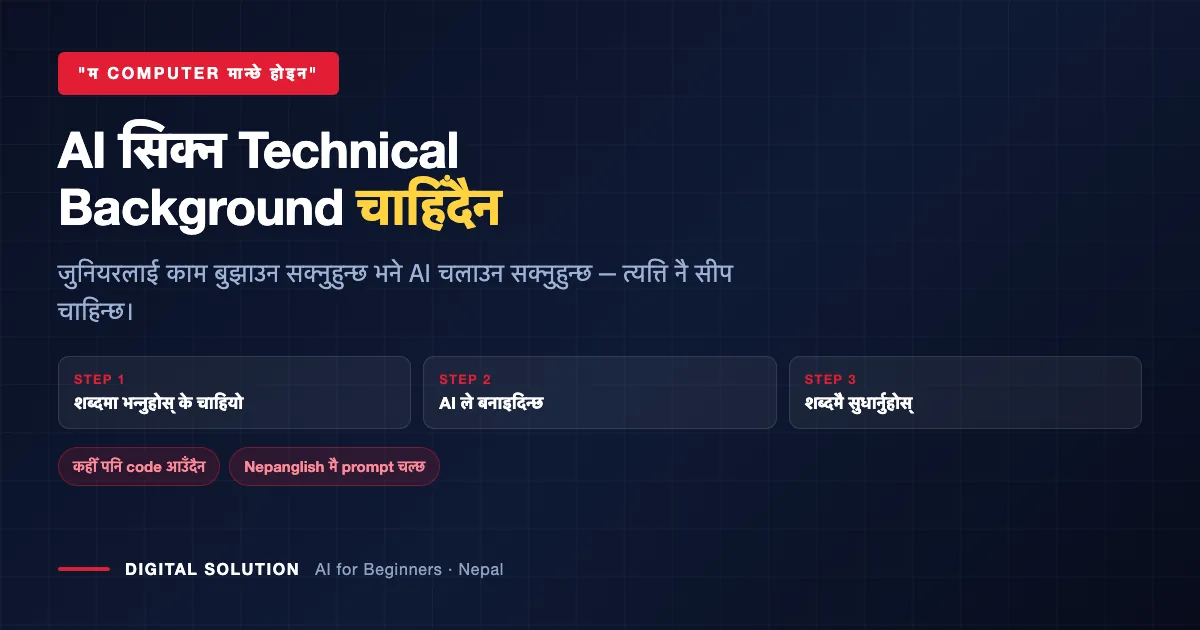
The most common sentence heard before any AI training in Nepal is some version of: “म computer मान्छे होइन” — “I’m not a computer person.”
It is said by teachers with twenty years of classroom mastery, by businesspeople who manage lakhs in monthly turnover, by government officers who navigate procedures most of us cannot follow. Highly capable people, convinced that AI belongs to someone else.
Rabin Paudel of Digital Solution has built his entire teaching approach around a simple counter-claim: if you can explain your work to a junior colleague, you can learn AI — because that is literally the skill modern AI tools require. Not coding. Explaining.
The Myth That Keeps Nepalis Away From AI
The myth: AI = programming = mathematics = not for me.
It was once true. Using machine learning a decade ago genuinely required code. But tools like ChatGPT, Gemini, and Claude changed the interface of AI from programming languages to human language. Today the entire interaction is:
- You describe what you want — in words.
- The AI produces it.
- You review, correct, and refine — in words.
There is no step where code appears. The gap between a beginner and an expert user is not technical knowledge; it is the quality of their instructions. And giving clear instructions is a skill Nepali professionals already exercise daily — with staff, students, and suppliers.
What about the English barrier?
This is the second fear, and Rabin’s answer is twofold. First, modern AI tools understand Nepali and Nepanglish surprisingly well — you can prompt in the mixed language you actually think in. Second, the training itself happens in Nepanglish, so no learner is forced to process new concepts through a foreign language at the same time. Nepali language is a feature of the learning process, not an obstacle to it.
The Non-Tech Teaching Method
Everything starts from your job, not from the tool
A typical foreign AI course starts with “What is a large language model?” Rabin’s sessions start with “What did you do at work yesterday that bored you?” The first prompt a learner ever writes is aimed at their own recurring task — the monthly report, the exam questions, the customer reply. When the output lands, the learner is no longer studying AI; they are using it. That psychological shift in the first hour is the whole method.
One pattern instead of a thousand prompts
Beginners are often handed giant lists — “500 ChatGPT prompts!” — which create dependence, not skill. The Digital Solution approach teaches a small reusable pattern instead:
Role + Context + Task + Format “You are an experienced [role]. Here is my situation: [context]. Do [task]. Give the answer as [format].”
A teacher, a trader, and a student all use the same skeleton with different content. Learners memorise one idea and generate their own prompts forever — in English, Nepali, or both.
Mistakes are part of the syllabus
Non-technical learners are typically terrified of “breaking something”. So the training deliberately shows AI being wrong: confidently inventing facts, misreading an instruction, producing generic mush from a vague prompt. Learners discover that nothing breaks — you simply ask again, better. Fear of the tool dies in that moment, and healthy skepticism of AI output is born in the same lesson. Both are essential.
Small wins, immediately applied
Each session ends with homework that is not an exercise — it is the learner’s actual upcoming work, done with AI. Tomorrow’s lesson plan. This week’s social media captions. The pending email backlog. By the next session, AI has already paid for the course in saved hours, and motivation takes care of itself.
What Non-Technical Nepalis Actually Do After Learning AI
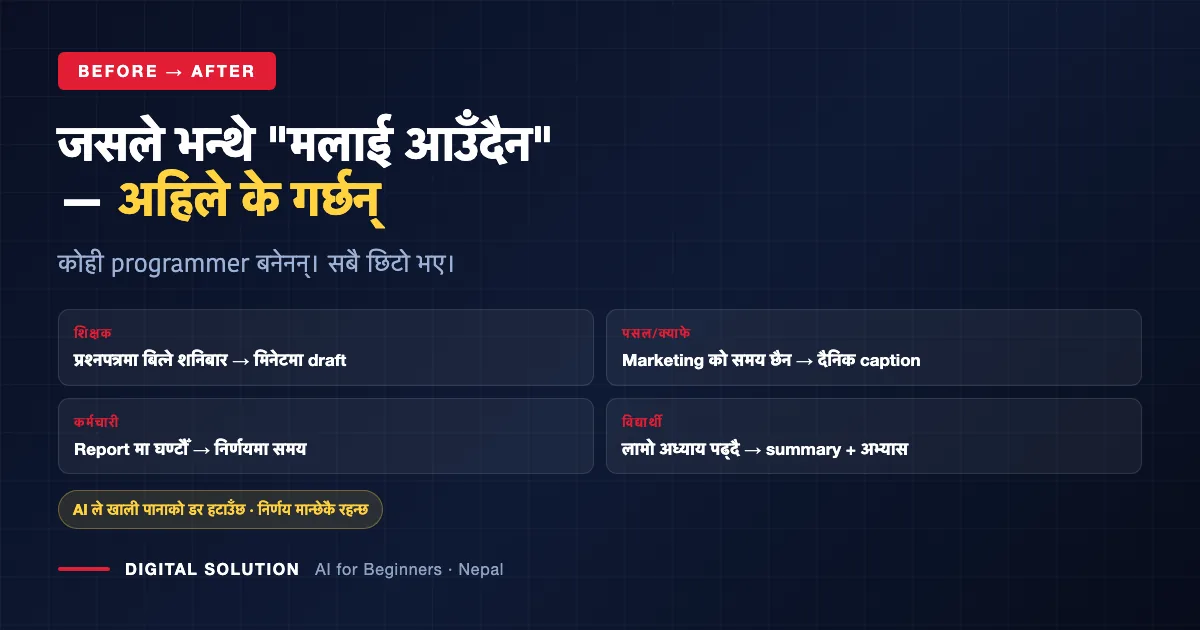
Concrete outcomes, from the kinds of learners who once said “म computer मान्छे होइन”:
| Learner | Before | After practical AI training |
|---|---|---|
| School teacher | Weekend spent making question papers | Question sets, worksheets and lesson plans drafted in minutes, refined by the teacher |
| Shop / café owner | No time for marketing | Daily Facebook/TikTok captions and offers written with AI in Nepali |
| Office professional | Hours on reports and emails | First drafts in minutes; time spent on judgment, not typing |
| Student | Passive reading of long chapters | AI-generated summaries, practice questions, and explanations on demand |
| Content creator | Script block, irregular uploads | Research, outlines and hooks with AI; creator keeps the voice and facts |
The pattern across all of them: AI removes the blank page, the human keeps the judgment. No participant became a programmer. Every participant became faster.
Why Nepali-Language AI Learning Works Better
It is worth stating plainly why learning AI in Nepali, from Nepali context is more effective for most people than a polished foreign course:
- Cognitive load — new concept + foreign language = double effort. Nepanglish teaching removes half the load instantly.
- Relevant examples — a prompt about a US real-estate newsletter teaches a Pokhara hotelier nothing. A prompt about responding to a Nepali guest’s review teaches everything.
- Local pitfalls — Nepal-specific issues (AI’s weaker Nepali spelling, fabricated “facts” about local topics, privacy of citizens’ documents) never appear in foreign syllabi, yet they are exactly where Nepali users get hurt.
- Confidence transfer — watching someone like yourself, in your language, use AI fluently does more for adoption than any certificate.
Getting Started: The Non-Techie’s First Week
For readers who want to begin today, before any formal training:
- Day 1–2: Open ChatGPT or Gemini (both have free tiers). Ask it, in Nepanglish, to help with one small real task. Notice that nothing bad happens.
- Day 3–4: Use the Role + Context + Task + Format pattern on your most repetitive piece of writing.
- Day 5: Ask AI to explain something you already know deeply. Spot its mistakes. This calibrates your trust permanently.
- Day 6–7: Pick your biggest weekly time-sink and let AI produce the first draft. Measure the minutes saved.
If after that week you want structure, speed, and the mistakes removed from your path — that is what guided training is for.
Frequently Asked Questions
Can I learn AI without knowing programming?
Yes. Tools like ChatGPT, Gemini, and Claude are operated entirely in normal language. The skill you need is writing clear instructions — closer to good communication than to coding.
Can I use ChatGPT in Nepali?
Yes. ChatGPT and Gemini both understand Nepali and mixed Nepali-English. Output quality in pure Nepali is improving constantly, and Nepanglish prompting works very well for most tasks.
I am weak in English. Can I still learn AI?
Yes — this is precisely why Nepali-language AI training exists. You can prompt in Nepanglish, and training conducted in Nepali removes the language barrier from the learning process itself.
How long does it take a non-technical person to become useful with AI?
Usefully productive: the first session, if training is practical. Confidently fluent across tools: a few weeks of applying it to daily work. It is a habit-formation timeline, not an academic one.
Where can I get non-technical AI training in Nepal?
Digital Solution, led by AI trainer Rabin Paudel, runs the AI Mastery Course — 10 days live on Zoom in Nepali, from Rs 3,000, for professionals, teachers, students and business owners. See how the live batch runs.
Join the AI Mastery Course
10 days live on Zoom in Nepali with Rabin Paudel — 7:00 PM Nepal time daily. Packages from Rs 3,000, paid by eSewa, Khalti, Fonepay or bank transfer. Registration takes about two minutes.
Related Reading

Rabin Paudel
Rabin Paudel is the Founder of Digital Solution, a Content Creator, and an AI Trainer. He shares practical and easy-to-understand content on Artificial Intelligence, Digital Literacy, Online Services, FinTech, and Technology. His mission is to make technology simple, accessible, and useful for everyone.
View all posts by Rabin Paudel →