
Update, 1 November 2026: the EDV form is not open. On 29 October the US Ninth Circuit Court of Appeals granted the government’s request to pause the order that would have opened DV-2027 registration by 1 November. No opening date exists now. Check only dvprogram.state.gov, and treat any “EDV is open” post as fake. Read what happened.
As of 27 October 2026 (10 Kartik 2083). Checked against the US Department of State’s DV-2026 instructions (Federal Register, 1 October 2024), the passport rule of 11 March 2026 and the US$1 fee rule of 16 September 2025, plus news reports on the DV-2027 court case up to 22 October 2026. The DV-2027 instructions had not been published when we checked.
This guide explains how to fill EDV form entries from Nepal, one field at a time, so you can finish it in a single sitting yourself, or check every field if someone helps you. EDV means Electronic Diversity Visa, the US green card lottery, and the only real form is on dvprogram.state.gov.
One warning first. The field-by-field steps below come from the last instructions the State Department actually published, those for DV-2026, updated with two rules that are already final: a valid passport is now required at entry, and entry costs US$1. The DV-2027 form may differ once its instructions are published. Read them on the day they appear and follow them over anything written here.
Fill your EDV form with Digital Solution
- We fill your EDV entry on the official site, dvprogram.state.gov, if and when an entry period opens, with you present or on a call.
- Correct 600 x 600 photos for you, your spouse and every child, plus a clean passport scan in the required format.
- We help you pay the US$1 government fee. Our service charge is separate and we tell you the amount before we start.
- You get the confirmation number and a printed confirmation page on the spot, and the entry uses your own email.
- We never promise selection. The lottery is random, and only Entrant Status Check gives results.
Quick answers
| Question | Answer |
|---|---|
| Official website | dvprogram.state.gov only |
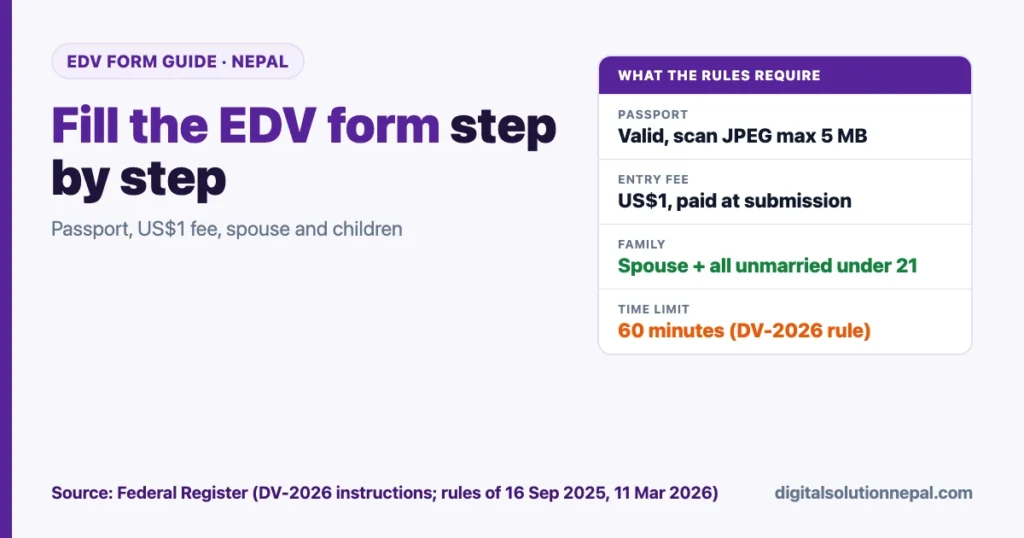
| Cost to enter | US$1, paid when you submit (fee rule effective 16 September 2025) |
| Passport | Valid, unexpired passport details plus a JPEG scan, max 5 MB (rule effective 10 April 2026) |
| Photo | Every person listed: JPEG, 600 x 600 pixels, max 240 kB, taken in last 6 months (DV-2026 rule) |
| Spouse and children | Must be listed even if they will not travel |
| Time limit per session | 60 minutes in DV-2026; the form cannot be saved and resumed |
| How results come | Only through Entrant Status Check, using your confirmation number |
| Is Nepal eligible? | Nepal was eligible for DV-2026; the next list is not yet published |
When the EDV form opens: where things stand
DV-2027 registration did not open in October 2025. On 5 November 2025 the State Department said it would announce the dates “as soon as practicable”.
A US federal court ordered DV-2027 registration by 1 November, but on 29 October 2026 the Ninth Circuit paused that order. The form is not open and no date exists. This guide is for when an entry period is announced. Our court order explainer tracks the case.
No dates have been announced for DV-2028. Our EDV 2028 opening date page explains what is confirmed and what is guesswork. Whatever you read anywhere, including here, check dvprogram.state.gov in your own browser before you act.
How to fill EDV form without stress: prepare these first
The form must be finished in one session, so collect everything first and keep it in one folder on your phone or computer.
| Item | Who needs it | Rule source |
|---|---|---|
| Valid, unexpired passport | The entrant (the person applying) | Rule of 11 March 2026 |
| Passport scan: biographic and signature page, JPEG, max 5 MB, no PDF | The entrant | Rule of 11 March 2026 |
| Digital photo, 600 x 600 px JPEG, max 240 kB, under 6 months old | Entrant, spouse and every eligible child | DV-2026 instructions |
| Full names, dates of birth, city and country of birth | Spouse and every eligible child | DV-2026 instructions |
| Education or work details | The entrant | DV-2026 instructions |
| An email address you will keep using | The entrant | DV-2026 instructions |
| A card that can pay US$1 online | Whoever pays for the entry | Fee rule, 16 September 2025 |
Passport
The March 2026 rule asks for the passport number, the name on it, the country or authority that issued it, and the expiry date. It also requires a scan of the biographic and signature page, as a JPEG no larger than 5 MB. PDF files are not accepted.
If your passport is expired or close to expiry, start now. Our guide to passport renewal in Nepal covers the process. Note that the rule speaks of the entrant’s passport. It does not list passport details for a spouse or children, but the new instructions may say more, so having their passports ready does no harm.
Photos for every family member
Each person on the entry needs a separate, recent photo. Under the DV-2026 instructions the image had to be in colour, in focus, on a plain white or off-white background, facing the camera with a neutral expression and both eyes open, and without eyeglasses. The head had to fill 50 to 69 percent of the image height.
Do not reuse last year’s photo. The DV-2026 instructions said that submitting the same photo as a prior year’s entry, or an edited photo, may make you ineligible. If you go to a photo studio in Nepal, ask for a DV-size digital file, not just prints, and check the pixel size and file size yourself before the day.
Education or work
You need either a completed 12-year course of formal schooling or two years of work in the past five years in an occupation that needs at least two years of training. Our reading for Nepal: a completed Class 12 (+2) meets the education test, while SEE (Class 10) alone does not. Nothing is uploaded for this at entry, but a selected applicant must prove it at the interview.
How to fill EDV form fields, in order
This is the order of the DV-2026 form, with the 2026 rule changes added where they apply. The new form may change the order or wording.
- Name. Last (family) name, first name, middle name, exactly as in your passport. If the passport has no middle name, leave it out. If you have only one name, put it in the last name field.
- Sex. Male or female. The March 2026 rule replaced “gender” with “sex” and says it should match sex at birth.
- Date of birth. Day, month, year. Convert from Bikram Sambat carefully and match the passport.
- City where you were born. Use the place as written in your documents.
- Country where you were born. Use the current name of the country. For most readers, Nepal.
- Country of eligibility. Usually your country of birth. It does not depend on where you live now. Nepal was on the DV-2026 eligible list.
- Photographs. Upload your own photo here, and photos of your spouse and children in their sections.
- Passport information and scan (new). Passport number, issuing country or authority and expiry date, plus the JPEG scan. The exact screen layout is not yet public.
- Mailing address. In Care Of, address lines, city or town, district or province, postal code and country.
- Country where you live today.
- Phone number. Optional.
- Email address. One you control and will keep. The State Department never emails to say you have won.
- Highest level of education. Choose from ten options, from “primary school only” to “doctorate”. Pick what you have actually completed.
- Marital status. Unmarried, married (spouse not a US citizen or green card holder), married (spouse is a US citizen or green card holder), divorced, widowed, or legally separated. If married, enter your spouse’s name, date of birth, sex, city and country of birth, and photo.
- Number of children and their details. Name, date of birth, sex, city and country of birth, and a photo for each eligible child.
- Pay US$1 and submit. The fee is collected at the time of submission (see below).
- Confirmation page. Save and print it at once.
The regulation as amended in 2026 also lists “the location of the consular office nearest” to where you live. The DV-2026 form did not show this as a numbered field. If it appears, our reading is that someone living in Nepal would choose the US Embassy in Kathmandu.
Spouse and children: list everyone, even if they will not travel
This is where many entries fail. In the DV-2026 instructions, leaving out an eligible spouse or child, or adding someone who is not your spouse or child, could make you ineligible, and your family with you.
Spouse. If you are legally married, list your spouse even if you live apart, even if you plan to divorce, and even if your spouse does not want to go to the US. The only exceptions are a spouse who is already a US citizen or green card holder, and a legal separation by court order. If you plan to marry after entering, do not list a future spouse.
Children. List every living child who is unmarried and under 21 on the date you submit. That includes natural children, legally adopted children and stepchildren, whether or not they live with you and whether or not they will move with you. Married children and children already 21 are not listed.
Husband and wife can each enter. Each spouse may submit one entry of their own, listing the other. More than one entry for the same person as the main applicant disqualifies all of that person’s entries.
| Family member | List them? |
|---|---|
| Spouse living with you | Yes |
| Spouse working abroad or living apart (not legally separated) | Yes |
| Spouse who is a US citizen or green card holder | No |
| Unmarried child under 21, living anywhere | Yes |
| Stepchild, unmarried and under 21 | Yes |
| Child who is married, or already 21 | No |
Paying the US$1 fee from Nepal
The fee rule of 16 September 2025 created a US$1 registration fee, collected at the time of registration. The March 2026 rule says every entrant pays it when submitting and that no waivers are available. It is separate from the US$330 Diversity Visa application fee that only selected applicants pay later.
According to the March 2026 rule, the Department collects the fee through Pay.gov, the US Treasury’s payment site, which internationally accepts credit and debit cards, PayPal and Venmo. The rule also admits some applicants may face obstacles paying depending on where they are.
What this means in Nepal, in our reading:
- An ordinary Nepali debit card usually cannot pay foreign websites. A dollar card (a foreign-currency prepaid card from a Nepali bank) or an international credit card is the likely route. Our guide to dollar card fees and limits explains which banks issue them and the USD 500 yearly limit.
- We have not tested a Nepali card on the DV payment page, because it has not opened. We cannot promise any specific card will work. Load a small balance and keep a backup card.
- Whether PayPal or Venmo can be used from Nepal depends on those services, not the State Department. Do not open an account through an agent for this.
- If a person offers to “pay for you”, they will see your details. Pay yourself, on the official page reached from dvprogram.state.gov.
The 60-minute limit and submitting
The DV-2026 instructions said you had 60 minutes from when you open the form to complete and submit it. After that, the system discarded everything entered, and the form could not be saved and finished later. Nobody yet knows if DV-2027 keeps the same limit, but plan for it.
Tips that follow from this:
- Have the passport scan and all photos already resized and saved before you open the form.
- Type family names and dates from a written list, not from memory.
- Use an updated browser and a stable connection, and keep mobile data ready as a backup.
- Do not leave it for the last week. The DV-2026 instructions warned that heavy demand can slow the site.
If the system rejects your entry, the DV-2026 rules allowed you to try again without penalty. If you pressed Submit but got no confirmation number, the entry was not recorded and you must submit again. Once you have a confirmation number, do not submit another entry.
Save the confirmation number
After a complete entry, a confirmation page shows your name and a unique confirmation number. Print it, screenshot it, and email it to yourself. Without this number you cannot use Entrant Status Check, which is the only place results are given.
The DV-2026 instructions warned that some agents fill the form, keep the confirmation page and then demand money for it. The March 2026 rule mentions victims being asked for up to US$15,000. If anyone helps you, sit with them while they type and leave with the confirmation page in your hand.
Want us to fill your EDV form?
Digital Solution fills your EDV entry on the official site with correct photos for every family member, the passport scan and the US$1 payment, and hands you the confirmation number. Our service charge is told upfront. EDV फारम भर्न WhatsApp गर्नुहोस्।
Frequently asked questions
Can I fill the EDV form on my mobile phone?
The DV-2026 instructions only asked for an updated browser. A phone can work, but resizing photos and handling a passport scan is easier on a computer. Prepare the files first either way.
Do my spouse and children need passports to enter?
The March 2026 rule requires a passport for the entrant. It does not list passport details for a spouse or children. Check the new instructions when they are published.
My spouse will not go to the US. Should I still list them?
Yes. Under the DV-2026 rules you must list a legal spouse even if they do not intend to immigrate. The exceptions are a court-ordered legal separation or a spouse who is already a US citizen or green card holder.
What happens if the 60 minutes run out?
In DV-2026 the system discarded the partial entry, and you had to start again. A discarded partial entry was not treated as a duplicate.
Can I pay the US$1 with a Nepali debit card?
Most Nepali debit cards cannot pay foreign sites. A dollar card or international credit card is more likely to work, but we cannot confirm any card until the payment page is live.
Is the EDV form still free?
No. Since the fee rule of 16 September 2025, every entrant pays US$1 at submission. Anyone charging thousands of rupees is charging for their own service.
Conclusion
Knowing how to fill EDV form fields correctly matters more than being early. The entry period, when it opens, will last at least 30 days. What disqualifies people is a missing child, a missing spouse, a reused photo, a wrong passport detail or a lost confirmation number.
Prepare the passport scan, a fresh photo for every family member and a card that pays in US dollars now. When the new instructions appear on travel.state.gov and the form opens on dvprogram.state.gov, read the instructions once, then fill the form in one sitting and keep your confirmation number safe.
Sources
- US Department of State, Diversity Visa Instructions for DV-2026, Federal Register (1 October 2024): https://www.federalregister.gov/documents/2024/10/01/2024-22482/diversity-visa-instructions-for-dv-2026
- US Department of State, Visas: Enhancing Vetting and Combatting Fraud in the Diversity Immigrant Visa Program, final rule, Federal Register (11 March 2026, effective 10 April 2026): https://www.federalregister.gov/documents/2026/03/11/2026-04737/visas-enhancing-vetting-and-combatting-fraud-in-the-diversity-immigrant-visa-program
- US Department of State, Schedule of Fees for Consular Services (US$1 Diversity Visa registration fee), Federal Register (16 September 2025): https://www.federalregister.gov/documents/2025/09/16/2025-17851/schedule-of-fees-for-consular-services-department-of-state-and-overseas-embassies-and
- US Department of State, Changes to Entry Period for 2027 Diversity Visa (DV) Program (5 November 2025): https://travel.state.gov/content/travel/en/News/visas-news/changes-to-2027-dv-program-entry-period.html
- US Department of State, photo examples: https://travel.state.gov/content/travel/en/us-visas/visa-information-resources/photos/photo-examples.html
- Official entry site: https://dvprogram.state.gov/
- Newsweek, 2027 green card lottery cancellation faces appeal (updated 22 October 2026): https://www.newsweek.com/2027-green-card-lottery-cancellation-faces-appeal-12598052
- Courthouse News, Red Eagle Law v. Rubio preliminary injunction order (14 October 2026): https://www.courthousenews.com/wp-content/uploads/2026/10/redeagle-v-rubio-ruling-101426.pdf
Digital Solution Pvt. Ltd. is an independent publisher, not affiliated with the US government; confirm every step in the official instructions on travel.state.gov and dvprogram.state.gov before you submit.

Rabin Paudel
Rabin Paudel is the Founder of Digital Solution, a Content Creator, and an AI Trainer. He shares practical and easy-to-understand content on Artificial Intelligence, Digital Literacy, Online Services, FinTech, and Technology. His mission is to make technology simple, accessible, and useful for everyone.
View all posts by Rabin Paudel →