
SSF Daily Dose #26 · Published 9 August 2026 (Shrawan 24, 2083). Source: रोजगारदाता र श्रमिकको सूचीकरण सम्बन्धी कार्यविधि, २०७५ (Employer and Worker Listing Procedure, 2075) — the regulation made under Section 70(2) of the Act. Sections 8–14 and Schedules 2, 4, 6, 9, 10, 11 and 12. Official SSF documents only; no third-party sources used. Confirm current practice with the Fund before acting.
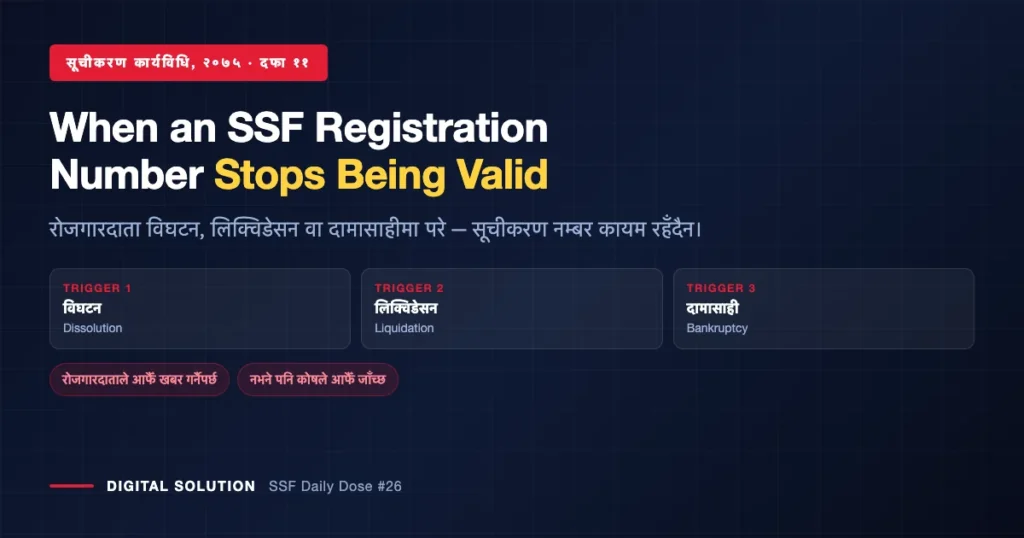
Almost every guide tells you how to get an SSF registration number. Almost none tells you that it can stop being valid. Section 11 of the Listing Procedure 2075 says plainly that when an employer is dissolved, goes into liquidation, or is declared bankrupt, the SSF registration number does not survive — and the Fund has the power to establish that on its own, whether or not the employer reports it.
This is Dose #26, a deep-dive into the parts of the Listing Procedure that Dose #7 did not reach: what the letter inside your 16-digit number actually means, when that number dies, and exactly which annexure form covers which situation.
The Letter Inside Your 16-Digit Number: 17 Industry Codes
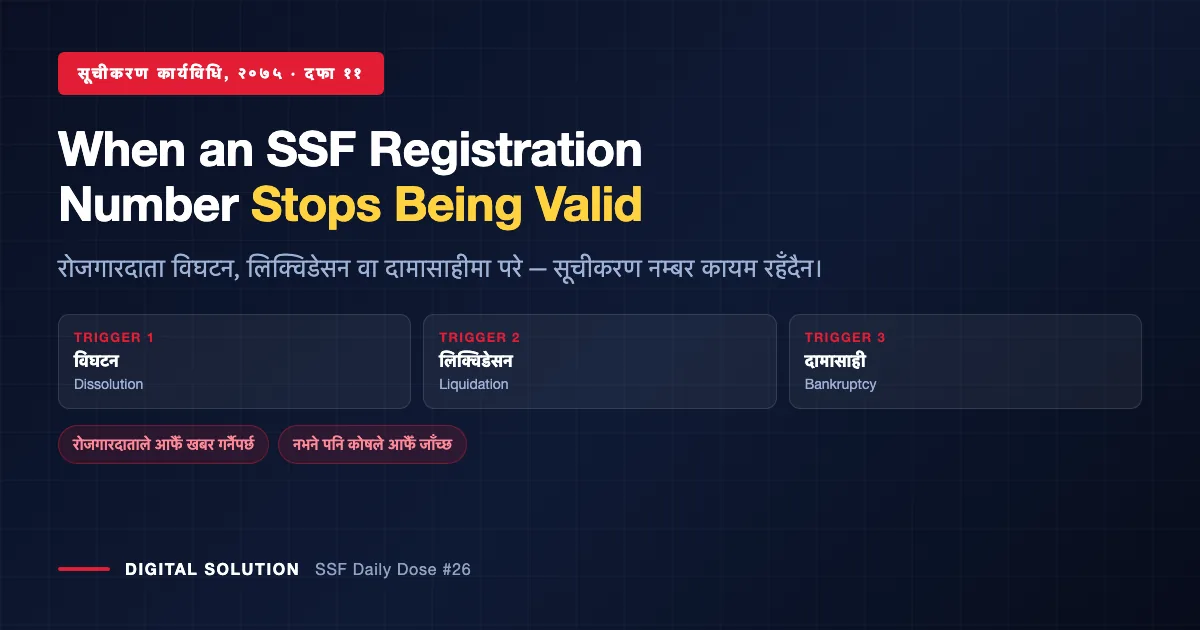
The employer registration number is built from province code + local level code + a letter + employer code. That letter is an industry classification code, and Schedule 9 (reflected in the Schedule 2 application form) defines seventeen of them, A through Q.
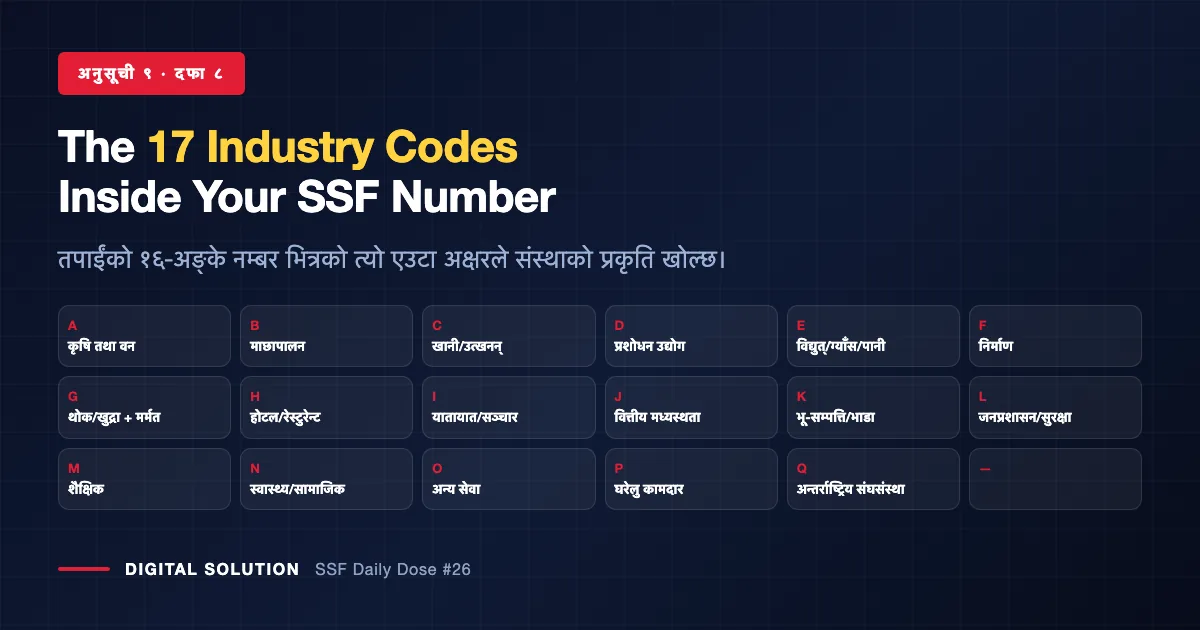
| Code | Nature of employer (रोजगारदाताको प्रकृति) |
|---|---|
| A | Agriculture and forestry — कृषि तथा वन |
| B | Fishing business — माछापालन व्यवसाय |
| C | Mining and quarrying — खानी तथा उत्खनन् क्रियाकलाप |
| D | Industrial (processing industry) production — औद्योगिक उत्पादन |
| E | Electricity, gas and water supply — विद्युत्, ग्याँस तथा पानीको आपूर्ति |
| F | Construction — निर्माण कार्य |
| G | Wholesale and retail of motors, motorcycles, personal or household goods, plus repair and maintenance |
| H | Hotels and restaurants — होटल तथा रेस्टुरेन्ट |
| I | Transport, warehousing and communication — यातायात, गोदाम एवं सञ्चार |
| J | Financial intermediation — वित्तीय मध्यस्थता |
| K | Real estate, rental and business activities — भू-सम्पत्ति, भाडा तथा व्यावसायिक क्रियाकलाप |
| L | Public administration, security and compulsory social security — जनप्रशासन, सुरक्षा एवं अनिवार्य सामाजिक सुरक्षा |
| M | Education — शैक्षिक क्रियाकलाप |
| N | Health and social work — स्वास्थ्य एवं सामाजिक कार्य |
| O | Other community, social and personal services — अन्य सामुदायिक, सामाजिक एवं व्यक्तिगत सेवा |
| P | Work of domestic workers in private households — घरेलु कामदार |
| Q | International organisations and their bodies — अन्तर्राष्ट्रिय संघसंस्था |
Why this is practically useful: you can read an SSF employer number and tell whether it belongs to a government body, a construction firm or a school — before you look anything up. A neat consequence: the Fund itself falls under code L, since “compulsory social security” is written into that category.
Schedule 2 also captures a second, separate classification — ownership type: (क) government, (ख) public institution, (ग) public limited, (घ) private limited, (ङ) cooperative, (च) non-governmental, (छ) other. Industry code and ownership type are recorded independently, so a private limited school and a government school share code M but differ on ownership.
Section 11: When the Registration Number Stops Being Valid
This is the provision most employers have never read, and it changes how you should think about closing a business in Nepal.
1. The employer’s own duty to report
If a listed employer established under prevailing law is dissolved (विघटन), enters liquidation (लिक्विडेसन), or is declared bankrupt (दामासाही) under prevailing law, the employer must inform the Fund. This is an obligation, not a courtesy.
2. The Fund’s independent power to verify
If information about such cancellation or dissolution reaches the Fund from any other source, the Fund must carry out its own enquiry. In other words, staying silent does not keep the number alive — the Fund is not required to wait for the employer.
3. The consequence
Where dissolution, liquidation or bankruptcy is established, the listing number obtained under Section 19 of the Act and Section 8 of this Procedure does not remain valid.
Section 11(4) — the one-month rule most employers miss. When a contributor ceases to be in employment for any reason, the employer must inform the Fund in the format prescribed in Schedule 12, within one month. This is a standing monthly discipline, not something that only matters when the company closes. Every resignation, termination and retirement triggers it.
The listing system is not an entry gate. It is a living database that tracks an employer from registration to dissolution — and updates worker eligibility along the way.
Read alongside the Fund’s financial administration and AML/CFT obligations, the logic is obvious: leaving a liquidated company’s registration number active in the system would itself be a misuse risk. Section 11 is what stops closed companies from becoming ghosts in the database.
If you are leaving a job rather than closing a company, the contributor side of this is covered in our guide to what happens to your SSF money after leaving a job.
Certificate and ID Card: Which Annexure Applies to Whom
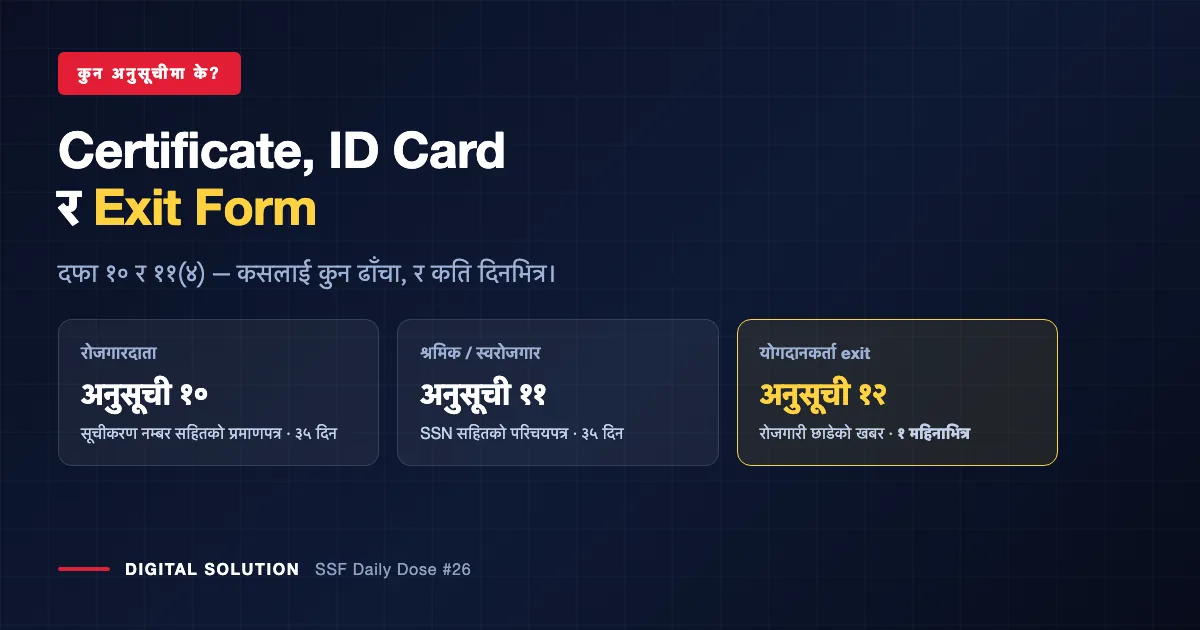
| Who receives it | Document | Format |
|---|---|---|
| Listed employer | Certificate bearing the listing number | Schedule 10 (अनुसूची १०) |
| Listed worker (formal sector) | Identity card bearing the Social Security Number | Schedule 11 (अनुसूची ११) |
| Informal sector / self-employed person | Identity card bearing the Social Security Number | Schedule 11 — the same format as formal workers |
| Employer reporting a contributor exit | Notification that a contributor has left employment | Schedule 12 — within one month |
Under Section 10(3), applications received under Section 6 — the informal-sector and self-employed route — carry the same 35-day timeline as formal workers. The Fund does not give itself extra time for the informal sector, which matters because that is where most of Nepal’s workforce sits.
What the Worker Application Form Actually Asks (Schedule 4)
Most summaries say “citizenship, nominee ID, authorisation letter”. The actual Schedule 4 form — used with Section 4(3) — goes considerably further:
- Full name (first, middle, last)
- Father’s name, mother’s name and grandfather’s name — three generations
- Spouse’s name, and the nominee (इच्छाएको व्यक्ति)
- Date of birth and sex
- Citizenship number, issuing district and issue date
- PAN (स्थायी लेखा नम्बर)
- Blood group (रक्त समूह)
- Permanent and current address — province, district, local level, ward, tole
- Date of first appointment and the employer’s listing number
Why blood group and three generations? This is not bureaucratic excess. Three-generation naming is Nepal’s standard way of resolving identity where names repeat, and a blood group only makes sense on a card that may be read during an accident — which fits a Fund that runs an accident and disability scheme. The form is designed for the emergency, not only for the file. Schedule 6, the informal-sector and self-employed form, asks for exactly the same details.
Records, Biometrics and Administrative Powers (Sections 12–14)
| Section | What it establishes |
|---|---|
| 12 — Records | All listing records are kept in an integrated computer system. A person’s personal and biometric information may not be used for any purpose other than the Fund’s own. |
| 13 — Removing obstacles | If any confusion arises during implementation, the Board of Directors has the power to clarify it. |
| 14 — Amending schedules | The Board may amend the schedules (the forms and formats) itself — so a form can be updated without amending the whole Procedure. |
Section 12 is worth pausing on. A written purpose-limitation on biometric data, inside a 2075 procedure, is more privacy protection than many newer Nepali systems provide. Section 14’s design choice is equally sensible: forms change more often than rules, so the Board can revise a schedule without reopening the entire Procedure.
Quick Recap
- 17 industry codes (A–Q) — agriculture (A) through international organisations (Q); the letter lives inside your registration number (Schedule 9).
- Section 11 — the number can be cancelled on dissolution, liquidation or bankruptcy; the employer must report it, and the Fund can investigate independently.
- Section 11(4) — every contributor who leaves employment must be reported in the Schedule 12 format within one month.
- Certificates and cards — employer: Schedule 10; worker, informal and self-employed: Schedule 11; all within 35 days.
- Schedule 4 / 6 forms collect detailed KYC down to grandfather’s name and blood group.
- Sections 12–14 — biometric purpose limitation, Board’s power to resolve confusion, Board’s power to amend schedules.
Need help with SSF registration or claims?
Digital Solution assists employers and workers with SSF listing, contributions, claim filing and document preparation across Nepal.
Frequently Asked Questions
Can an SSF registration number be cancelled?
Yes. Under Section 11 of the Listing Procedure 2075, where a listed employer is dissolved, goes into liquidation, or is declared bankrupt under prevailing law, the listing number obtained under Section 19 of the Act and Section 8 of the Procedure does not remain valid.
Does the employer have to inform SSF when the company closes?
Yes — the employer is required to inform the Fund of dissolution, liquidation or bankruptcy. Separately, if the Fund receives that information from any other source, it must conduct its own enquiry, so silence does not preserve the registration.
What must an employer do when a worker leaves?
Under Section 11(4), when a contributor ceases to be in employment for any reason, the employer must notify the Fund in the format prescribed in Schedule 12 within one month.
What does the letter in the SSF employer registration number mean?
It is the industry classification code from Schedule 9 — one of seventeen letters from A (agriculture and forestry) to Q (international organisations). It identifies the nature of the employer’s activity within the 16-digit number.
Which form gives the SSF certificate and which gives the ID card?
Under Section 10, a listed employer receives a certificate with the listing number in the Schedule 10 format. Listed workers, and informal-sector or self-employed persons, receive an identity card with the Social Security Number in the Schedule 11 format — the same format for both.
Why does the SSF form ask for blood group and grandfather’s name?
Three-generation naming is Nepal’s standard method of distinguishing people with repeating names, and blood group belongs on a card that may be read in an emergency — consistent with the Fund’s accident and disability scheme. Schedules 4 and 6 both collect these details.
Is biometric data collected by SSF protected?
Section 12 states that listing records are kept in an integrated computer system and that a person’s personal and biometric information shall not be used for any purpose other than the Fund’s own.
Related Reading
- SSF registration for employers: the full process
- Your SSF number (SSN): what it is and how to find it
- What happens to your SSF money after leaving a job
- Is SSF mandatory in Nepal?
- SSF Nepal: the complete guide
SSF Daily Dose — one contribution-based social security topic every day, sourced from official SSF documents. This dose covers रोजगारदाता र श्रमिकको सूचीकरण सम्बन्धी कार्यविधि, २०७५, Sections 8–14 and Schedules 2, 4, 6, 9, 10, 11 and 12.

Rabin Paudel
Rabin Paudel is the Founder of Digital Solution, a Content Creator, and an AI Trainer. He shares practical and easy-to-understand content on Artificial Intelligence, Digital Literacy, Online Services, FinTech, and Technology. His mission is to make technology simple, accessible, and useful for everyone.
View all posts by Rabin Paudel →