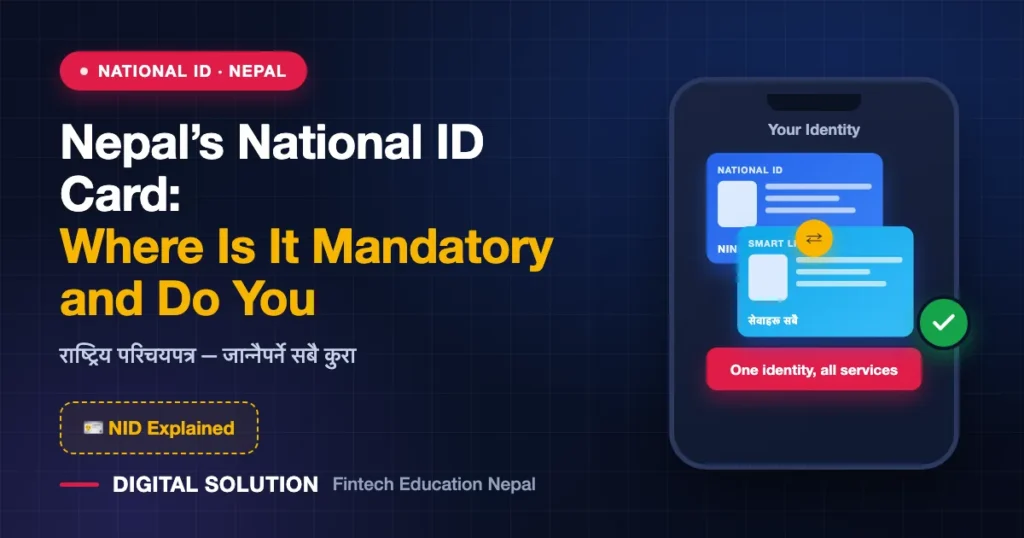
Nepal’s National Identity Card, commonly known as the National ID or Rastriya Parichaya Patra, is gradually becoming a central requirement for accessing government, financial, telecommunications, employment and investment-related services.
As more public and private institutions integrate their systems with the national identity database, many citizens are asking the same questions:
- Where is the National ID currently required?
- Is the physical card mandatory?
- Can services be accessed using only the National Identity Number?
- What should you do if the card is lost or damaged?
- Will a National ID also be required to open a new Demat account?
This article explains the key areas where the National ID is being used or made mandatory and clarifies the difference between the physical card and the National Identity Number.
What Is Nepal’s National ID?
The National ID is a biometric-based digital identity issued to Nepali citizens. It contains personal and biometric details such as:
- Full name
- Date of birth
- Permanent address
- Citizenship information
- Photograph
- Fingerprints
- Iris data
After biometric enrollment, each citizen receives a unique 10-digit National Identity Number.
This number is designed to become the primary identity reference for verifying individuals across government and private-sector services.
Where Is the National ID Required?
1. Opening a Bank Account and Updating KYC
Banks and financial institutions may require the National Identity Number when opening a new account or updating Know Your Customer, or KYC, details.
The purpose is to improve identity verification, reduce duplicate customer records and prevent fraudulent accounts created using false or borrowed documents.
Requirements may vary between banks, so customers should confirm the required documents with their respective financial institution.
2. Obtaining a New SIM Card
The National ID is increasingly being integrated into the process of issuing new SIM cards from Nepal Telecom and Ncell.
Linking SIM registration with verified national identity records can help prevent SIM cards from being issued under false names or using another person’s citizenship document.
This is especially important because unverified SIM cards are frequently associated with online scams, identity theft and financial fraud.
3. Driving Licence-Related Services
The National Identity Number may be required for driving licence applications, identity verification and the integration of transport-related records.
The broader objective is to connect citizen identity data with government transport systems and reduce duplicate or inaccurate records.
4. Land and Property Transactions
The National ID may be required when buying or selling land and other immovable property.
Identity verification is critical in property transactions because it helps confirm that the buyer and seller are genuine and that the documents being presented belong to the individuals involved.
Integrating property transactions with the National ID system can help reduce impersonation, document misuse and fraudulent ownership transfers.
5. Social Security Allowances and Pensions
The National ID is being used to verify beneficiaries receiving social security allowances and pension payments.
This may include:
- Senior citizen allowances
- Disability allowances
- Single-woman allowances
- Other government welfare payments
- Pension-related verification
The system aims to reduce duplicate beneficiaries, payments made under false identities and benefits continuing under the names of deceased individuals.
6. PAN and Tax Filing
The National Identity Number may also be integrated with Personal PAN registration, taxpayer profile updates and tax filing systems.
This can help match tax records with the correct individual and reduce duplicate PAN records or identity inconsistencies within the tax system.
7. Company Registration and Corporate Updates
The National ID may be requested when registering a company or verifying the identity of founders, shareholders, directors or authorised representatives.
It may also be used while updating company information or submitting certain corporate records.
However, requirements may differ depending on the type of company service. Applicants should check the latest instructions issued by the Office of the Company Registrar.
8. Opening a TMS or Broker Account
Investors opening a Trading Management System, or TMS, account may be asked to provide their National Identity Number as part of the KYC process.
This can help prevent duplicate trading accounts, inaccurate investor profiles and accounts created using false identification.
The exact requirement may depend on the broker company, depository participant and the system being used.
9. Applying for a New Labour Permit
The National Identity Number may be required when applying for a new labour permit for foreign employment.
It helps verify that the citizenship, passport, labour approval and other employment-related documents belong to the same person.
This integration can improve transparency and reduce identity-related irregularities in the foreign employment process.
10. Applying for an E-Passport
The National Identity Number is required for Nepal’s e-passport application process.
One important point is that applicants may not always need to wait for the physical National ID card. In many cases, the National Identity Number received after biometric enrollment is the key requirement.
Applicants should still carry the documents requested by the passport office.
11. Opening a New Demat Account
The National Identity Number is also expected to become compulsory for opening new Demat accounts under the forthcoming implementation arrangements.
Before applying, investors should verify the exact effective date and requirements with their bank, depository participant, merchant banker, CDS and Clearing Limited, or the relevant regulatory authority.
Existing Demat account holders may also be asked to update their KYC details in the future, depending on the official implementation procedure.
Do You Need the Physical National ID Card?
This is one of the most common areas of confusion.
For many digitally connected services, the 10-digit National Identity Number may be more important than the physical card itself.
Citizens who have completed biometric enrollment but have not yet received their printed card may still be able to access certain services using:
- The National Identity Number
- The enrollment confirmation slip
- The application number
- An official SMS containing the number
- Citizenship documents
However, the process is not identical across all institutions.
Some offices may ask for the physical card, while others may accept the number or enrollment slip. Citizens should therefore confirm the exact documentation requirements before visiting the service provider.
It is safer to say that the National Identity Number may be sufficient for many services, rather than assuming that the physical card will never be required.
What If the National ID Card Is Lost or Damaged?
If the physical card is:
- Lost
- Burned
- Torn
- Damaged
- Destroyed
- No longer readable
the cardholder can apply for a duplicate card through the relevant District Administration Office or an authorised National ID registration centre.
A duplicate card may be issued after payment of the prescribed fee, which is currently stated as NPR 500.
The National Identity Number remains the same. A new identity number is not created simply because a duplicate physical card is issued.
How Can You Find Your National Identity Number?
Citizens who have already completed biometric enrollment can retrieve or verify their National Identity Number using their application details and the official citizen services provided by the responsible department.
The enrollment slip should be kept safely because it may contain the application number required to track the National ID status.
Citizens who have not completed enrollment must visit an authorised registration centre with their original citizenship certificate and any additional documents required for verification.
Important Security Precautions
The National Identity Number and enrollment information are sensitive personal data.
Citizens should follow these precautions:
- Do not post a photo of the National ID card on social media.
- Do not publicly share the enrollment slip or application number.
- Do not disclose the National Identity Number to unknown individuals.
- Do not enter personal information on suspicious websites or links.
- Use only official portals and verified service providers.
- Never share passwords, OTP codes or biometric verification details.
- Blur sensitive information before sending documents digitally.
Conclusion
Nepal’s National ID is becoming more than a physical identity card. It is developing into a central digital identity that can be used across banking, telecommunications, passports, social security, taxation, property transactions, foreign employment and capital-market services.
Citizens should complete biometric enrollment, keep their National Identity Number secure and verify the latest requirements before accessing any service.
Because implementation dates and procedures may vary between institutions, always check the most recent official notice issued by the relevant bank, government office, broker, depository participant or regulatory authority.
Have you received your physical National ID card, or do you currently have only the National Identity Number? Share your experience without posting your personal number or card details.
Digital Solution | Rabin Paudel
🤝 National ID process मा अल्झिनुभयो?
Status check, enrollment, विवरण मिलेन — जे समस्या भए पनि हामी step-by-step guide गरिदिन्छौं।

Rabin Paudel
Rabin Paudel is the Founder of Digital Solution, a Content Creator, and an AI Trainer. He shares practical and easy-to-understand content on Artificial Intelligence, Digital Literacy, Online Services, FinTech, and Technology. His mission is to make technology simple, accessible, and useful for everyone.
View all posts by Rabin Paudel →