
Last updated: August 2026 (Shrawan 2083). Based on the National Identity Card and Civil Registration Act 2076, its Regulations 2077 (as amended to 2082) and DONIDCR guidance. Local citizen charters may differ — confirm with your ward before visiting.
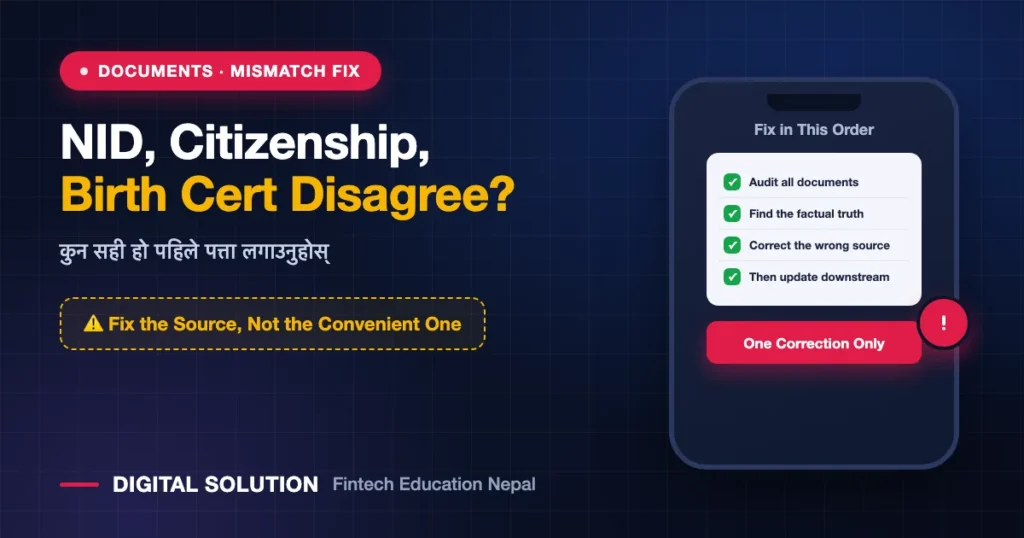
Your citizenship says one date of birth. Your birth certificate says another. Your National ID copies one of them, and your academic certificates disagree with both. Before you “make them all the same,” you have to establish which one is factually true — because fixing them in the wrong order makes the problem permanent.
The Rule Nobody Tells You
There is no rule that the oldest document is always right. Compare the hospital’s original record, first school admission, parents’ citizenship, any court order and the issuing office’s original register — then determine the factually correct detail.
Copying a wrong citizenship into a birth certificate, or using a wrong birth certificate to correct your National ID, entrenches the error across every system.
Step 1: Audit the Differences
Make a table of every document and every field that differs:
| Document | Name (NP / EN) | Date of birth (BS / AD) | Parents’ names | Address |
|---|---|---|---|---|
| Birth certificate | ||||
| Citizenship | ||||
| National ID | ||||
| Academic certificates | ||||
| Passport |
This single exercise usually reveals which record is the outlier — and which is the source of the error.
Step 2: Fix the Source First
Each document has its own authority:
- Birth certificate → local registrar / ward office (correction guide) — remember the correction facility can currently be used only once
- Citizenship certificate → District Administration Office
- National ID → National ID registration station at the DAO / Area Administration Office
- Academic certificates → the school/board’s own correction process
Generally, correct the document that is factually wrong, not the one that is inconvenient — and expect downstream documents to need updating afterwards.
Step 3: Special Care With Marriage-Related Name Changes
A spouse’s surname generally cannot be added to the National ID unless it is legally established in the citizenship record. The citizenship must be amended first. Using different names across citizenship, passport, academic certificates and National ID creates verification failures in banking, foreign employment and immigration.
Step 4: When Administrative Correction Isn’t Enough
Where the difference spans years, has legal consequences for age, involves disputed parentage, or the evidence genuinely conflicts, a court decision may be required rather than an over-the-counter correction. Ask the office in writing what evidence would satisfy them before you file.
If You Are Refused
Ask for a written decision with reasons and an application number. Escalate to the municipality’s registration section / chief administrative officer, the Department, or take legal advice. Submitting false documents to force a correction is punishable.
FAQ
Which document should I change — citizenship or birth certificate?
The one that is factually wrong. Determine the truth from the earliest reliable records first.
Will correcting my birth certificate change my NIN?
No — the NIN generally stays the same; the underlying details are what get updated.
How many times can I correct a vital event certificate?
Currently once — so fix everything in one application.
Official Basis
- Act 2076 and Regulations 2077, Rule 23 (as amended)
- DONIDCR official FAQ
- National ID and citizenship administration procedures
🤝 Stuck with a registration problem?
Tell us your situation — late registration, missing documents, mismatched details or a ward office refusal — and Digital Solution will map the correct process for your case.
Disclaimer: Digital Solution Nepal is an independent educational/digital-service assistance website, not a government body. Vital event registration rules, fees and local checklists change through notices and vary between local levels — your ward office, local registrar and DONIDCR are final. For complex legal or identity disputes, consult a qualified lawyer.

Rabin Paudel
Rabin Paudel is the Founder of Digital Solution, a Content Creator, and an AI Trainer. He shares practical and easy-to-understand content on Artificial Intelligence, Digital Literacy, Online Services, FinTech, and Technology. His mission is to make technology simple, accessible, and useful for everyone.
View all posts by Rabin Paudel →