
Updated 12 August 2026. Ncell launched Business Cloudsuite on 11 August 2026. Every price and specification below was read directly off Ncell’s own pricing pages and each competitor’s own pricing page on 12 August 2026. Hosting prices change often — check before you buy.
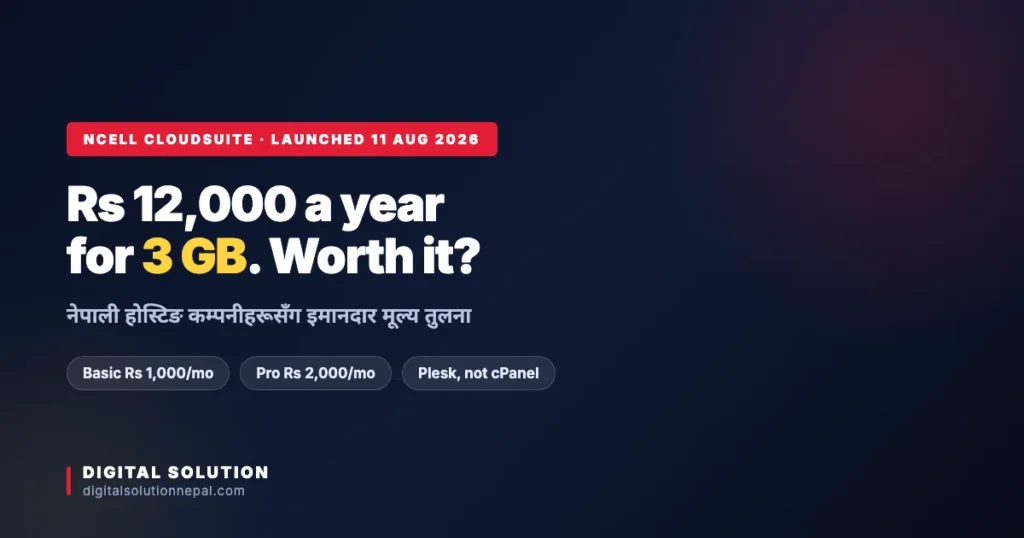
Ncell has entered the web hosting business. The headline number is Rs 1,000 a month, or Rs 12,000 a year, and for that you get 3 GB of shared storage.
That is roughly five times what an established Nepali host charges for an entry plan. So the obvious question — is the Ncell Business Cloudsuite price justified? — deserves a real answer rather than a hot take. The short version: for a blog, a portfolio or a small business website, no. For a narrow set of buyers, there is a genuine argument. And the argument that gets repeated most often online, about data localisation law, is mostly wrong.
What Ncell actually launched
Ncell Business Cloudsuite went live on 11 August 2026, announced by Chief Enterprise Business Officer Dion Asencio. It sells shared web hosting and domain registration from cloudsuite.ncell.com.np.
One correction worth making early, because it appears in a lot of coverage: the company is Ncell, not “Ncell Axiata” any more. Axiata sold its stake and exited in December 2023. The legal entity name lingers on paperwork, but Axiata is no longer the owner.
Here is what the two plans contain, taken from Ncell’s order pages:
| Basic | Pro | |
|---|---|---|
| Monthly | Rs 1,000 | Rs 2,000 |
| Yearly | Rs 12,000 | Rs 24,000 |
| Storage | 3 GB shared | 6 GB shared |
| Data transfer | 50 GB/month | 75 GB/month |
| Email accounts | 5 (250 MB each) | 20 (500 MB each) |
| Databases | 5 | 10 |
| Subdomains | not listed | up to 5 |
| Websites | 1 | 1 |
Three details that most summaries get wrong:
The control panel is Plesk, not cPanel. Ncell’s own FAQ names Plesk repeatedly. If you are used to cPanel — and almost every Nepali host uses cPanel — the interface will be unfamiliar. It is a perfectly good panel, just a different one.
The price already includes tax. Ncell’s cart states “Included statutory taxes and levies (VAT and TSC)”. This matters more than it sounds, and we will come back to it, because every Nepali competitor quotes prices before 13% VAT.
Paying yearly saves you nothing. Rs 12,000 is exactly twelve times Rs 1,000. The page invites you not to “miss a discount on long-term purchases”, but for hosting there is no such discount.
What Nepali hosting companies charge
Now the comparison. These are entry-level shared hosting plans, read off each company’s own pricing page on 12 August 2026.
| Host | Plan | Price/year | Storage | Panel |
|---|---|---|---|---|
| Web Host Nepal | Basic | Rs 1,000 | 200 MB | cPanel |
| AGM Web Hosting | SLH-1 | Rs 1,299 | 500 MB SSD | cPanel |
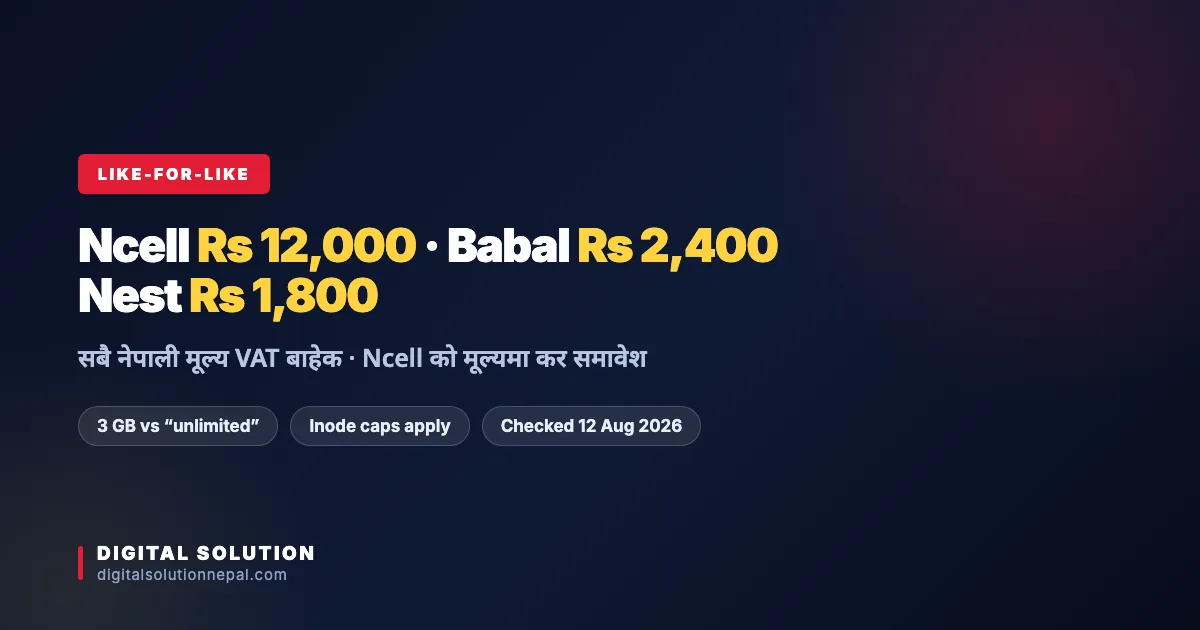
| Nest Nepal | Web Essential | Rs 1,800 | “Unlimited” NVMe | cPanel |
| Babal Host | Starter | Rs 2,400 | “Unlimited” NVMe | cPanel |
| Himalayan Host | Local Cloud | Rs 3,500 | “Unlimited… max 25 GB” | DirectAdmin |
| Prabhu Host | M-Cloud P0 | Rs 4,000 | “Unlimited” NVMe | cPanel |
| Thulo (was Gurkha Host) | Lite Unlimited | Rs 4,188 | Unlimited | cPanel |
| Ncell Cloudsuite | Basic | Rs 12,000 | 3 GB | Plesk |
Note on Gurkha Host: it is no longer an independent company. gurkhahost.com now redirects to business.thulo.com — it has become a Thulo.com product. If you have an older comparison bookmarked, it is out of date.
Note on tax: all the Nepali hosts above quote before VAT; add 13%. Ncell’s Rs 12,000 is tax-inclusive. Comparing the raw numbers slightly overstates Ncell’s premium — the honest comparison is Babal at about Rs 2,712 all-in against Ncell at Rs 12,000 all-in.
Even after that correction, Ncell is roughly 4–5× the price of the mainstream Nepali entry tier, and it gives you 3 GB where they advertise “unlimited”.
The “unlimited” asterisk you should know about
Before concluding that Nepali hosts are simply better value, be honest about what “unlimited” means. It is a marketing word, and it is bounded in ways the headline does not show:
- Babal Host caps at 200,000 inodes (roughly, total files)
- Nest Nepal caps at 100,000 files
- Himalayan Host states it outright on its own page: “Unlimited SSD Storage Maximum 25 GB”
That last line is the most honest sentence in Nepali hosting marketing. “Unlimited” in shared hosting universally means unmetered up to fair-use limits on files, CPU and I/O — not infinite disk.
For perspective: a typical WordPress business site with a few hundred posts and images sits comfortably under 2 GB. So 3 GB is genuinely enough for most small sites — the problem with Ncell’s Basic plan is not that 3 GB is unusable, it is that you are paying five times the going rate for it.
Also worth noting: no Nepali host except Babal Host publishes what the price renews at. Babal explicitly states “renews at same price”. For the others, the advertised figure may or may not be a first-year rate — ask before you pay. We cover this trap in more depth in our guide to domain and hosting deals for Nepal.
So is Ncell Business Cloudsuite overpriced?
For a blog, portfolio, small business site or small online store — yes, clearly. You would be paying Rs 12,000 a year for 3 GB and a shared server, when Nest Nepal or Babal Host will sell you an entry plan with cPanel and far more headroom for around Rs 2,000–2,700 including VAT.
Nothing in the Basic plan’s specification justifies the gap. 50 GB of monthly transfer, 5 email accounts and 5 databases are ordinary numbers. The plan is not more powerful — it is more expensive.
But “overpriced” and “pointless” are different claims, and there are two things Ncell genuinely offers that most of the market does not.
What Ncell genuinely has that others don’t
A verified data centre in Nepal. This is real, not marketing. Ncell operates its flagship IDC at Nakkhu, Lalitpur, with disaster recovery in Pokhara and a regional facility in Hetauda, running Oracle Private Cloud Appliance hardware. We confirmed independently that cloudsuite.ncell.com.np resolves to an IP registered to Ncell’s network, in Nepal.
Several Nepali hosts also claim Kathmandu hosting — Babal Host, Thulo and Himalayan Host among them. But some do not: Nest Nepal describes a “globally managed server network” with no Nepal claim, and Web Host Nepal, despite advertising a Kathmandu data centre, runs its own website on servers in Germany. If in-country hosting matters to you, ask the provider directly and get it in writing.
A government-listed facility. Ncell became the first company enlisted by the Department of Information Technology as a data centre and cloud service provider, in April 2025. For a specific class of customer, that listing is the entire value proposition — as the next section explains.
On the certification claim, be precise: Ncell’s facility holds ANSI/TIA-942-C Rated-3 certification (design and constructed facility). It is often written as “Tier III”, but that is a different standard body’s term. TIA-942 Rated-3 is a real, meaningful certification — just describe it accurately.
Does hosting in Nepal actually make your site faster?
Everyone asserts this; almost nobody measures it. So we did.
We ran ping tests from a residential broadband connection in Kathmandu on 12 August 2026 to servers in each region. These are minimum round-trip times — the floor, before any server processing:
| Where the server is | Round trip from Kathmandu |
|---|---|
| Inside Nepal | ~7–8 ms |
| India (Mumbai) | ~46 ms |
| India (Bangalore) | ~70 ms |
| Singapore | ~96 ms |
| Germany | ~175 ms |
| USA (east coast) | ~256 ms |
| USA (west coast) | ~291 ms |
So yes — the difference is real and large. A US-hosted site starts roughly 35 times further away than a Nepal-hosted one, in network terms.
Two findings worth knowing. First, Singapore is slower than its distance suggests (~96 ms) because Nepali traffic reaches it through India rather than directly — our traceroutes exit Nepal southward into Delhi. Second, domestic traffic genuinely stays domestic: we watched Nepal-to-Nepal packets cross npIX, Nepal’s internet exchange, and arrive in about 8 ms.
But here is the cheap shortcut most people miss. Cloudflare has run a Kathmandu point of presence since 2018. Put a foreign-hosted site behind Cloudflare’s free plan and Nepali visitors are served from Kathmandu anyway — we measured a Cloudflare-fronted Nepali news site at 7 ms, identical to in-country hosting. For a normal content website, that free CDN buys you most of the speed benefit of a Nepal data centre without the Rs 12,000 bill.
Honest caveat: these are our own measurements from one ISP on one day, not a published benchmark. Treat them as indicative magnitudes. Jitter was high — average round trips ran roughly double the minimums.
The data localisation argument — what the law actually says
This is where most commentary goes wrong, so it is worth getting right.
There is no general law requiring Nepali businesses to host their data inside Nepal. Not for shops, not for SMEs, not for bloggers, not for ordinary companies. If someone tells you your business is legally required to host in Nepal, ask them for the clause.
What genuinely exists is a set of sector-specific rules. If your business falls in one of these, in-Nepal hosting stops being a preference and becomes a requirement:
1. NRB’s payment directive. The Payment System Related Unified Directives, 2081, Directive 3/081, requires institutions licensed by Nepal Rastra Bank for payment business to keep their data centre only with an operator listed by the Department of Information Technology. It does not literally say “inside Nepal” — but DoIT listing requires a physical facility with building and fire-safety documentation, so in practice it means a Nepali facility. This binds NRB payment licensees, including banks in respect of that licensed payment business.
2. Government bodies and security agencies. The Data Center and Cloud Service Directive, 2081 requires government security agencies to use the state’s Integrated Data Management Center, and says any data centre storing government data must hold at least a tier-3 rating.
3. Government websites. A separate gazetted directive — the Government Office Website Development and Management Directive, 2078 — requires websites built by government offices to be hosted in the Government Integrated Data Centre. Note what this means in practice: a government office generally cannot buy commercial hosting for its website at all, Ncell’s included. The state hosts it.
4. Insurance companies. The Nepal Insurance Authority’s IT guidance for insurers requires an insurer to take cloud data centre services only from providers registered in Nepal and operating within Nepal, to keep its core application server at its head office, and to place its backup data centre in a different province from the head office.
5. The stock exchange. Under the Stock Exchange Operation Regulation, the trading system’s server and data hosting may not be kept abroad without the consent of the Government of Nepal. Note the scope carefully: this binds the exchange itself, not brokers, and it is a consent requirement rather than a flat ban.
6. Electronic invoicing — the newest and broadest one. The Electronic Invoicing Procedure, 2082, in force since March 2026, requires the server used for electronic invoicing to sit inside Nepal, on the taxpayer’s own business premises. If you use cloud instead, the procedure requires both that the cloud server be located in Nepal and that the cloud provider itself be registered in Nepal. Even multinationals running invoicing software abroad must automatically mirror every invoice to a server inside Nepal at the moment it is issued.
That sixth one is the rule most likely to catch an ordinary — if sizeable — Nepali business, because it follows turnover rather than industry. The Inland Revenue Department has been phasing in mandatory e-invoicing and CBMS connection starting with larger taxpayers. If your turnover is approaching that territory, check where your billing system’s server actually lives before you renew anything.
And one fact that cuts directly against the popular narrative: NRB’s own IT Guidelines expressly permit banks to store and process data abroad, subject to segregation, access controls and regulator inspection rights. Nepali banks are not, as a general matter, required to keep everything onshore.
So the accurate version is this. Ncell’s Nepal data centre is a real advantage for NRB-licensed payment institutions, government projects, and any organisation whose own contract or internal policy requires in-country hosting. For everybody else, it is a preference — sometimes a reasonable one — not a legal obligation.
Ncell’s own press release is carefully worded, saying Cloudsuite “helps them meet regulatory requirements”. That is fair. Do not let anyone upgrade it into “the law requires this”.
Two things missing from the launch
If you are considering the Pro plan for anything business-critical, two gaps are worth knowing about before you commit.
There is no published uptime SLA for hosting. Ncell’s SLA page commits only to “aims to provide reliable access”. The much-quoted 99.982% figure is the data centre facility rating, not a service guarantee to you as a customer. By contrast, Babal Host publishes a 99.9% uptime commitment with a free-month remedy — a weaker facility, but a stronger promise.
The policy pages went live unfinished. As of 12 August 2026, Ncell’s SLA and refund policy pages both still carry an unremoved drafting note stating that the page is a starter policy draft to be confirmed before publication. That is a launch-day oversight rather than anything sinister, and it will presumably be fixed. But it does mean the refund terms you would be agreeing to today are not settled — worth waiting for, or asking about in writing.
Which should you actually buy?
| Your situation | What makes sense |
|---|---|
| Blog, portfolio, personal site | Nest Nepal or Babal Host entry plan (~Rs 2,000–2,700 with VAT) |
| Small business site or brochure site | Babal Host Starter — published renewal price, cPanel, Nepal-hosted line |
| Online store, growing traffic | A higher local tier, or an international host — compare on I/O and inode limits, not disk |
| NRB-licensed payment business | Ncell Cloudsuite — the DoIT listing is the point |
| Insurer, or a large taxpayer on e-invoicing | Ncell Cloudsuite — your sector rule requires a Nepal-based provider |
| Contract or policy requires in-Nepal hosting | Ncell Cloudsuite — one of the few with a verified Nepal facility |
| Government office website | Not this — the law routes you to the Government Integrated Data Centre |
| You need the cheapest possible | Web Host Nepal Rs 1,000/yr — but check that 200 MB is genuinely enough |
If you are buying internationally instead — often the better call for e-commerce — our guide to domain and hosting deals from Nepal covers paying legally in dollars, and our dollar card guide explains the NRB rules on card limits.
One free thing worth knowing
Ncell sells .com domains at Rs 2,601 for the first year, renewing at Rs 4,233 — a real promo-to-renewal gap, so budget for the second year.
But if you want a .com.np domain, registration is free of cost through the .np registry. You do not need to buy it from anyone. We explain the paperwork in our guides to the .np domain registration letter and the application letter format.
Frequently asked questions
How much does Ncell Business Cloudsuite cost?
Rs 1,000 per month or Rs 12,000 per year for the Basic plan (3 GB storage), and Rs 2,000 per month or Rs 24,000 per year for Pro (6 GB). Both prices include VAT and TSC. Paying annually gives no discount.
Is Ncell Business Cloudsuite worth it for a small website?
For most small websites, no. Established Nepali hosts sell entry plans with cPanel and much larger storage allowances for roughly Rs 1,800–2,400 a year plus VAT. Ncell makes sense mainly if you specifically need a Nepal-based, DoIT-listed data centre.
Does Ncell really host in Nepal?
Yes. Ncell operates its own data centres at Nakkhu (Lalitpur), Pokhara and Hetauda, and its hosting service resolves to an IP registered to Ncell’s network in Nepal. The facility holds ANSI/TIA-942-C Rated-3 certification.
Is my Nepali business legally required to host inside Nepal?
There is no general data localisation law covering ordinary businesses. But sector rules do exist: NRB payment licensees, insurance companies, the stock exchange’s trading system, government bodies, and — since March 2026 — the servers used for electronic invoicing, which must sit inside Nepal. Outside those, it is a choice. Nepal Rastra Bank’s own IT Guidelines actually permit banks to process data abroad with proper controls.
Will hosting in Nepal make my website faster?
Measurably, yes — we recorded about 7–8 ms round trip to Nepali servers from Kathmandu, against roughly 96 ms to Singapore and 256 ms to the US east coast. But putting a foreign-hosted site behind Cloudflare’s free plan serves Nepali visitors from Cloudflare’s Kathmandu location, which we measured at the same 7 ms. For a normal content site that is the cheaper route to the same result.
Does Ncell Cloudsuite use cPanel?
No — it uses Plesk. Almost every Nepali competitor uses cPanel, so migrating between them means learning a different interface.
Can I get a .com.np domain from Ncell?
You can register domains through Ncell, but .com.np registration is free through the .np registry itself. There is no need to pay for it.
Need help choosing?
Picking hosting is one of those decisions that is cheap to get right and expensive to undo. If you are unsure which plan fits your site — or you are already paying too much and want to move — Digital Solution helps Nepali businesses with exactly this from our office in Pokhara.
WhatsApp us on +977 9766597181 with what your site does and roughly how much traffic it gets, and we will tell you honestly what you need. If the answer is “the Rs 2,000 plan is fine”, that is what we will say.
Prices and specifications were read from each company’s own website on 12 August 2026 and are subject to change. Nepali hosts’ prices are quoted before 13% VAT; Ncell’s are tax-inclusive. This article contains no affiliate links to any hosting company named above.

Rabin Paudel
Rabin Paudel is the Founder of Digital Solution, a Content Creator, and an AI Trainer. He shares practical and easy-to-understand content on Artificial Intelligence, Digital Literacy, Online Services, FinTech, and Technology. His mission is to make technology simple, accessible, and useful for everyone.
View all posts by Rabin Paudel →