
As of 12 October 2026 (Asoj 2083). Tariffs are from the Nepal Telecommunications Authority’s updated approved tariff list dated 2083/05/16; subscriber numbers are from NTA’s Bhadra 2083 MIS report. Approved tariffs exclude TSC and VAT. Your bill will be higher, and the installation charge, router and any “maintenance” fee are separate.
The internet price in Nepal that an ISP can charge is not whatever it likes. Every package rate has to be approved by the Nepal Telecommunications Authority (NTA) first, and NTA publishes the approved list. That list is the closest thing Nepal has to an official price sheet for home internet.
We went through the full 68-page list and pulled out the approved packages of the ten largest ISPs, ranked by how many fixed-broadband customers each one has. For each ISP you get the approved speed, the monthly rate, the sharing ratio where NTA states it, and the date of approval.
Two things to keep in mind before the tables. First, these are regulator-approved tariffs, excluding tax; the number on your bill adds TSC and VAT. Second, an approval date tells you how old the price structure is. Some of the biggest ISPs are still operating on tariffs approved in 2078 or 2076, while WorldLink, Vianet and Subisu got new ones approved in Shrawan–Bhadra 2083.
Key takeaways
- WorldLink has 11.22 lakh fixed-broadband customers, 31% of the market. Its newest approved tariff (2083/04/21) starts at 200 Mbps for Rs 1,190 and goes to 600 Mbps for Rs 1,667.
- Vianet (10.6%) got the longest list approved: 26 fiber speeds from 40 Mbps at Rs 907 to 650 Mbps at Rs 2,699 (2083/04/25).
- Subisu (7.6%) is the only big ISP whose approved packages carry a data cap with fallback speed, for example 100 Mbps at Rs 1,096 with a 1,000 GB cap.
- Nepal Telecom is the second-largest provider by customers, but its standard FTTH packages do not appear in this list; only Premium FTTH (500 Mbps and 1 Gbps yearly) and lease-line rates do.
- DishHome, Classic Tech and Websurfer are still on tariffs approved in 2079, 2078 and 2076 respectively.
- All tariffs are exclusive of TSC and VAT. “Sharing ratio” (1:1, 1:2, 1:4, 1:8) tells you how many customers can share the same bandwidth; a lower second number is better.
Nepal’s top 10 ISPs by subscribers (NTA MIS, Bhadra 2083)
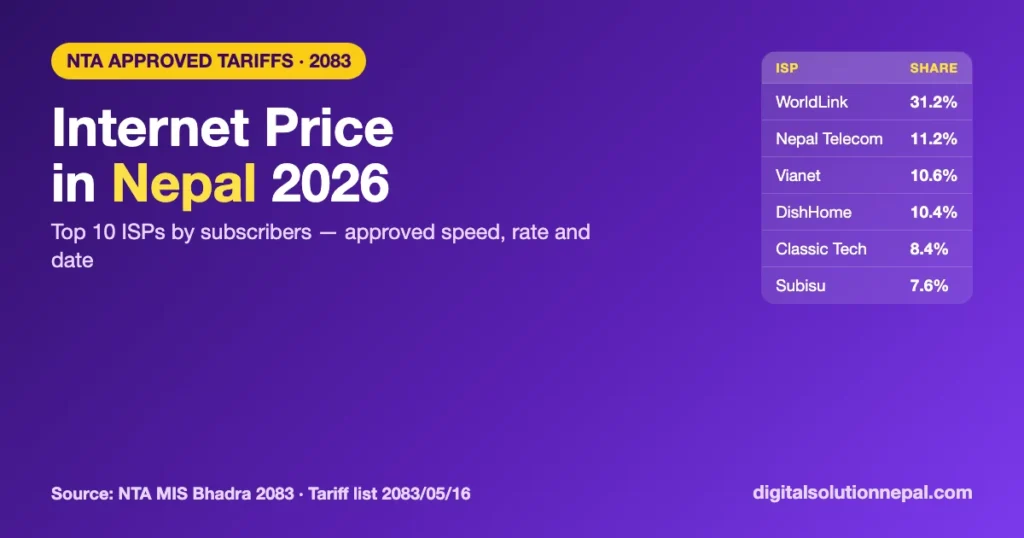
NTA’s monthly MIS report lists the top twenty ISPs by fixed-broadband subscribers. Here are the ten largest.
| Rank | ISP | Fixed-broadband subscribers | Market share |
|---|---|---|---|
| 1 | WorldLink Communications | 11,22,094 | 31.22% |
| 2 | Nepal Telecom (Nepal Doorsanchar Company) | 4,02,132 | 11.19% |
| 3 | Vianet Communication | 3,80,937 | 10.60% |
| 4 | DishHome (Dish Media Network) | 3,74,628 | 10.42% |
| 5 | Classic Tech | 3,00,653 | 8.37% |
| 6 | Subisu CableNet | 2,72,270 | 7.58% |
| 7 | Websurfer Nepal | 1,73,204 | 4.82% |
| 8 | Techminds Network | 1,12,375 | 3.13% |
| 9 | WiFi Nepal | 1,06,270 | 2.96% |
| 10 | CG Communications (CG Net) | 95,423 | 2.66% |
Nepal had 35,93,692 fixed-broadband connections in Bhadra 2083, almost all of them fiber. The top four alone hold 63% of them. For how Nepal Telecom has been losing fiber customers to the private ISPs, see our analysis of NT’s fiber customer loss.
How to read NTA’s approved tariff list
- Monthly rate is what NTA approved for that speed, before tax. ISPs may sell below it (festival offers, yearly discounts) but not above it.
- Sharing ratio is in the ISP’s own filing. 1:1 means dedicated bandwidth; 1:8 means up to eight customers share it. Two ISPs quoting Rs 1,200 for 100 Mbps are not offering the same thing if one is 1:2 and the other 1:8.
- FUP (fair usage policy) noted on a package means the speed can be reduced after heavy use.
- Data cap / fallback (Subisu’s model) means full speed until the monthly GB figure is used, then the fallback speed for the rest of the month.
- Approval date is in Bikram Sambat as printed by NTA. We give an approximate Gregorian date in brackets.
- NTA’s list is cumulative: older approvals for the same ISP are kept. We show the newest tariff in full and summarise the earlier ones.
1. WorldLink: approved packages
WorldLink is Nepal’s largest ISP by a wide margin. NTA approved a new high-speed tariff for it in Shrawan 2083.
Approved 2083/04/21 (≈ 6 August 2026) — sharing ratio 1:2
| Package | Monthly tariff (Rs, excl. tax) |
|---|---|
| 200 Mbps | 1,190 |
| 250 Mbps | 1,250 |
| 300 Mbps | 1,300 |
| 400 Mbps | 1,350 |
| 500 Mbps | 1,400 |
| 600 Mbps | 1,667 |
Prices exclude all taxes and include support and maintenance.
Earlier approval still on the list — 2080/05/22 (≈ 8 September 2023), sharing ratio 1:2, FUP applies
| Package | Monthly (Rs) | Yearly (Rs) |
|---|---|---|
| 50 Mbps | 950 | 9,600 |
| 75 Mbps | 1,050 | 10,700 |
| 100 Mbps | 1,150 | 11,400 |
| 150 Mbps | 1,200 | 11,750 |
What stands out: in the 2083 tariff, going from 200 Mbps to 500 Mbps costs only Rs 210 more a month. WorldLink’s filing is clearly built to sell speed, not to charge for it.
2. Nepal Telecom: what the list contains
Nepal Telecom’s everyday FTTH packages are not in this NTA document. What the list carries for Nepal Doorsanchar Company Limited is its premium and wholesale tariffs.
Premium FTTH — approved 2080/07/20 (≈ 6 November 2023), FUP applies
| Package | Yearly tariff (Rs, excl. tax) |
|---|---|
| Premium FTTH 500 Mbps | 57,818.86 |
| Premium FTTH 1 Gbps | 82,708.25 |
Internet lease line — approved 2080/02/18 (≈ 1 June 2023)
| Bandwidth | Rate per Mbps per month (Rs, excl. tax) |
|---|---|
| 1–50 Mbps | 1,600 |
| Above 50 Mbps | 1,500 |
For NT’s current consumer fiber and festival packages, see our NTC Dashain-Tihar offer guide.
3. Vianet: approved packages
Vianet filed the most detailed tariff of any ISP: 26 fiber speeds in Rs 25–200 steps.
Approved 2083/04/25 (≈ 10 August 2026) — fiber, monthly, excl. tax
| Speed | Rs/month | Speed | Rs/month |
|---|---|---|---|
| 40 Mbps | 907.08 | 325 Mbps | 1,858.40 |
| 50 Mbps | 951.32 | 350 Mbps | 1,880.54 |
| 60 Mbps | 973.46 | 375 Mbps | 1,902.66 |
| 70 Mbps | 1,061.94 | 400 Mbps | 1,969.02 |
| 75 Mbps | 1,106.20 | 425 Mbps | 2,013.28 |
| 80 Mbps | 1,150.44 | 450 Mbps | 2,101.76 |
| 100 Mbps | 1,261.06 | 475 Mbps | 2,190.26 |
| 125 Mbps | 1,305.30 | 500 Mbps | 2,256.64 |
| 150 Mbps | 1,349.56 | 550 Mbps | 2,455.76 |
| 175 Mbps | 1,393.80 | 600 Mbps | 2,610.62 |
| 200 Mbps | 1,526.54 | 650 Mbps | 2,699.12 |
| 225 Mbps | 1,592.92 | ||
| 250 Mbps | 1,659.30 | ||
| 275 Mbps | 1,725.66 | ||
| 300 Mbps | 1,836.28 |
The filing does not state a sharing ratio for this tariff. Prices exclude all taxes and include support and maintenance.
Earlier approval — 2078/06/25 (≈ 11 October 2021), sharing ratio 1:8
| Speed | Package | Rs/month |
|---|---|---|
| 20 Mbps | Fiber Home Extra Value | 1,314.56 |
| 30 Mbps | Fiber Home Gunsampanna-30 | 1,549.30 |
| 35 Mbps | Fiber Home Super Value TV+ | 1,596.25 |
| 40 Mbps | Fiber Home Gunsampanna-40 | 1,737.09 |
| 45 Mbps | Fiber Home Mega Value | 1,784.04 |
| 50 Mbps | Fiber Home Mega Value TV+ | 1,877.94 |
| 75 Mbps | Fiber Home Gunsampanna-75 | 2,300.47 |
| 80 Mbps | Fiber Home Gunsampanna-80 | 2,394.37 |
| 100 Mbps | Fiber Home Gunsampanna-100 | 2,629.11 |
An older 2076/11/05 tariff (10–60 Mbps, Rs 1,126.76–2,065.72) is also still listed. Compare the two: in 2078, 100 Mbps was approved at Rs 2,629; in 2083 it is Rs 1,261, less than half.
4. DishHome (Dish Media Network): approved packages
DishHome’s fiber service sits on tariffs approved in 2079 and 2078. Nothing newer appears in the list.
Residential package — approved 2079/01/22 (≈ 5 May 2022), sharing ratio 1:8
| Speed | Rs/month (excl. TSC & VAT) |
|---|---|
| 10 Mbps | 498.56 |
| 15 Mbps | 563.38 |
| 20 Mbps | 830.94 |
| 25 Mbps | 1,032.86 |
| 40 Mbps | 1,408.45 |
SME (dedicated), same approval: 40 Mbps at Rs 5,499 a month.
Approved 2078/08/05 (≈ 21 November 2021), sharing ratio 1:8
| Speed | Rs/month |
|---|---|
| 30 Mbps | 1,173.71 |
| 60 Mbps | 1,643.19 |
| 80 Mbps | 1,877.93 |
| 100 Mbps | 2,065.73 |
A 2076/10/24 filing with SME cable and wireless plans (3–45 Mbps) is also on the list. If DishHome is selling you a 2026 package at a very different speed and price, it is operating within these ceilings or under a newer approval not yet in the published list; ask them which.
5. Classic Tech: approved packages
Approved 2078/09/26 (≈ 10 January 2022), sharing ratio 1:1
| Package | Rs/month (excl. TSC & VAT) |
|---|---|
| Toofan 50 Mbps | 1,785 |
| Toofan 80 Mbps | 2,071 |
| Toofan 100 Mbps | 2,571 |
Classic Tech is the only large ISP whose filed tariff is 1:1, meaning dedicated bandwidth. That is why the per-Mbps rate looks high next to shared packages. The list has no newer Classic Tech approval.
6. Subisu: approved packages
Subisu’s model is different from everyone else’s: each package has a monthly data allowance and a fallback speed. It also has the newest approval in the whole document.
Approved 2083/05/08 (≈ 24 August 2026), sharing ratio 1:4
| Speed | Rs/month (excl. tax) | Data cap | Fallback speed |
|---|---|---|---|
| 450 Mbps | 1,858 | 1,900 GB | 100 Mbps |
| 650 Mbps | 2,124 | 2,000 GB | 150 Mbps |
Approved 2083/04/25 (≈ 10 August 2026), sharing ratio 1:4
| Speed | Rs/month | Data cap | Fallback speed |
|---|---|---|---|
| 20 Mbps | 751 | 500 GB | 5 Mbps |
| 30 Mbps | 801 | 500 GB | 7 Mbps |
| 50 Mbps | 905 | 700 GB | 15 Mbps |
| 65 Mbps | 927 | 800 GB | 20 Mbps |
| 80 Mbps | 1,011 | 900 GB | 25 Mbps |
| 100 Mbps | 1,096 | 1,000 GB | 30 Mbps |
| 150 Mbps | 1,180 | 1,350 GB | 35 Mbps |
| 200 Mbps | 1,264 | 1,400 GB | 40 Mbps |
| 250 Mbps | 1,391 | 1,500 GB | 50 Mbps |
| 300 Mbps | 1,517 | 1,600 GB | 80 Mbps |
Earlier Subisu approvals remain listed: a 2079/01/22 data-limit plan (10 Mbps Rs 747.85, 15 Mbps Rs 868.34, 20 Mbps Rs 751.17, 30 Mbps Rs 1,117.62) and a 2076/01/06 unlimited FTTH plan from 512 Kbps to 60 Mbps.
Is 1,000 GB a month enough? For a family that streams in HD every evening, usually yes; 4K streaming or large game downloads can get through it. The fallback speed, not the cap, is what to look at: after the cap, 100 Mbps becomes 30 Mbps.
7. Websurfer: approved packages
Approved 2076/02/03 (≈ 17 May 2019), sharing ratio 1:8
| Speed | Rs/month (excl. tax) |
|---|---|
| 10 Mbps | 950 |
| 20 Mbps | 1,250 |
| 30 Mbps | 1,350 |
This is the oldest tariff among the top ten. Websurfer’s current retail packages are far faster than 30 Mbps, so the published list is clearly behind what the company sells; the approved rates above are the only ones NTA shows.
8. Techminds: approved packages
Retail — approved 2080/05/22 (≈ 8 September 2023), sharing ratio 1:8, no FUP
| Package | Monthly (Rs) | Yearly (Rs) |
|---|---|---|
| TMN 20 Mbps | 632.11 | 6,321.11 |
| TMN 30 Mbps | 716.39 | 7,163.93 |
| TMN 40 Mbps | 758.53 | 7,585.34 |
| TMN 55 Mbps | 910.24 | 9,102.40 |
| TMN 75 Mbps | 1,095.66 | 10,956.60 |
| TMN 100 Mbps | 1,264.22 | 12,642.23 |
| TMN 150 Mbps | 1,474.93 | 14,749.26 |
SME — same approval, sharing ratio 1:2
| Package | Monthly (Rs) | Yearly (Rs) |
|---|---|---|
| SME 10 Mbps | 910.24 | 9,102.40 |
| SME 50 Mbps | 1,095.66 | 10,956.60 |
| SME 75 Mbps | 1,264.22 | 12,642.20 |
| SME 100 Mbps | 1,517.07 | 15,170.70 |
A 2078/07/15 tariff (10 Mbps Rs 897.42 to 50 Mbps Rs 1,420.91) is also still listed.
9. WiFi Nepal: approved packages
FTTH — approved 2080/05/22 (≈ 8 September 2023), sharing ratio 1:2, no FUP
| Package | Monthly (Rs) | 3 months (Rs) | Yearly (Rs) |
|---|---|---|---|
| 50 Mbps | 810 | 2,190 | 8,190 |
| 80 Mbps | 905 | 2,455 | 9,145 |
| 50 Mbps Day Surfing (6 am – 8 pm) | – | 1,145 | 3,430 |
The filing notes that the previous approved rates were discontinued. The daytime-only package is unusual: 50 Mbps for Rs 3,430 a year if you only need internet during the day, for example at a shop or office.
10. CG Communications (CG Net): approved packages
Approved 2080/05/22 (≈ 8 September 2023), sharing ratio 1:8, FUP applies
| Package | Monthly (Rs) | 3 months (Rs) | Yearly (Rs) |
|---|---|---|---|
| 50 Mbps | 814 | 2,190.48 | 8,228.40 |
| 80 Mbps | 900 | 2,438.10 | 9,142.90 |
CG Net’s market packages are marketed at much higher speeds than 80 Mbps; as with Websurfer and DishHome, the published list has not caught up with the retail menu.
Internet price in Nepal at 100 Mbps: approved rates side by side
This table is our comparison, built from the figures above. Where an ISP has no 100 Mbps package in its newest approval, we used the nearest speed and say so. All figures exclude tax.
| ISP | Approved package | Rs/month | Sharing ratio | Approval |
|---|---|---|---|---|
| WorldLink | 200 Mbps (nearest; no 100 Mbps in 2083 filing) | 1,190 | 1:2 | 2083/04/21 |
| WorldLink | 100 Mbps | 1,150 | 1:2 | 2080/05/22 |
| Vianet | 100 Mbps | 1,261.06 | not stated | 2083/04/25 |
| Subisu | 100 Mbps (1,000 GB cap, 30 Mbps fallback) | 1,096 | 1:4 | 2083/04/25 |
| Techminds | TMN 100 Mbps | 1,264.22 | 1:8 | 2080/05/22 |
| WiFi Nepal | 80 Mbps (nearest) | 905 | 1:2 | 2080/05/22 |
| CG Net | 80 Mbps (nearest) | 900 | 1:8 | 2080/05/22 |
| DishHome | 100 Mbps | 2,065.73 | 1:8 | 2078/08/05 |
| Classic Tech | Toofan 100 Mbps | 2,571 | 1:1 (dedicated) | 2078/09/26 |
Read this with the sharing ratio in mind. WiFi Nepal’s Rs 905 for 80 Mbps at 1:2 and CG Net’s Rs 900 for 80 Mbps at 1:8 are the same price for a different product. Classic Tech’s Rs 2,571 is for dedicated bandwidth.
Internet price in Nepal on your bill: tax and extras
The approved tariff is the starting point, not the amount you pay.
- TSC and VAT are added. NTA’s approved rates are explicitly “exclusive of TSC & VAT”. VAT is 13%. The telecommunication service charge (TSC) has applied to internet since fiscal year 2076/77, and how it is applied to maintenance fees has been argued between ISPs and the government; your invoice shows the actual split.
- One-time charges are separate. Installation or “drop wire” charges, the ONU/router deposit or price, and any TV set-top box are not in the tariff.
- Yearly plans are cheaper per month. WorldLink’s 2080 approval, for example, lists 100 Mbps at Rs 1,150 monthly but Rs 11,400 yearly, which is Rs 950 a month.
- FUP and fallback change the speed, not the price. Ask what happens after the fair-usage limit or data cap before you choose the headline speed.
If you want to check what you were charged against the approved list, NTA’s complaint line and the ISP’s own billing page are the two places to start; keep the invoice.
Need a document, a CV or AI training rather than a router?
Order online or message us. कागजात, CV वा AI training का लागि सम्पर्क गर्नुहोस्।
Frequently asked questions
Which is the biggest ISP in Nepal?
WorldLink, with 11,22,094 fixed-broadband subscribers and a 31.22% market share in NTA’s Bhadra 2083 MIS report. Nepal Telecom is second with 4,02,132 and Vianet third with 3,80,937.
What is the cheapest approved internet package in Nepal?
Among the top ten ISPs, the lowest approved monthly rate is DishHome’s 10 Mbps residential package at Rs 498.56 (approved 2079/01/22). For usable speed, Techminds’ 20 Mbps at Rs 632.11 and Subisu’s 20 Mbps at Rs 751 (500 GB cap) are the lowest-priced entries, all before tax.
Why is my WorldLink or Vianet bill higher than the NTA rate?
Because the approved tariff excludes TSC and VAT, and one-time charges (installation, router, TV box) are billed separately. Yearly plans are also priced differently from monthly ones.
What does sharing ratio 1:8 mean?
Up to eight customers can share the same bandwidth. 1:1 means dedicated bandwidth for you alone. A 1:2 package at the same price is a better product than a 1:8 one.
Can an ISP charge more than the NTA-approved tariff?
No. The approved tariff is the ceiling for that package. ISPs can offer discounts and promotions below it.
Conclusion
The internet price in Nepal has two layers: the rate NTA approved, and the bill you receive after tax and extras. On the approved layer, the newest filings from WorldLink (200–600 Mbps for Rs 1,190–1,667), Vianet (40–650 Mbps for Rs 907–2,699) and Subisu (20–650 Mbps with data caps) show where the market is in 2083: speed is cheap, and the differences are in sharing ratio, data caps and fallback rules.
DishHome, Classic Tech, Websurfer and CG Net are still listed on older approvals, so for those four the published list says less about today’s retail packages than the ISP’s own price page does. Whichever ISP you pick, ask three questions before paying: what is the sharing ratio, what happens after the FUP or data cap, and what is the total for a year including tax and the router.
Sources
- Nepal Telecommunications Authority, Updated Approved Tariff List of Internet Service Providers (2083/05/16), 68 pages: https://nta.gov.np/uploads/contents/Updated%20Approved%20Tariff%20List%20of%20Internet%20Service%20Providers%2020830516.pdf
- Nepal Telecommunications Authority, MIS Report, Bhadra 2083, section 2.5 “List of Top Twenty Internet Service Providers”: https://nta.gov.np/uploads/contents/MIS_2083%20Bhadra.pdf
Digital Solution Pvt. Ltd. is an independent publisher and is not affiliated with any ISP or with NTA. Figures are copied from the NTA documents above; Gregorian dates are approximate conversions from Bikram Sambat. ISPs’ retail packages and promotions can differ from the approved list.

Rabin Paudel
Rabin Paudel is the Founder of Digital Solution, a Content Creator, and an AI Trainer. He shares practical and easy-to-understand content on Artificial Intelligence, Digital Literacy, Online Services, FinTech, and Technology. His mission is to make technology simple, accessible, and useful for everyone.
View all posts by Rabin Paudel →